Author: Caitlin McGurk (page 143 of 158)

Found in the Collection: Alex Toth (1928-2006)

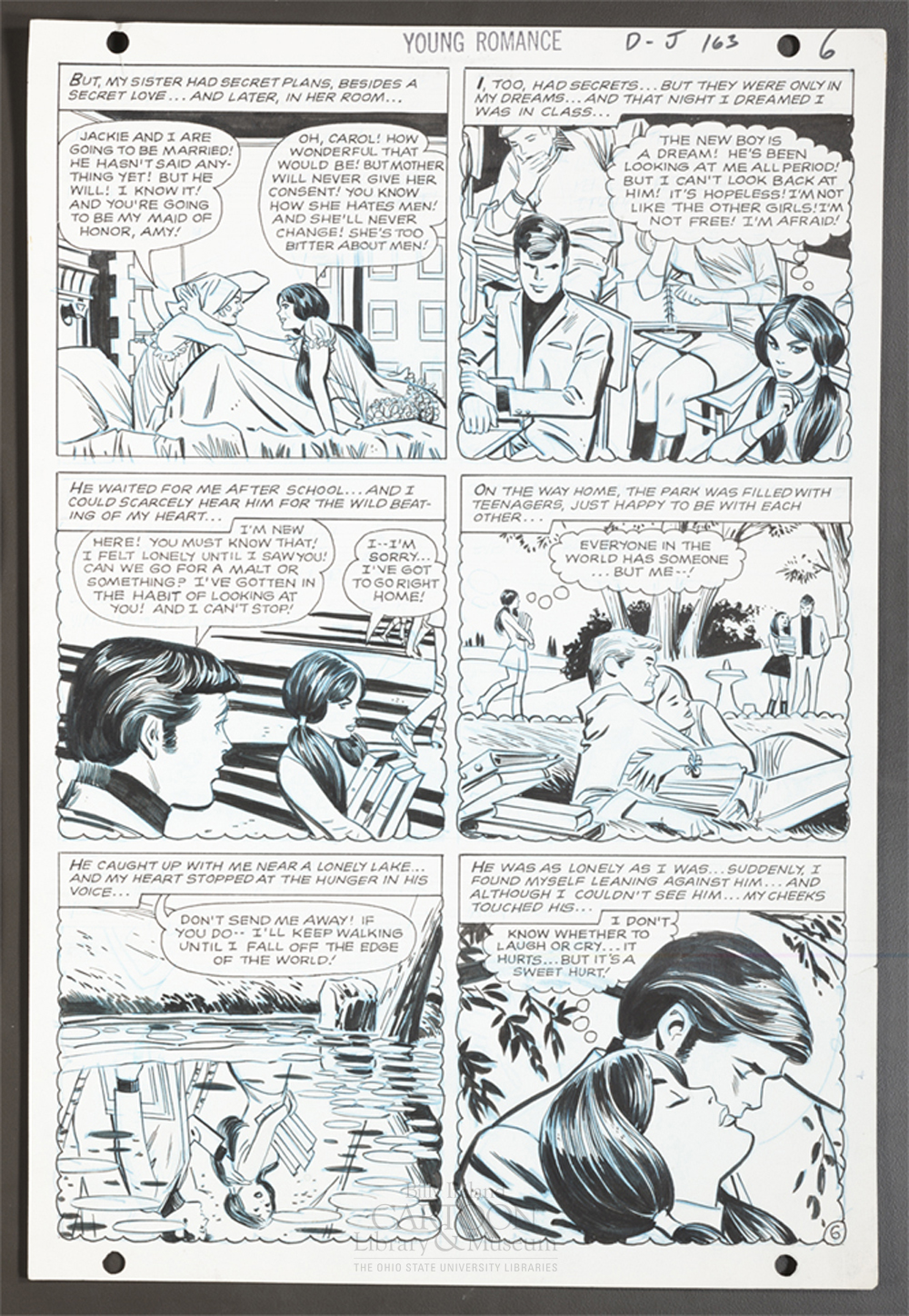
In memoriam of the anniversary of Alex Toth’s death (this past Sunday, May 27th), we have dug up a few of his works from the late 60s-early 70s. A page from issue number 12 of the DC Comics series “The Witching Hour”, and a page from one of the many romance comics he illustrated (penciled, in the case of our sample), “Young Romance”.

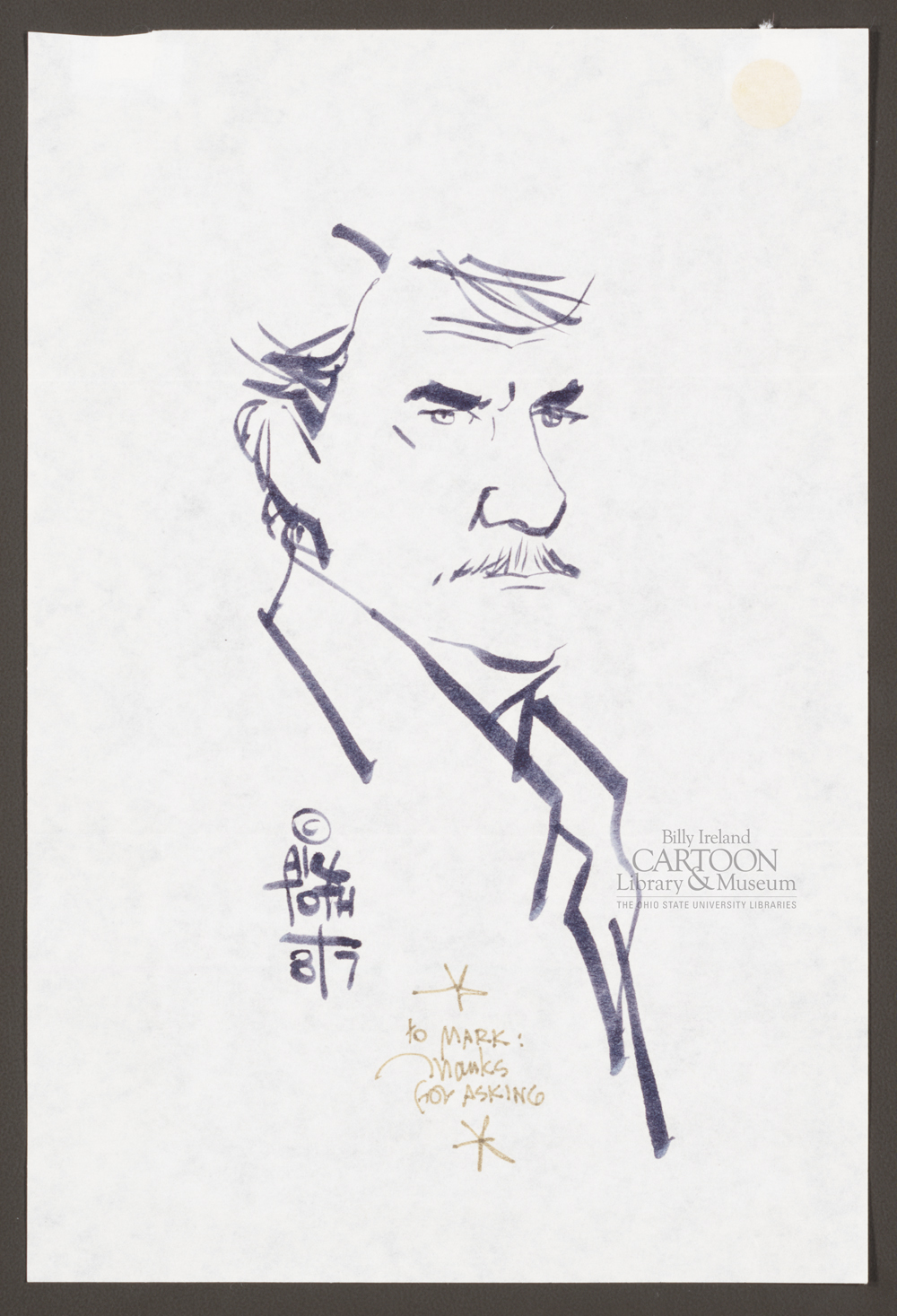
But first, a powerfully simplistic self-portrait that Toth did for collector Mark J. Cohen, whose collection resides here at the Billy Ireland Cartoon Library & Museum and contains over 370 cartoonist self portraits. A number of these pieces were displayed in our 2011 exhibit, Gallery Of Rogues: Cartoonist Self-Caricatures.

Original Alex Toth self-caricature. From the Mark J. Cohen and Rose Marie McDaniel Collection, The Ohio State University Billy Ireland Cartoon Library & Museum

Widely considered to be one of the greatest cartoonists of our time, and a protege of Milton Caniff (our founding donor!), Toth is revered not for the creation of any particular character or brilliant strip, but for his absolute command of the comics art-form at large.

Below, an original page from DC Comics’ 1969 The Witching Hour, which quite perfectly displays Toth’s supreme understanding of design and the layout of a page.

Original Alex Toth page from "The Witching Hour #12". From the International Museum of Cartoon Art Collection, The Ohio State University Billy Ireland Cartoon Library & Museum (click to enlarge)

Known best for his work on Zorro comics and animation work for Hanna-Barbera Productions (including the design of Space Ghost), Toth was an influence on many and a placater to few. He was strong willed and outspoken about disliking much in the field; from gratuitous violence in comics to the abstract and experimental.

To quote his autobiography in Kitchen Sink Press’ 1995 book Alex Toth: “I detest stupidity, ignorance, and arrogant disregard for craft in a “professional,” and I’ve made enemies of such people through the last thirty-three years! Much to my own disadvantage, I might add! But I am what I am, and it’s the only way I know to live a life, in as honest a manner as is possible! Play it, and say it, straight!”

Original art from "Young Romance #163", pencilled by Alex Toth and inked by Dick Giordano. From International Museum of Cartoon Art Collection, The Ohio State University Billy Ireland Cartoon Library & Museum. (click to enlarge)

In May of 2006, Toth passed away at his drawing table at age 77, in his home in Burbank, CA.

Found in the Collection: Paul Orban (1896-1974)

Largely uncelebrated, the late Paul Orban’s highly crosshatched and contrasted science fiction, fantasy and horror illustrations are impossible to take your eyes off of in person. The attention to detail and design is incredibly absorbing- and what’s more is that the pieces themselves are actually quite small, and appear to be drawn nearly to-size.

Paul Orban original art for "Ullr Uprising". From the San Francisco Academy of Comic Art Collection, The Ohio State University Billy Ireland Cartoon Library & Museum (click to enlarge)

The pieces above and below were both interior illustrations for H. Beam Piper’s 1952 science fiction pulp Ullr Uprising.

Paul Orban original illustration for "Ullr Uprising". From the San Francisco Academy of Comic Art Collection, The Ohio State University Billy Ireland Cartoon Library & Museum (click to enlarge)

Born the son of a blacksmith in Budapest on June 23rd, 1886 Paul Orban emigrated to the United States at age 6 with his father and sister to escape poverty in Hungary. They lived in Chicago, Illinois where Orban grew up and worked until moving to New York after his second marriage in 1929. While in Chicago, he studied at the Chicago Academy of Fine Arts, graduating in 1917. His illustration career began during his studies, working as a staff artist for The Chicago Sunday Tribune as early as 1915. During the 1920s, he became the art director of a Chicago advertising company.

Paul Orban original illustration for "The Black Stranger" story in Fantasy Magazine. From San Francisco Academy of Comic Art Collection, The Ohio State University Billy Ireland Cartoon Library & Museum (click to enlarge)

After moving to New York, Orban’s focus moved to freelance art- and he began selling his illustrations to pulp magazines, illustrating novels, and more. His work could be seen in Science Fiction Digest Magazine, Astounding Stories, Doc Savage, The Avenger, Detective Novels, Horror Stories, Popular Detective, Thrilling Mystery, Rodeo Romances, Popular Western, Thrilling Adventures, among countless others.

Paul Orban original scratch-board illustration. From San Francisco Academy of Comic Art Collection, The Ohio State University Cartoon Library and Museum (click to enlarge)

Orban also created a large body of Masonic paintings for the Masonic Outlook magazine between 1929-1932, many of which can be seen in the Masonic Digital Archives.

All of the original works shown in this post come from our San Francisco Academy of Comic Art collection. Although Bill Blackbeard was known mostly for collecting newsprint comic strips, he also accumulated thousands of pulp novels containing work from artists like Orban, and some original art to boot. These books were donated to the Billy Ireland Cartoon Library  & Museum as part of the larger San Francisco Academy of Comic Art collection, and have been transferred to the Rare Books & Manuscripts special collections library at The Ohio State University.

Older posts Newer posts