From Woody's Couch

Our Playbook on OSU History

Page 98 of 105

Pomerene’s ‘palatial feel’ to be restored

Pomerene Hall, 1927

The state’s Controlling Board has given the go-ahead for a make-over of Pomerene Hall, which served for many years as Ohio State’s women students’ union. (See Columbus Dispatch article link below.)

Designed by architecture professor Howard Dwight Smith, Pomerene was built in two phases. The 1922 section contained a gymnasium, where women’s physical education classes were held, and social rooms. A second phase in 1927 added a natatorium, lounges, a kitchen and refectory. The Dean of Women’s offices also were housed there, as were lounges, meeting rooms and a food-service unit called the Refectory. The building was named after Frank Pomerene, an 1891 graduate and one-time member of the Board of Trustees.

Pomerene Hall dining room, c1940s

The Refectory’s first home had been in Campbell Hall, but it was moved to Pomerene when the second building opened. In addition to serving food, the eatery served as a laboratory for students in the Institutional Management Division of the School of Home Economics. Agnes Skinner Smith managed the Refectory for more than 40 years, until she retired in 1968.

Following the construction of the Ohio Union in 1951, Pomerene Hall lost most of its original functions; however, many of he women’s physical education classes were held there until the late 1970s when an addition to the Larkins recreation center was built, allowing for more men’s and women’s locker room space.


Since then, Pomerene has housed various University programs and offices, including the School of Physical Activity and Educational Services. That department moved in 2006 to the then-new RPAC building.
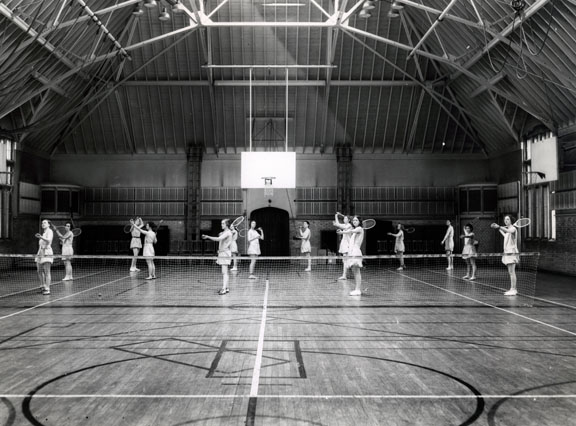
Tennis class, 1932
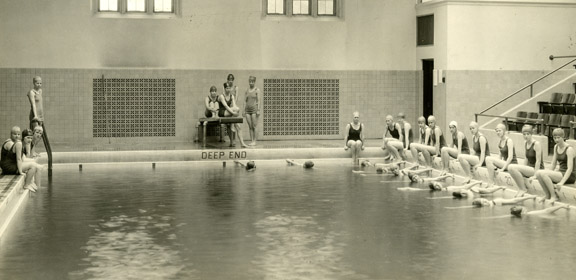
Pomerene Hall swimming pool, n.d.


Here’s the Dispatch article link: 

http://www.dispatch.com/content/blogs/the-eteam/2011/10/ohio-state-renovation.html


Homecoming: “It’s (always been) a Buckeye World”

1928

Homecoming is a time for celebration, not just for alumni, but for current students as well. Over the years, there have been all kinds of activities in which students have expressed their school pride:

1960

Since at least the 1920s, students at OSU have decorated their houses and dorms in honor of the event. Some of the past decorating themes have been: Huckleberry Hound (a character associated with Yogi Bear, 1959), Disneyland (1960), Heroes (1979), and “Grimm’s Buckeye Tales” (1963). Such themes have produced some truly theatrical decorations, including a giant boot and “Joe Ohio,” inspired by the giant gorilla in the 1998 Disney movie, “Mighty Joe Young.” As parade floats became more popular in the 1970s, the art of decorating Greek houses declined. However, and other campus venues continue to decorated with scarlet and gray.

"Fog Raiser", 1924

Other festivities have included bonfires, dances, and in the 1920s a “Fog Raiser circus” held at the Coliseum at the state fairgrounds. The 1922 event included performances by the Men’s Glee Club, and the Scarlet Mask (a campus theatrical group), as well as dance numbers. Notably, since the venue is suitable for livestock, horses were used in several of the performances, including a jousting competition between several of King Arthur’s knights (the members of Sigma Chi). The military department concluded the event with a mock battle and a chariot race. Unlike the famous scene from “Ben Hur,” there were no reported deaths or injuries.

Filed by C.N.

Bleeds Scarlet and Gray: Milton Caniff

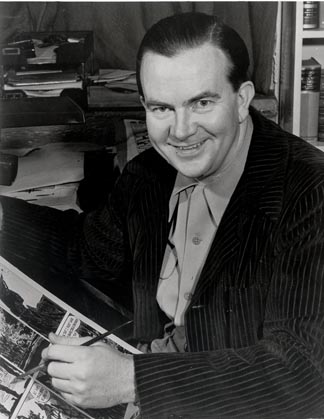
Milton Caniff, 1950

(Editor’s Note: This post is part of a series of profiles of life-long Buckeyes who have had a notable impact on the University. In other words, they bleed scarlet and gray.)

We’ve been talking lately about football season, and Homecoming, especially, which for alumni is always a great time to reconnect with other former students. One of OSU’s more famous alumni – and one of its most loyal – is Milton Caniff, sometimes known as the “Rembrandt of the comic strip.”

Caniff was born in 1907 in Hillsboro, Ohio, and he began drawing cartoons in grade school. One of his first professional jobs was at the Dayton Journal Herald. As an undergraduate at

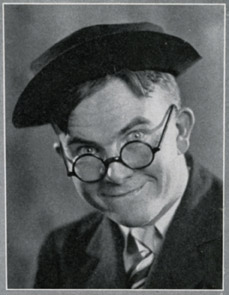
Caniff in the Scarlet Mask show "Beau Kay", 1927

Ohio State he served as art director of the Makio and the Sun Dial, also creating football program covers and working as a cartoonist for The Columbus Dispatch. These projects also helped to fund his education.  Caniff was also a member of Sigma Chi, president of Strollers, and vice president of Scarlet Mask, a male acting troupe at OSU. He graduated in 1930 with a bachelor’s degree in Journalism. He later wrote that, “In my five years [at OSU], I have run up a debt I will never liquidate. But I shall try, even though there can be no price tag on brain surgery from within.”

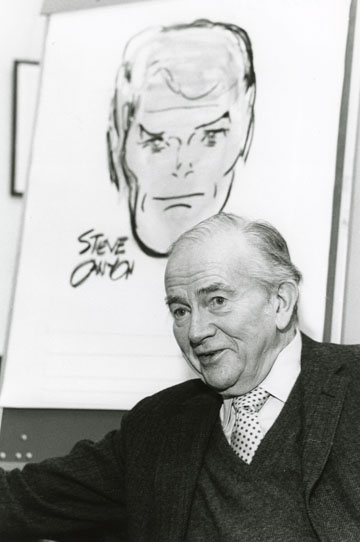
Caniff went on to become a world-renowned cartoonist. He is most famous for his two comic strips, “Terry and the Pirates,” and “Steve Canyon.” Caniff later said that he took inspiration for many of his “Terry” characters from real people he met at OSU, including his good friend Frank “Dude” Hennick (OSU class of 1925), who inspired the character of Capt. Dude Higgs. In 1947, Caniff launched “Steve Canyon,” a serial cartoon about an Air Force pilot for hire that was so popular, it spawned a short-lived television series in the late 1950s. Canyon wrote the strip for more than 40 years.

At the August 1974 Commencement, Caniff was awarded an honorary doctorate of Humane Letters and gave the Commencement address. Milton Caniff died on Easter Sunday in 1988 at the age of 81. He donated much of his work to the School of Journalism. His papers and artwork became one of the founding collections of the Billy Ireland Cartoon Library and Museum, named for Caniff’s good friend and fellow Columbus Dispatch cartoonist.

Filed by C.N.


« Older posts Newer posts »