From Woody's Couch

Our Playbook on OSU History

Page 89 of 106

Tracking the early history of African-American fraternities at OSU

Patrons sometimes are baffled that we don’t know the exact chronology of certain individuals, organizational entities or student groups on campus. They wonder aloud, “Haven’t you made a list?”

And the answer usually is, “No, we haven’t.” We’re archivists, so we’re very busy collecting, organizing and preserving our materials. We rarely have time for research; we rely on our patrons for such things.
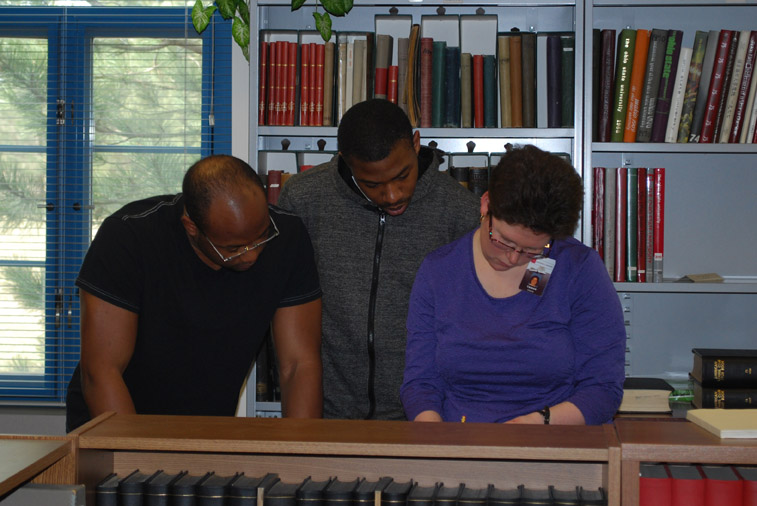
Keith Johnson and Herman Jones Jr. work with University Archivist Tamar Chute

Such was the case when two students – Keith Johnson and Herman Jones Jr. – walked in one afternoon looking for information about the first African-American fraternity on campus. They didn’t assume we had a list; we’re pretty certain they had no expectations at all. But what a find they ended up making to add to our chronology of African-American Greek life on campus.

They had in their hand a book called Black Greek 101: the culture, customs and challenges of Black fraternities and sororities, by Walter M. Kimbrough (2003). Inside was a comment from the author citing a 1906 article in The Chicago Defender about a new African-American fraternity at OSU called Pi Gamma Omicron. The two students’ professor had posed a challenge to them and their classmates: Anyone who can find evidence of this group here at OSU gets extra credit.

Unfortunately, there is little evidence left of student groups at Ohio State from the time that Pi Gamma Omicron was founded. This means the Archives has very little information about African-American Greek Life from this period. The Alpha Phi Alpha fraternity’s web site states that it was chartered at Ohio State in 1911, although the earliest reference of the fraternity here at the Archives is 1918. The Archives also has found references dating back to 1919 of another African-American fraternity, Kappa Alpha Psi, as well as the African-American sorority, Delta Sigma Theta.

So when Herman and Keith told us what they were seeking, we weren’t sure we would be able to help them.
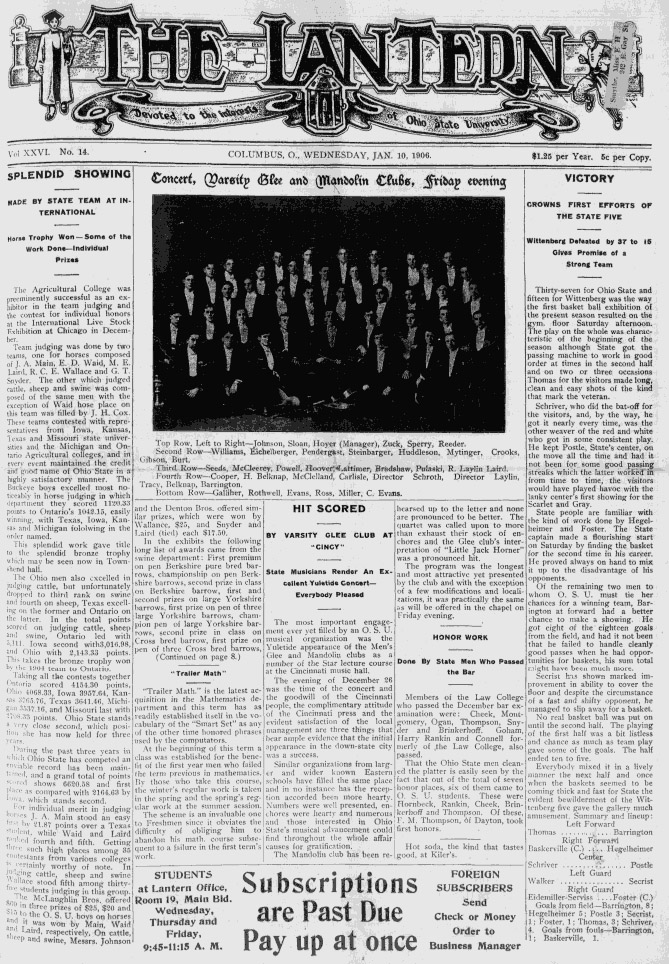
Lantern cover, 1906

This is where technology comes in: Recently, the OSU Libraries digitized the full run of The Lantern, OSU’s student newspaper. Every issue from 1881 through 1997 is now available in a searchable database. (The Lantern’s online archives can be found as a link on the right-hand side of our home page at go.osu.edu/archives.) So after looking through our paper records here at the Archives and finding nothing, University Archivist Tamar Chute decided to try The Lantern’s online archives. And there, she found it. (Click here to see the story.)

W.E. Davis, 1908


A story in the Jan. 10, 1906, issue said that a new fraternity called Pi Gamma Omicron had been founded, and it listed all of the founding members’ names. Herman and Keith had discovered the evidence they needed to show their professor that the book citation was correct. But they wanted to know more – who were these founding members?

This is where our patrons help us out tremendously in our reference service. The Archives has a copy of a 1983 dissertation by Pamela Pritchard, “The Negro Experience at Ohio State University in the First Sixty-five Years, 1873-1938,” in which she had compiled a list of African-American OSU graduates from 1892 to 1950. Some of the founding
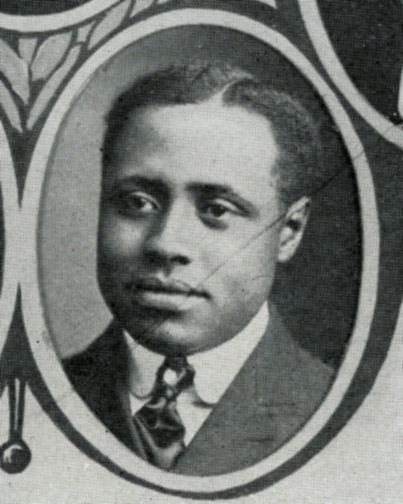
Elmer Shackelford, 1906

members of Pi Gamma Omicron were listed in the dissertation – W.E. Davis and Elmer Shackelford – and we were subsequently able to find their graduation photos. (Pritchard’s dissertation lists Shackelford as the first African American at OSU to earn a certificate of law – then the equivalent of a law degree.)

With the other fraternity members, we were able to find how long they attended OSU, what their majors were, where they lived and some of their extracurricular activities. (See the list here.)

Near the end of their afternoon of research, one of the students said, “I’ve never had so much fun doing research in my life.” We were very proud!

Herman and Keith later made a class presentation, which we were very happy to attend, after which they received not only extra credit but applause from the entire class and their professor.

It might seem like a small thing to have found just one article about a fraternity; after all, we don’t have any evidence – at least, yet – of how long Pi Gamma Omicron was on campus. But every such find pieces together the historical puzzle of this University’s past. We thank Herman and Keith for their research, copies of which we’ve placed among our reference materials so future patrons can build on it. Who knows what else they might find?

Keith Johnson and Herman Jones Jr. pose with the book that started it all: "Black Greek 101"


March Madness Part II: The offbeat side of OSU

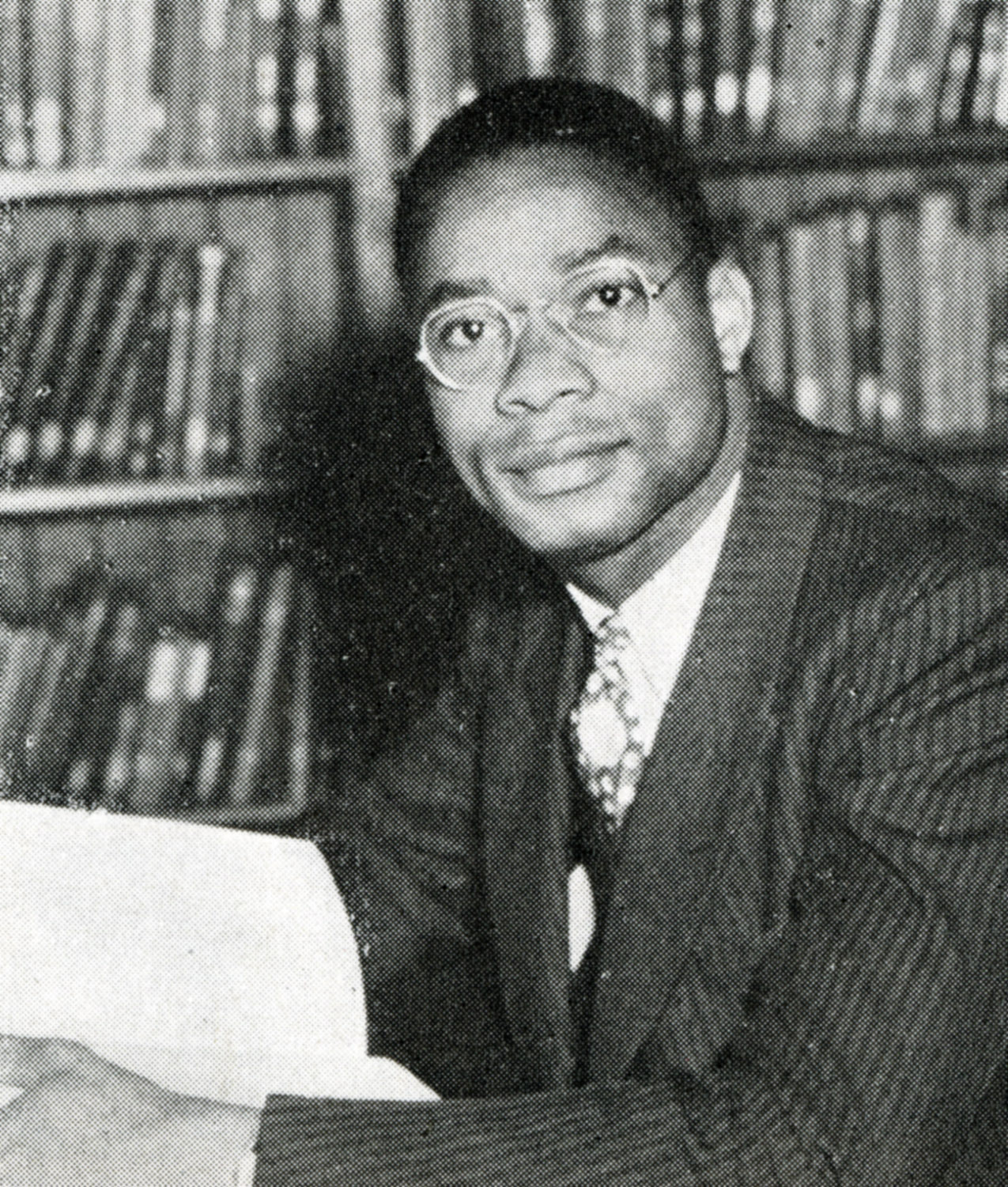
Prince Orizu, 1942

Ohio State Royalty?

Prince Akweke Abysinnia Nwafor Orizu of Nigeria studied at Ohio State in the early 1940s. Prince Orizu, or “Chris” as hewas known on campus, came to OSU around 1940 to study political science; he had previously received his Junior Certificate from Cambridge University in England. The then-22-year-old prince was a member of the Nwei, a progressive monarchy in the then-British Protectorate of Nigeria. Why did he choose Ohio State? He told the alumni magazine it was because it was in the heart of America. Apparently, it was known on campus that he was part of the ruling family. After returning to Nigeria, Prince Orizu had a long political career, followed by service in education. He died in 1999.

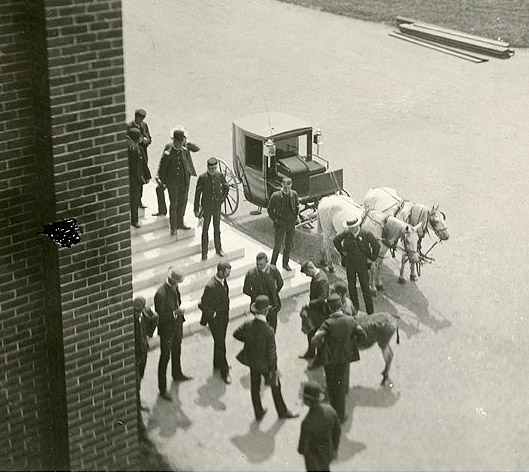
Donkey at Univ. Hall, 1893


Roaming Livestock

How can Ohio State forget its roots when it has—and seems always will have—livestock running amok, with or without the aid of students? In the early years of the University (prior to the turn of the century) a group of students carried a (very quiet and cooperative) donkey up to the third floor of the old University Hall. They put the donkey in a professor’s office and waited until morning. Students who arrived early for class that morning were rewarded with helping to carry the donkey back down the stairs. Sounds like fun, huh? Once again it is clear that the Internet had not been invented yet.


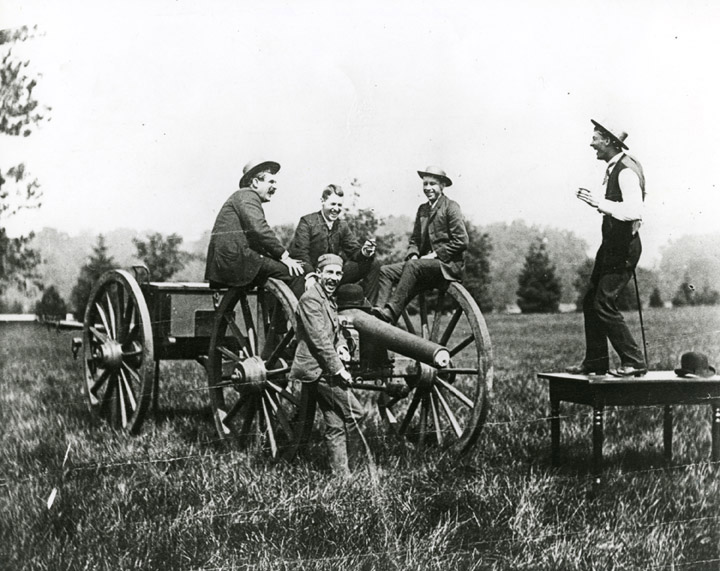
Students with cannon, 1884

If You Give a College a Cannon…

You get chaos. For that, we can thank Luigi Lomia, OSU’s first U.S. Army drill instructor. He arranged for cannons to be brought to campus as part of the military training that was required for all male students at the time. He was, after all, an artillery man himself. However, it appears it soon became a common prank to drag a cannon off to the river, or to push one into Mirror Lake. The following morning, the students in drill would have to lug it back into place. There is also an account of someone attempting to fire a tree trunk from the cannon. Amazingly, there were no casualties among students, faculty or livestock reported after any of the stunts.

March Madness Part I: The offbeat side of OSU

The NCAA Men’s Basketball Tournament is about to begin, and there will definitely be times when collectively we might say, “That didn’t just happen, did it?” So we thought we’d tell a few stories from OSU’s past to elicit a similar response of disbelief:

Saints and Sinners

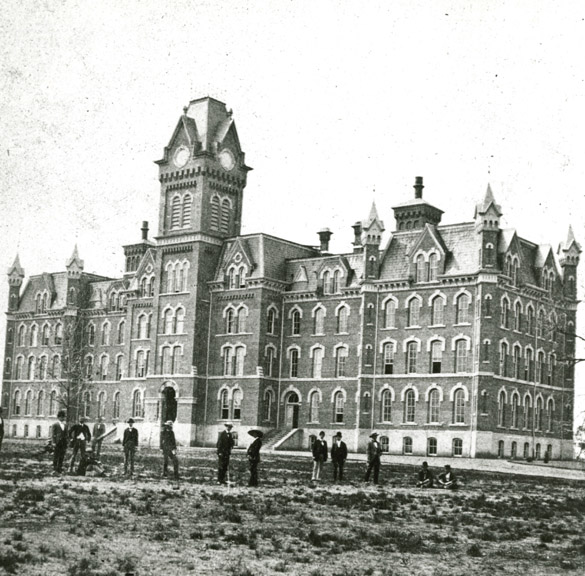
University Hall, 1874

It may be hard to imagine but when the University first opened, there were only seven faculty members and about two dozen students. More incredibly, many of the first faculty members resided in University Hall, along with many of the college’s first male students. The faculty’s quarters were mostly on the upper floors, known as the “Saints’ Roost,” and many of the students lived in the cellar, otherwise known as “Purgatory.” Of course, sharing close quarters was bound to lead to some disturbances. One former student’s account mentioned that residents of Purgatory occasionally made their way up the stairs at night; they formed a line and the leader would tap on certain faculty members’ doors at odd hours of the night. When the unsuspecting faculty member opened the door, the line would start forward and each passing student would hit the Saint with a pillow until he shut the door. Sounds like fun, huh? Clearly, the Internet had not yet been invented.

The Chemistry Building curse?

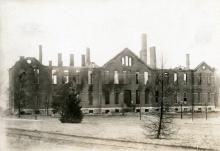
Chemistry Building #1 fire damage, 1887

OSU’s chemistry department got off to a rocky start: Originally housed on the third floor of University Hall, it was soon moved to a newly constructed building on the site of, most recently, Brown Hall. When a fire started in the building in 1887, the whole structure burned down because of a lack of water to extinguish the flames.

The next chemistry building was built two years later on the site of the present Derby Hall.

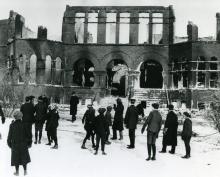
Chemistry Building #2 fire damage, 1904

It burned down in 1904. A recounting of the incident said there were “ludicrous happenings due to excitement” that occurred that night.

Apparently the firefighters were afraid of the chemicals housed in the building, so they did not try to put out the flames (whether or not the chemicals were a threat is not known). However, that did not stop students from entering the burning building and attempting to save the contents, including bottles of distilled water.

The third chemistry building, now known as Derby Hall, was rebuilt in 1906 on the site of its predecessor. It too, caught fire soon after it was completed; however the building was saved. Its first addition was, of course, a fire-proof storage shed for the chemicals. No doubt this helped to break the curse.

Hairy men in dresses

Scarlet Mask group

It’s likely someone has written a thesis about why people laugh when men dress up in women’s clothing. The entertainment method surely worked for OSU audiences during the first half of the 20th century, given the long run of a student acting group called Scarlet Mask. The men’s musical comedy club that later evolved into an honorary dramatic organization was started in 1919 by a group of five OSU students. Most of the plays were comedies, and they were a source of entertainment for students and local residents before the advent of television. Some of the early plays (prior to 1925) were penned by none other than humorist James Thurber. One of the group’s signature pieces was to have very big, hairy men—such as members of the football team—come out on stage dressed in frilly women’s clothing. Another key member was Milton Caniff, creator of long-running comic strips, “Terry and the Pirates” and “Steve Canyon.” Who knows? If he had not become a renowned cartoonist, he might have his career on stage. The Scarlet Mask Club disbanded in the 1930s, primarily due to a lack of funding, but the club was periodically resurrected for the next decade or so. Its last run ended in 1953.

« Older posts Newer posts »