From Woody's Couch

Our Playbook on OSU History

Page 88 of 106

This Week in OSU History: ‘Dynamo’ takes over presidency

James Canfield, 1897

It turns out E. Gordon Gee is not the University’s first president who could be mistaken for a human sparkplug. Back in 1895, OSU’s fourth president was elected – James Canfield – and he was considered quite the “human dynamo,” too.

Canfield was born in Delaware, Ohio, in 1847, but his family soon moved to New York City, where he grew up and attended school. He graduated from Williams College, and briefly practiced law in that “state up north” before taking a teaching position at the University of Kansas in 1877, which he held for 14 years. His teaching focus was English, History, Civics and Political Science, and he became a sought-after orator.

In 1891 Canfield accepted the Chancellorship at the University of Nebraska, and four years later – on April 11, 1895 – he was elected President of Ohio State. The Board of Trustees knew his reputation as a “human dynamo,” so it should have come as no surprise to them that Canfield immediately went to work once in office.

One of Canfield’s first acts as president was to establish a lab in 1895 near Lake Erie (the precursor to Stone Lab. Under his leadership, enrollment surpassed 1,000 (1897), and the Power Plant and Armory were built. The University also added Domestic Science, Commerce and Administration courses to the curriculum.

Canfield Hall, 1940s

Canfield was by all accounts a very “take charge” person. According to the University’s 75-year history, he once stopped to ask the janitors and scrub-women why they were not on their hands and knees, scrubbing the floor. So it is no wonder that his administration was also marked with conflict – particularly over Canfield’s attempt to form a partnership between OSU and a Columbus medical college. It turns out the University did end up partnering with the Starling Loving Hospital—shortly after Canfield left office. The move ultimately led to the formation of OSU’s Medical Center.

Canfield resigned his post in 1899 to become the Librarian at Columbia University. He died in 1909.

In 1940, Canfield Hall was named as a tribute to him and his daughter, the novelist Dorothy Canfield Fisher.


Filed by C.N.


Spring is in the air: Evolution of the Oval

University Hall, 1897

It may come as a surprise to many, but the Oval was not in the original campus design. It was, as Shakespeare would have put it, a happy accident.  The original campus design was that of an English country manor: University Hall was set on the highest point, and a long curving drive ran diagonally across what is now the Oval towards present-day Page Hall, where the drive met High Street.  It was not until the 1890s – some two decades after the University opened – that the Oval began to take shape.

In 1890 the second chemistry building (the first had burned down, and yes, the second one also would  fall victim to fire) was built on the site of Derby Hall. In 1891 construction began on both Hayes Hall and Orton Hall. The Botany Building already stood on the site of the Faculty Club. So the North and South sides of the Oval were beginning to take shape. It should also be mentioned that several of the faculty members had homes on the grounds, including one that would have stood on the Oval today.

In 1893 the master plan proposed by Captain Herman Haerlin was the first to propose an open space on campus with no roads running through it. However, this space was described as a “quadrangle.” This plan was further aided by the completion of several new buildings: Townshend Hall, Biological Hall (on the site of Hagerty Hall), and the Armory. The roads on the North and South sides of the space were changed to connect all of the buildings, so now there were two roads linking High Street and Neil Avenue in a roughly circular shape.

In 1901 the end of the Oval closest to High Street was reshaped, giving it a more curved appearance, and making the Oval an oval. The diagonal drive that cut across the space was removed in 1912, the same year the Thompson Library was completed.

So, the Oval has changed little since 1901, which largely explains how it got its name. The first reference to “the oval” came in 1910. From 1912-1913 it was usually referred to as “the campus oval.” From 1913 to 1920 it was back to “the oval.” Note that it was not capitalized until 1920.

Oval, 1916

The Oval, prior to the Long Walk, 1913


In 1914 many of the walks on the Oval were repaved, and it was at that time that the Long Walk was constructed (the “long walk” was first mentioned in 1919 and capitalized, also beginning in 1920). Another major transformation occurred in the 1970s: the roads around the Oval were made pedestrian-only walkways. This explains how you can now walk out the front doors of University, Bricker, Orton, and Hagerty Halls without getting hit by a car.

Filed by C.N.

Trip to the Final Four a familiar journey for Buckeyes

Basketball team after their National Championship victory

Overall, Ohio State has played in nine Final Four tournament games (not including the game tomorrow or the 1999 game vacated by the NCAA). Pretty impressive, huh? Here’s the breakdown:

  • The first NCAA tournament in 1939 featured Ohio State versus Villanova University in the Final Four matchup. Ohio State defeated Villanova to move on to the championship game versus the University of Oregon. Unfortunately, the Buckeyes lost that game, 46-33.
  • In 1944 the Buckeyes played their first of three consecutive Final Four games. That year, they lost to Dartmouth University, 60-53.
  • The following year Ohio State again lost in the semifinals to New York University, 70-65.
  • The 1946 tournament had Ohio State losing another Final Four game, this time against the University of North Carolina, 60-57. OSU did, however, play a third-place game, in which the Buckeyes beat University of California, 63-45.
  • In 1960 Ohio State defeated NYU, 76-54, on its way to winning the National Championship.
  • During the 1961 and 1962 seasons, Ohio State returned to the Final Four, defeating St. Joseph’s University, 95-69, and Wake Forest University, 84-68, respectively.
  • The Buckeyes returned to the Final Four in 1968, losing to North Carolina, 80-66, but once again winning a third-place game against the University of Houston, 89-85.
  • The last official Final Four appearance came in 2007 with a win over Georgetown University, 67-60.

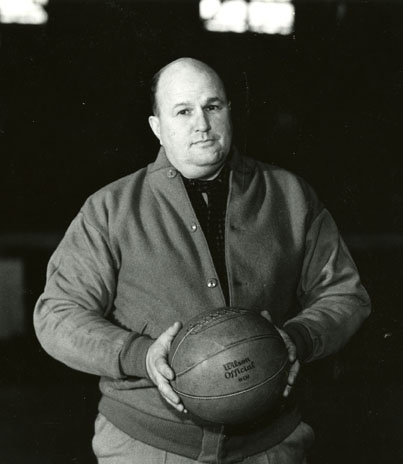
Harold Olsen, 1935

And one more quick fact about the NCAA tournament and Ohio State:

Did you know Ohio State’s longest tenured basketball coach, Harold G. Olsen, played a pivotal role in the creation of the NCAA Men’s Basketball Tournament? While head coach at Ohio State (1922-1946), Olsen organized a push for a postseason national playoff tournament. The first year of the tournament featured eight teams, including Ohio State, and was played at Northwestern University.

Olsen led the Buckeyes to four Final Four appearances during his tenure as head coach. Olsen also led the Buckeyes to five Big Ten Championships in 1925, 1933, 1939, 1944, and 1946. As president of NABC (National Association of Basketball Coaches), chair of the NCAA Basketball Committee for eight years, and a member of the 1948 Olympic Committee, Olsen earned a place in the Naismith Memorial Basketball Hall of Fame.

« Older posts Newer posts »