From Woody's Couch

Our Playbook on OSU History

Page 57 of 105

Long Gone Campus Traditions: Hats off to the era of freshman beanies!

1940

1940

Perhaps one of the few Ohio State traditions new students may wish to stay buried is the class cap, otherwise known as the ‘beanie.’ Freshmen (men only) used to be strong-armed into wearing caps in the name of creating school spirit and class unity. If by unity the administration meant commiseration, well then they got what they set out to achieve.

The caps and rules were in use from 1912 until the mid-century. Wearing the caps was just one of the rules enforced by “all men of the upper classes;” however, the junior men’s honorary Bucket and Dipper and its members were the only people ever authorized, by the Student Senate and the President of the University, to carry out the traditional punishment: namely, throwing offenders into Mirror Lake. Ironically, if some unauthorized person attempted to chuck a freshman in the lake, Bucket and Dipper members were honor-bound to protect the freshman.

A freshman is tossed into Mirror Lake, 1926

A freshman is tossed into Mirror Lake, 1926

Freshmen men were thus required to wear the caps from Freshman Week at the beginning of the term, until Cap Bonfire on Tradition Day, in June. Students caught without their beanies, or violating one of the freshmen rules, were punished. As one Alumni Monthly article put it, “Irregular meetings of Bucket and Dipper are held when freshmen are chased from the Long Walk and from the steps of University or Derby Hall.” These meetings convened on the edge of Mirror Lake and ended with the offending freshmen taking a swim. Other rules that could earn a dunking: skipping Chapel (which was mandatory until 1926), doing something to offend an upper classman (such as the freshman who posted signs saying “Bucket and Dipper go to Hell” near the Long Walk), or setting foot on the Long Walk.

As for Bucket and Dipper, the 14 members at that time were all junior men and had been chosen for their leadership, scholarship and service. Such greats as Chic Harley and Milt Caniff were members. During their initiation, members were thrown in Mirror Lake, so perhaps they had the prerequisite experience needed.
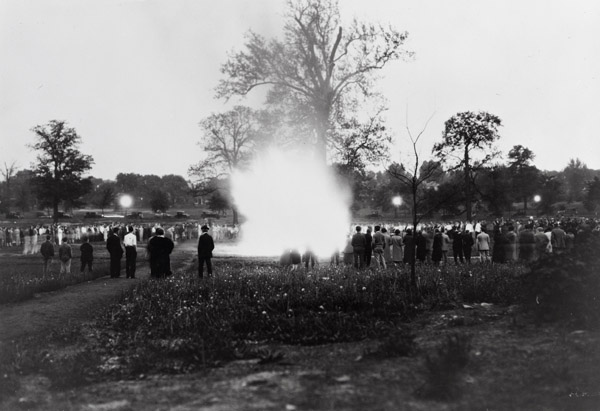
Freshman week cap burning, 1926

Freshman week cap burning, 1926

Thus, in June the freshman waged a two-day war on Bucket and Dipper. The “war” usually consisted on a tug-of-war across Mirror Lake—where the freshman consistently ended up in the lake. That night, students would gather for the Cap Bonfire, when some freshman opted to burn their beanies. (Many freshman did keep their beanies as a memento of their servitude.) Following the bonfire, many freshmen (again, ladies were excluded) went for a walk in their shirttails to cause a ruckus outside the home of then-OSU President William Oxley Thompson.

In 1926 Bucket and Dipper attempted to delay the burning; in the melee that followed, 103 freshman were thrown in the lake and the police were called. Ironically, it was a policeman that gave a freshman a concussion, not a trip into the lake. The following year, then-OSU President George Rightmire forbade Bucket and Dipper from dunking anyone, deserved or not. From then on, it seems the Bucket and Dipper initiates were the only ones to go swimming.

 As for the caps themselves, fashion in hats changed rather rapidly. Some prime examples from Ohio State include the “peanut-shaped skull cap,” “knitted toboggan” cap or “jockey-style” cap, or one with a “rolled brim topped with a scarlet button.”

Filed by C.N.

 To learn more about the tradition of freshmen beanies at OSU and other Big Ten universities, visit our web exhibit, “Beanies of the Big 10” at http://library.osu.edu/projects/beanies/.


Korean War Anniversary: Conflict had multiple effects on OSU

Ohio State students in the Marine Reserves were some of the first called to active duty in Korea, 1950

Ohio State students in the Marine Reserves were some of the first called to active duty in Korea, 1950

Last week marked the 60th anniversary of the Korean War, which affected campus measurably, despite the fact it was being played out halfway across the globe.

Students in Company C, 7th Infantry Battalion, left Columbus for Camp Pendleton in September 1950. Within weeks, some of the men were in Korea, Japan and Guam.

Students in the Company C, 7th Infantry Battalion, left Columbus for Camp Pendleton in September 1950. Within weeks, some of the men were in Korea, Japan and Guam.

One of the first developments at OSU, according to a history of OSU Pres. Howard Bevis’ administration, was the appointment in autumn 1950 of a committee on Civil Defense, whose mission was to give Ohio communities the “knowledge and facilities” at the University to help them cope with atomic warfare. By March 1951 University emergency facilities had been inventoried by the campus Civil Defense Council, and local and state authorities had been notified of their availability. A War Emergency Committee was also created.

Because of the threat of atomic warfare, the city made extensive preparations for civil defense against such attacks. (At the time, Columbus was seen as a logical target in Ohio.) In early December 1950, OSU Vice President Bland Stradley announced the University would work both with Columbus and with Franklin County officials in preparing against atomic bombs.

Another effect of the war was a ban by the National Production Board on the construction of buildings for “amusement, recreational or entertainment purposes.” (St. John Arena’s construction did not begin until 1954, after the war ended.)

John F. Archer, 1944

John F. Archer, 1944

One of the biggest effects of the war, of course, was on enrollment. Early on, a University committee was created to coordinate information about the draft and calls to service of faculty and students. Like World War II, OSU faced a considerable dip in enrollment because of the war, so University officials tried to stem off an even further drop through a coordinated campaign to encourage male students to stay in school until they were called up, instead of enlisting. At the beginning of the winter quarter of 1951, Bevis issued a letter to male students, urging them to “stay in school as long as you can and do your work the very best you can! Whatever happens, this will make you of greater service to your country.”

In June 1950, the Alumni Monthly reported that dozens of Ohio State alumni were on the front lines when the war broke out. The first OSU casualty was Lt. John F. Archer, who was killed in action July 29, 1950. He had withdrawn from OSU during World War II to fight in that conflict; in the two years in which he served in World War II he won five battle stars. 

Women students dig for gold at annual role-reversal dance

A couple at the Gold Diggers dance, 1949

A couple at the Gold Diggers dance, 1949

While the name is a bit misleading, the Gold Diggers’ Prom is yet another long-gone campus tradition. Beginning in the late 1930s, a dance was held once a year where the ladies and gents essentially reversed roles: The young woman would ask a young man to accompany her to the event, and she would pay for everything, from tickets to corsages.

The night of the dance, she would pick him up– with whatever means of conveyance was feasible – at his dorm, fraternity, or wherever he lived. At the dance, the Queen would crown a King, who would preside over the dance in place of the Queen.

For many years, the contest to be Gold Diggers’ Prom king in the spring was almost as intense as the one held in the fall for Homecoming Queen. According to a 1938 issue of The Lantern, “competition is mounting to a fever pitch as more and more candidates enter the race for King of the Gold Diggers’ Prom. The male of the species is walking around campus these days with a supercilious grin, gloating that ‘at long last’ he is coming into his own.”

Dale Denny, the Gold Digger King of 1958

Dale Denny, the Gold Digger King of 1958

Meanwhile, there was always good-natured teasing and shenanigans attached to the dance: Girls would bring their boyfriends corsages of carrots and beets instead of flowers. A carriage may await the boyfriend instead of an automobile. Boyfriends would make their dates wait, in memory of all the times they spent waiting on the young ladies.

The term ‘gold digger’ originally meant men who went out to California to join the gold rush in the 1840s. Its current meaning was coined in 1915, but did not gain popularity until the 1930s (the time of the dance) when many young women had to support themselves because of the Great Depression; thus, theoretically, they would go looking for rich husbands.

As with many social mores, women’s expectations for marriage and financial security began to change after World War II, and the dance eventually was finally dropped in the 1960s.

The crowning of the Gold Digger King, 1952

The crowning of the Gold Digger King, 1952

« Older posts Newer posts »