From Woody's Couch

Our Playbook on OSU History

Page 56 of 106

OSU alum and acclaimed artist Bellows ‘made good at anything’

George Bellows, c1903

George Bellows, c1903

With the opening of the George Bellows exhibit at the Columbus Museum of Art, we would like to take the opportunity to talk about this OSU alum, who became one of the nation’s most celebrated artists in his relatively short life.

George Bellows was born on Long Island in New York in 1882, but moved with his family to Columbus when he was a child. His father wanted him to become a builder and architect like himself, but Bellows, the son, rebelled. Fellow Ohio State classmate Fred Cornell (the author of Carmen, Ohio) later said of Bellows: “He was rigid in the teachings of his parents. But, in the things that are of the mind, he stepped out for himself… He made good at anything to which he turned his hand.”
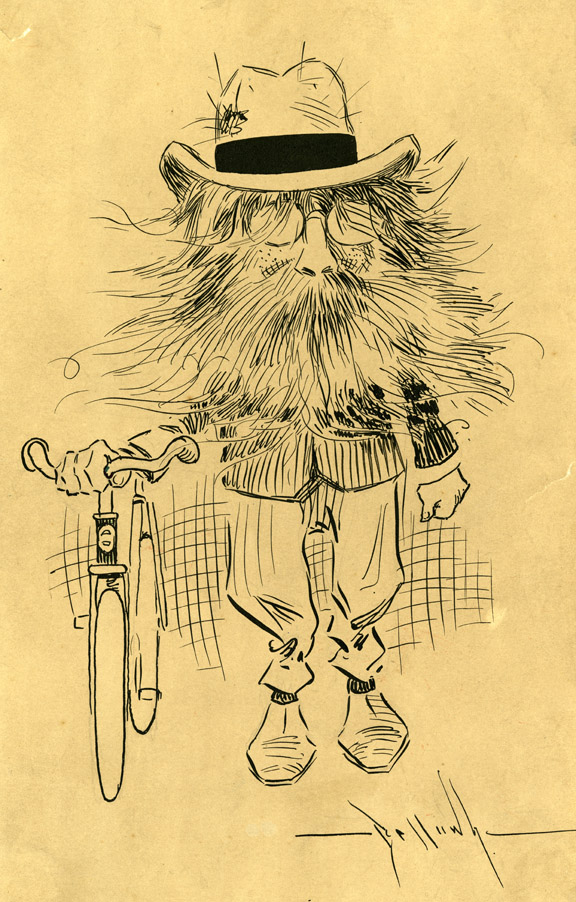
Bellows' sketch of Professor Nathaniel Lord, c1903

Bellows’ sketch of Professor Nathaniel Lord, c1903

Bellows graduated from Central High School before attending Ohio State from 1902 to 1904. Known as “Ho” Bellows to his fellow undergrads, the young artist spent much of his time participating in the Men’s Glee Club and the Baseball and Basketball teams, and he also served as art editor of the Makio, Ohio State’s yearbook. The 1904 Makio in particular bears his mark, with cartoons and illustrations throughout, including some rather entertaining sketches of his professors.

Bellows left Ohio State to attend the New York School of Art under Robert Henri, a leader of the American realism movement. While Columbus gave Bellows his start, New York was undoubtedly where he found his inspiration. There, he also met another art student, Emma Story, whom he later persuaded to marry him. His work developed, and his love of athletic contests of all varieties is recorded on canvas. He painted what he wanted to paint, without regard for fashion, style, artistic formula, the critics or popularity.
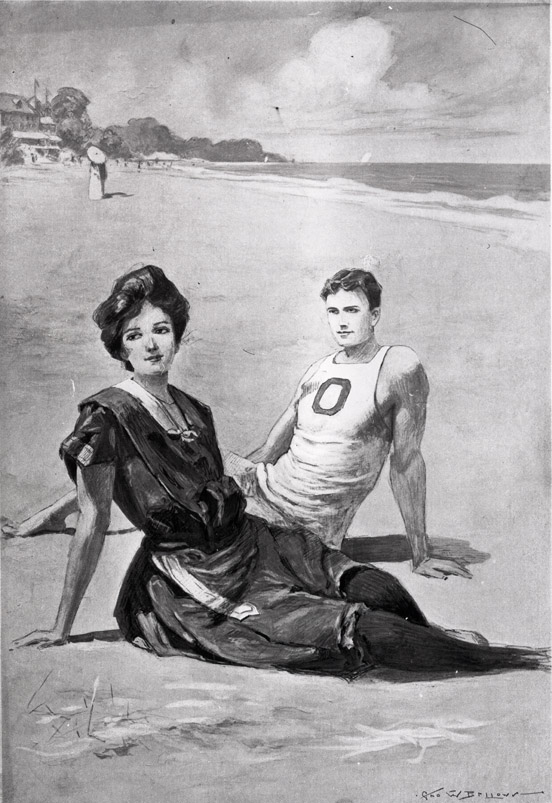
"Summer Day" by George Bellows, n.d.

“Summer Day” by George Bellows, n.d.

Sadly, George Bellows passed away all too soon at the age of 42 after an emergency appendectomy in 1925. It did not take long after his death for the museums to start clamoring for his work, and for critics to declare his work as some of the greatest examples of American art in the 20th century.

Last year, OSU Libraries and the Columbus Museum of Art partnered to acquire Bellows’ business ledgers in which he maintained meticulous records of his artistic production, including sales and exhibition showings.

–          Filed by C.N.
OSU couple’s marriage – and love of the Buckeyes – lasted a lifetime

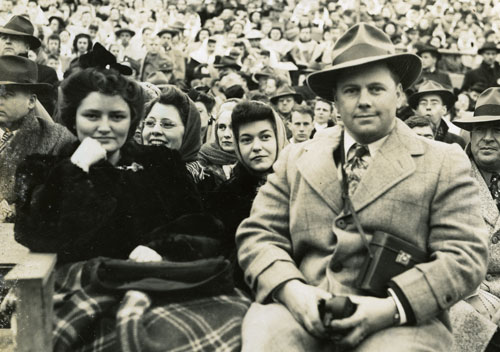
Virginia and Glenn at a game in the 1940s

Virginia and Glenn at a game in the 1940s

(Editor’s note: Below, Karen Lane, an OSU alumna, writes a wonderful short history of her aunt and uncle’s love of the Buckeyes that marked their long, long happy marriage. Have a similar story of OSU football faithfuls? Contact Kevlin Haire at haire.14@osu.edu. We want to most sincerely thank Karen for sharing both her relatives’ story and some wonderful photos of them.) 

On September 26, 1934, Glenn and Virginia Spangler stepped onto The Oval as freshmen, who became incidentally, the youngest married couple to simultaneously attend The Ohio State University. Glenn was 19 and his bride of four months was just 17. Their marriage was for a lifetime as was their love for OSU.

Enrolled as students in the College of Education, Glenn and Virginia spent a four-year honeymoon at Ohio State, studying, sometimes chaperoning student events, and on many weekends going “home” to help work the Armstrong farm on Salt Creek (Pickaway/Hocking Counties) near Laurelville, Ohio. But on football weekends there were no trips to southern Ohio, only west to Ohio Stadium.

From left to right, Wesley Leas, Virginia Spangler and Glenn Spangler, Spring Commencement, 1938

From left to right, Wesley Leas, Virginia and Glenn Spangler, Spring Commencement, 1938

On October 6, 1934, Glenn and Virginia watched the Buckeyes trounce Indiana, 33 to 0, under the direction of new head football coach, Francis Schmidt. From that victory until they graduated in 1938, the young Spanglers were on hand to cheer the OSU football team to victory.  

After graduation, Glenn and Virginia became beloved teachers, first at North Canton High School and then in the Bellevue (Ohio) schools. They regularly made trips south to help on the farm and, during football season, to watch the OSU Buckeyes play.

In 1961 they settled permanently in Central Ohio, building a house in the booming little suburb of Grove City. It was from this house that a weekly tradition began: If the Bucks played at home, a hamper full of fried chicken, coleslaw and cake shared trunk-space with blankets and a thermos of hot chocolate for a tailgate picnic beside Ohio Stadium. Televised away-games were anticipated, talked about, watched and dissected by all who dropped in for a visit during football season.  If the game was not televised, then the radio was tuned in to the game.

In the early 1980s, Glenn bought an RCA video camera and recorder, which regularly taped OSU games that were inconveniently aired on Channel 34 Sunday mornings during church. And when QUBE, the precursor to cable television, was pioneered in Columbus, they became one of the first subscribers . . . to watch OSU football. 

Virginia and Glenn, 1980s

Virginia and Glenn, 1980s

After retiring from South-Western City Schools, Glenn and Virginia also traveled to watch the team. Trips with their football-loving nephews took them to nearby Big Ten games – Indiana, Illinois and Northwestern. They attended at least two Rose Bowls, a Gator Bowl, and to one last trip out west for the Fiesta Bowl.

 After Glenn’s death in 1990, Virginia continued to follow the Buckeyes on television and in the newspaper. Although no longer able to attend all the games in the Stadium she continued to purchase season tickets, which she shared with her family, passing on her (and Glenn’s) affection for the game and for the Ohio State University Buckeyes.

A brief genealogy of Glenn and Virginia Spangler:

Glenn Edison Spangler (03 March 1915 – 22 May 1990)

Virginia Adele Armstrong Spangler (11 August 1917 – 08 March 2005).

Adelphi (Ohio) High School graduates: Glenn-1932. Virginia – 30 April 1934.

Married in Greenup, Kentucky – 03 May 1934

Ohio State University graduates – 13 June 1938

‘Across the Field,’ and into the record books: Drum-major firsts

"Tubby" Essington, 1923

“Tubby” Essington, 1923

The Ohio State University Marching Band began as a drum corps in the 1878-79 academic year, so from the very beginning the band has had a drum major. At that time, the drum major led the musical unit that accompanied the weekly parade of cadets and kept tempo for the units to follow, according to Script Ohio, the definitive OSUMB history.

It wasn’t until the early 1920s, though, that the band had its first drum major who exhibited the showmanship and personality to be a standout figure on the field. That figure was G. Edwin Essington, whose nickname was “Tubby.” It’s unclear why it began, but Essington was the one who started the tradition that continues today.

Dwight Hudson, 1970s

Dwight Hudson, 1970s

He served as drum major for three seasons, from 1920 to 1922. He is best remembered for leading the parade through the streets of Chicago after the Buckeyes defeated the University of Chicago on its home turf in 1921. His characteristic showmanship gained him national recognition that day: At that time, marching bands were in the process of transitioning from traditional military bands to the large, complex entertainment units we know today. The following year, he performed at the first game played in Ohio Stadium. (The Buckeyes were defeated by Michigan, but the band no doubt put on a good show.) He graduated from Ohio State in 1925.

Fifty years later, the Marching Band introduced its first African-American drum major to Ohio Stadium crowds: Dwight Hudson. He started twirling in elementary school and wrote a letter to Paul Droste, then the Marching Band’s director, that he wanted to become the band’s drum major someday. To achieve that goal, he practiced – so much that in 1975 he placed 7th in the world twirling competition. When he came to Ohio State, Dwight Hudson fulfilled his wish: In 1977 he became the drum major. Hudson served as drum major for three years, longer than any other drum major since Essington. His final performance was at the 1980 Rose Bowl.

Shelley Graf, 1981

Shelley Graf, 1981

More than 100 years after the first band formed, the first woman earned the spot of drum major.

Michelle “Shelley” Graf was not only the first woman drum major at Ohio State, but also in the Big Ten. She also started twirling at a very young age, and she performed with her high school band, although as a majorette. Since Ohio State did not have majorettes, she decided to try for drum major. She was assistant drum major in 1980, then won the lead job in 1981. Graf still works for the University as a clinical instructor in the School of Health and Rehabilitation Sciences and as a physical therapist at the Wexner Medical Center. Every November, she leads her patients in performing Script Ohio.

 Filed by C.N.

« Older posts Newer posts »