

The NCAA Men’s Basketball Tournament is about to begin, and there will definitely be times when collectively we might say, “That didn’t just happen, did it?” So we thought we’d tell a few stories from OSU’s past to elicit a similar response of disbelief:
Saints and Sinners
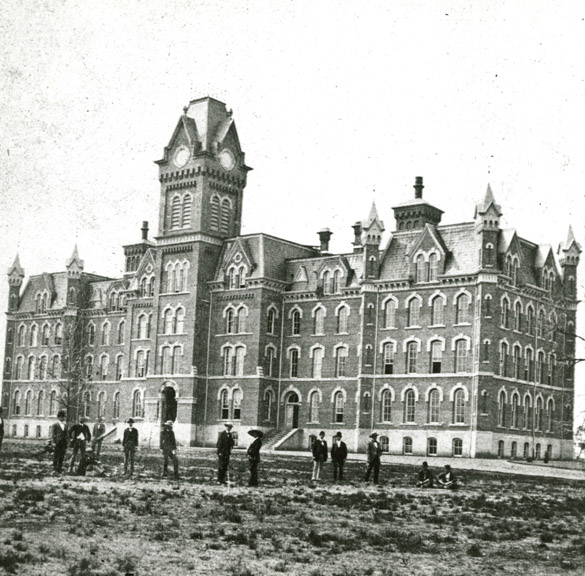
University Hall, 1874
It may be hard to imagine but when the University first opened, there were only seven faculty members and about two dozen students. More incredibly, many of the first faculty members resided in University Hall, along with many of the college’s first male students. The faculty’s quarters were mostly on the upper floors, known as the “Saints’ Roost,” and many of the students lived in the cellar, otherwise known as “Purgatory.” Of course, sharing close quarters was bound to lead to some disturbances. One former student’s account mentioned that residents of Purgatory occasionally made their way up the stairs at night; they formed a line and the leader would tap on certain faculty members’ doors at odd hours of the night. When the unsuspecting faculty member opened the door, the line would start forward and each passing student would hit the Saint with a pillow until he shut the door. Sounds like fun, huh? Clearly, the Internet had not yet been invented.
The Chemistry Building curse?
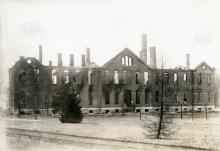
Chemistry Building #1 fire damage, 1887
OSU’s chemistry department got off to a rocky start: Originally housed on the third floor of University Hall, it was soon moved to a newly constructed building on the site of, most recently, Brown Hall. When a fire started in the building in 1887, the whole structure burned down because of a lack of water to extinguish the flames.
The next chemistry building was built two years later on the site of the present Derby Hall.
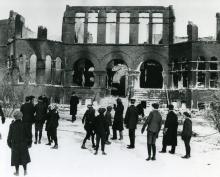
Chemistry Building #2 fire damage, 1904
It burned down in 1904. A recounting of the incident said there were “ludicrous happenings due to excitement” that occurred that night.
Apparently the firefighters were afraid of the chemicals housed in the building, so they did not try to put out the flames (whether or not the chemicals were a threat is not known). However, that did not stop students from entering the burning building and attempting to save the contents, including bottles of distilled water.
The third chemistry building, now known as Derby Hall, was rebuilt in 1906 on the site of its predecessor. It too, caught fire soon after it was completed; however the building was saved. Its first addition was, of course, a fire-proof storage shed for the chemicals. No doubt this helped to break the curse.
Hairy men in dresses

Scarlet Mask group
It’s likely someone has written a thesis about why people laugh when men dress up in women’s clothing. The entertainment method surely worked for OSU audiences during the first half of the 20th century, given the long run of a student acting group called Scarlet Mask. The men’s musical comedy club that later evolved into an honorary dramatic organization was started in 1919 by a group of five OSU students. Most of the plays were comedies, and they were a source of entertainment for students and local residents before the advent of television. Some of the early plays (prior to 1925) were penned by none other than humorist James Thurber. One of the group’s signature pieces was to have very big, hairy men—such as members of the football team—come out on stage dressed in frilly women’s clothing. Another key member was Milton Caniff, creator of long-running comic strips, “Terry and the Pirates” and “Steve Canyon.” Who knows? If he had not become a renowned cartoonist, he might have his career on stage. The Scarlet Mask Club disbanded in the 1930s, primarily due to a lack of funding, but the club was periodically resurrected for the next decade or so. Its last run ended in 1953.






Recent Comments