From Woody's Couch

Our Playbook on OSU History

Category: Professors (page 12 of 14)

OSU professor: ‘Not how to make a living, but how to live’

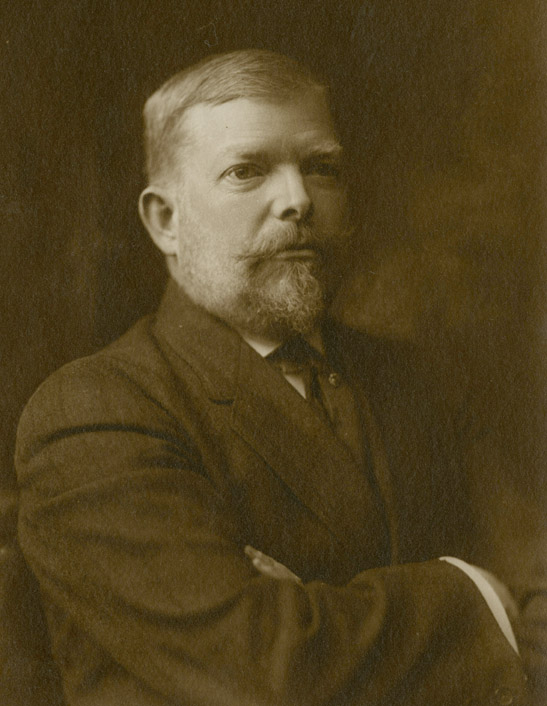
Joseph Taylor, circa 1910

They say you should write what you know. Joseph Russell Taylor wrote and drew what he felt and remembered. Nearly 50 years at Ohio State left Taylor with an abundance of memories of campus life, activities, and traditions to fill his writings, which are crammed full of memories and emotions. His art, which favored watercolor scenes of local landscapes, is on display at the Faculty Club.

An English professor and art instructor, Taylor graduated from Ohio State in 1888 and immediately became an assistant of drawing. With the exception of one year of graduate work at Columbia University, he would remain at Ohio State until his death. He moved from drawing to rhetoric, then to English literature, eventually becoming professor of English in 1908, a position he would hold until his death on March 30, 1933.

Taylor left an indelible impression on both the students and faculty of Ohio State University. One of his students when he was an art instructor was George Bellows; OSU alumnus James Thurber named Taylor one of his three most important teachers. In fact, Thurber was one of three people to speak at a commemorative program in 1933 for Taylor at the Faculty Club (then located on the third floor of Bricker Hall.) Also speaking were OSU Pres. George Rightmire and OSU English Prof. Billy Graves. After Taylor’s death, the art shown at the commemorative program was given to his family. They were returned to the Faculty Club after the recent death of Taylor’s granddaughter.

Others noted Taylor’s close connection with nature, his enthusiasm, and the value he put on student opinions and perceptions. Most of all, they noted his love for, as Thurber described it, “a more graceful way of living, a finer care for the quieter glows and gleamings in life”. Taylor’s own words, however, provide the best summation of his views on life. Thurber once described how Taylor told his students that “we are not here to teach you how to make a living, but how to live.”

The exhibit of his artwork is on display Nov. 1 – Dec. 14, 2012. A reception and presentation about the artist will be held this Friday from 6-8 p.m. For more information go to the Faculty Club’s web site:
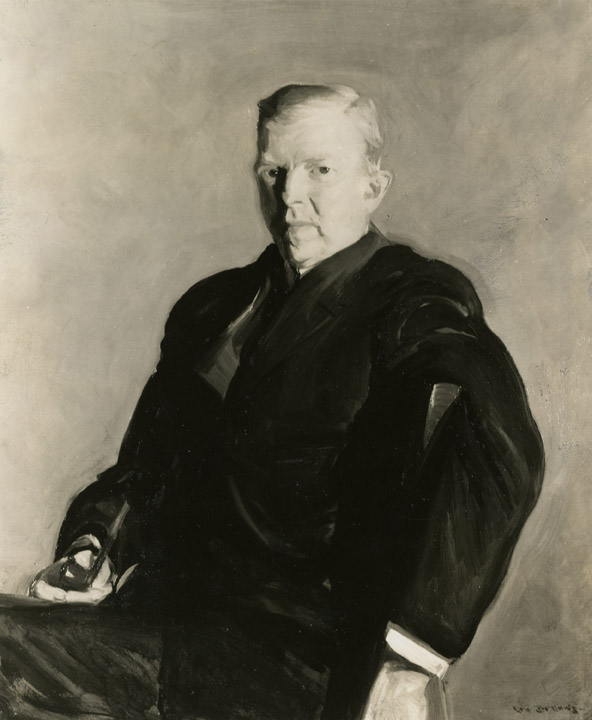
A portrait of Joseph Taylor by George Bellows, 1920s
Bleeds Scarlet and Gray: Dedicated alum’s final resting place is Bricker Hall

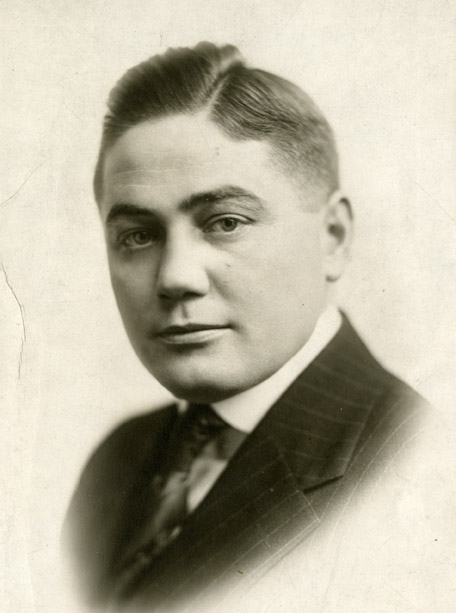
Herbert Atkinson, 1920

OSU alumnus Herbert Atkinson was a devoted OSU student and alumnus whose final wish was for his ashes to be buried in Bricker Hall. Here’s how it happened:

Atkinson started his journey at OSU as a freshman in 1906, working his way through college with a colorful array of jobs: waiting tables, mowing lawns and mucking stables, and working as a metal polisher in the summer in his hometown of Fremont, Ohio. Somehow, he found time to join Bucket and Dipper, play Varsity Basketball for three years, and cheer on the Buckeyes as a member of the Varsity cheerleading squad for one year. Immediately after he earned his law degree from OSU in 1913, he was appointed secretary of the State Highway Department, according to the alumni magazine. He left the following year to practice law.

Eventually, Atkinson entered the political field, and was elected in 1918 as the Franklin County representative in the state legislature. He was re-elected twice, and for those last two terms served as the Democratic floor leader. He went on to found Atkinson-Dauksch Insurance and Bonding Agency, which grew to become one of Ohio’s largest agencies before his retirement in 1944.

As an alumnus, Atkins was active with his alma mater. He served as first vice president of the Ohio State Alumni Association for 13 years, and he was a member of the University’s athletic board for 13 years.

But it was his service on the Board of Trustees that really set him apart. In 1925 he was appointed to fill a vacant position on Ohio State’s Board of Trustees—a position that he would hold for the next 23 years. During his tenure, he helped select three Ohio State presidents: George W. Rightmire, (acting president) William McPherson and Howard L. Bevis. He was instrumental in establishing the schools of Aviation, Fine and Applied Arts, Social Administration, Home Economics, Optometry and Music. During his long tenure, he also helped complete such projects as University School, Don Scott Field, the construction of the Men’s Gymnasium and Natatorium, and the Stadium Dormitories.

Board of Trustees, 1925: Front Row: Mrs. W.O. Thompson, Lawrence E. Laybourne, President W.O. Thompson, Alma Wacker Paterson, Back Row: Egbert Mack, Julius F. Stone, Harry A. Caton, Herbert S. Atkinson, John Kaiser, Carl E. Steeb

He died in 1952. According to the Board of Trustees minutes, his widow, Laura, told then-OSU President Howard L. Bevis that Atkinson’s wish was for his ashes to be kept somewhere on campus. Because of his nearly quarter-century of century on the Board of Trustees, Bevis recommended to the board that his ashes be installed in Bricker Hall. The Trustees unanimously approved the recommendation.

(Left to right) President Bevis, Charles Kettering, Mrs. Atkinson and Carl Steeb pose for a portrait during the dedication of Herbert Atkinson’s ashes at Bricker Hall, 1954

Today, when ascending the main staircase between the first and second floors, look for the plaque in the wall, outside the meeting room of the Board of Trustees—that’s where his ashes reside.

Bricker Hall

Filed by C.N.

Spring is in the air: When Chadwick Arboretum comes alive

Chadwick Arboretum lake, 1994

What makes a college campus attractive? One of the key elements is its gardens, and OSU is no exception. The campus has had gardens dating back to the early 1880s, but they’ve never been just for show. The 1883 annual report to the Board of Trustees from the Department of Horticulture reported that:

“Owing to our long continued summer drouth (sic) the plants did not look as well as usual. [However,] By the completion of the Green-house … we will not only add to the attractiveness of the University, but also furnish a valuable means of illustration for the students of this department.”

For many years, the Horticultural Gardens were located behind Townshend Hall, just a stone’s throw from the Ohio Stadium. In April 1980, the Department proposed to establish the Chadwick Arboretum north of the Agriculture Administration building.  The Board of Trustees approved the proposal in July of that year, and a dedication ceremony was held in May 1981. At the time, the Arboretum included several acres of gardens along Lane Avenue, near the Agriculture Administration Building. In 1989 a lake was added, and in 1990, its first director was hired. The arboretum was then expanded to 36 acres, surrounding the OSU sports parks on the west side of the river. In 1995, The Richard and Annette Bloch Cancer Survivors Plaza was added to the Arboretum grounds on the northeast side of Olentangy River Road.

Lewis Chadwick, 1987

The Arboretum was named after Dr. Lewis C. Chadwick, an internationally acclaimed horticulturist, who worked extensively with OSU campus planners in selecting appropriate plants for various campus areas. He was employed for 38 years in Department of Horticulture, retiring in 1967. He kept up his University ties, continuing to work on projects—including the arboretum that now carries his name. Throughout his career at the University, Chadwick attempted to collect or produce landscape plants from around the world, as well as planting many trees across campus. He died in 1993 at the age of 91.


Filed by C.N.

Older posts Newer posts