


Richard Byrd had a crucial impact on
Polar exploration.
This blog post is part of the Frozen Friday Series, an A-Z journey of the Polar Archives. Each week, we will feature some aspect of the history of polar exploration with a blog post written by our student authors.
By the early 1920s, nearly all the great “firsts” were gone from polar exploration. Carsten Borchgrevink had spent the long winter on Antarctic soil 1899-1900. The North Pole had been discovered in 1908. Roald Amundsen had reached the geographic South Pole in 1911. Robert Falcon Scott and Ernest Shackleton became household names. During the latter part of the 1920s, polar exploration would shift from the “heroic age” to the “mechanical age.” Richard Evelyn Byrd would come to be known as the first explorer to fully realize the value of mechanized exploration.
Beginning his career in the United States Navy, Byrd turned to flight and to the excitement of exploration. He first ventured into the Arctic in 1925, when a broader Navy-run expedition was launched. There he gained a reputation as a good leader and excellent organizer, as well as developing a taste for publicity. Upon his return, after only one trip into the Arctic, Byrd boldly asserted that “Aviation will conquer the Arctic—and the Antarctic, too.”[i] He would make it his life’s work to prove this claim.

Byrd as an aviator in the navy.
A year after his first journey, Byrd was back in the Arctic—this time to fly to the North Pole. Byrd was far from the first to envision greatness as the ‘Conqueror of the North Pole’ (a title later given to him by American newspapers). Human footprints had marred the Pole for over a decade and only the year before had the Norwegian explorer, Roald Amundsen, and American sportsman Lincoln Ellsworth tried, unsuccessfully, to fly to the North Pole. As Byrd prepared for his own attempt, Amundsen had returned for a second try. Byrd, however, did not see his efforts just as part of the race to be the first, but rather as a way to prove the usefulness and reliability of airplanes in the air space above the Arctic.

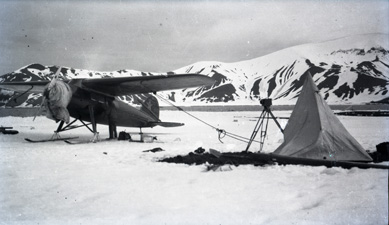
The ‘Josephine Ford’ in the Antarctic.
More images from Byrd’s Arctic Expedition
of 1926 can be found online here.
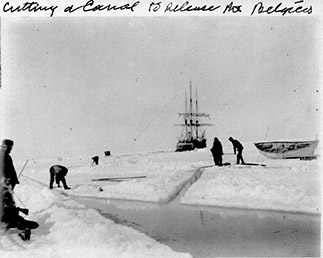
After some very skillful fundraising, Byrd arrived at King’s Bay, Spitsbergen on April 29th, 1926, with all the equipment he needed for an attempt at the Pole. His plane, a massive Fokker tri-motor, was named the Josephine Ford in honor of the daughter of one of his chief benefactors, Edsel Ford. Amundsen, already at King’s Bay, was less than thrilled. Upon arrival, Byrd was unable to dock at the pier, blocked by the Norwegian gunboat Heimdahl, with no place to unload the Josephine Ford. A creative Byrd had his men cut a path through the ice-choked waters and load his plane onto a make-shift raft crafted from rowboats and wooden planks. It was a rather dangerous, if ultimately successful, endeavor (a phrase applicable to most of Byrd’s adventures).
In his first attempts at flying the Josephine Ford, Byrd broke the skis twice without leaving the ground. One of Amundsen’s men, Bernt Balchen, suggested repairing the broken skis with oars from Byrd’s ship and taking off at midnight, while the snow would be more firm. On May 9, 1926 Byrd and his pilot, Floyd Bennett set off for the North Pole. Aided by nearly perfect weather and a tailwind, Byrd and Bennett reached the Pole, circled, and returned in sixteen hours. They were greeted by their euphoric friends and rivals. Even Amundsen participated, crying and hugging the returning pilots.
Byrd received the Medal of Honor for this flight. However, the validity of the achievement was questioned almost immediately, though not vocally until after Byrd’s death in 1957. Critics say that it was impossible to complete a journey of fifteen-hundred miles in such a short time, even with a tailwind. Balchen,came forward to cast doubt on Byrd’s claim and would eventually publish a rebut of Byrd after the explorer’s death. Balchen also claimed that pilot Floyd Bennett, having died several decades before, had admitted the fraud, although this contradicted Bennett’s own published statements. The controversy continues even today. Scholars have continued to study Byrd’s flight diary, discovered amongst the explorer’s papers during the processing of the collection in the 1990s.[ii]
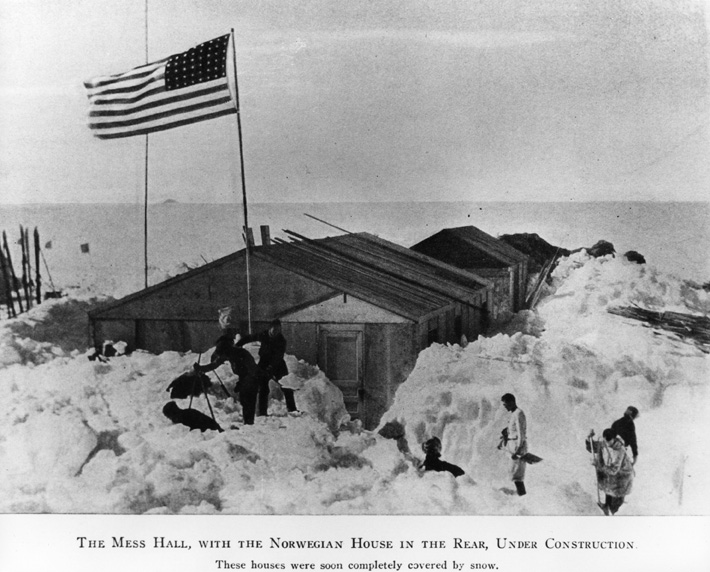
A view of Little America’s mess hall, under construction.
Regardless, Byrd’s reputation does not depend solely on his North Pole flight. In 1928, Byrd led his first expedition to Antarctica. After establishing the camp Little America, Byrd prepared to take to the air once again. Byrd’s flight to the South Pole became the second successful visit to the pole after Amundsen’s journey on foot in 1911.What took Amundsen over three months, took Byrd a mere sixteen hours in the airplane Floyd Bennett. (For a man who loved danger and publicity, Byrd’s comment about his trip to the South Pole is rather short and bland: “One gets there and that is about all there is for the telling.”[iii])
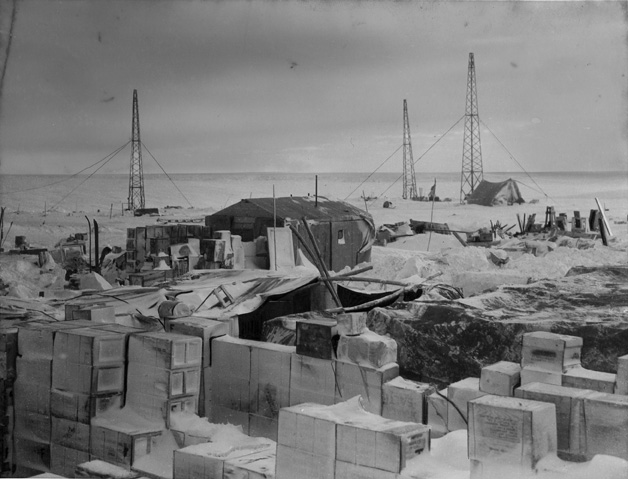
Another view of the iconic ‘Little America’.
Byrd’s desire to advance science fueled his second trip to Antarctica in 1933. This trip would set the bar for scientific research in the polar regions. Returning to Little America, equipment was set up to study the weather and the upper atmosphere. Many branches of science were represented on this expedition, including biology, forecasting, geology, mapping, and communication via radio. This trip also proved the usefulness of motor vehicles in the polar regions. The expedition was not without drama, however. Byrd suffered from carbon monoxide poisoning from his stove and generator during the four months he spent alone at his remote hut Advance Base, one hundred and twenty-three miles from his base camp, Little America. Though he survived this ordeal, it is believed that the experience weakened his health over the remaining course of his lifetime.
Nick-named the “Mayor of Antarctica,” Byrd would return to the continent 3 more times before his death 1957. By the time of Byrd’s final expedition, he had seen over 1.5 million square miles of the frozen continent and photographed over sixty percent of the coastline.
The Ohio State University acquired the Papers of Admiral Richard E. Byrd in the mid-1980s in a competitive bid process with several other institutions of higher education. The University’s Institute of Polar Studies was renamed the Byrd Polar Research Center in 1987 as a permanent tribute to the explorer. The Polar Archival Program was officially established in 1990, with the Byrd collection as it’s cornerstone.
It is nearly impossible to encompass the life of Richard Byrd into one short blog post. To learn more about Admiral Byrd and his collection, please visit: https://library.osu.edu/find/collections/byrd-polar-archives/byrd/.
Written by Autumn Snellgrove and edited by John Hooton.
[i] Explorer, page 99
[ii] For a published version of this incredible document, please see To The Pole: The Diary and Notebook of Richard E. Byrd, 1925-1927. Edited by Raimund E. Goerler and published In 1998 by the Ohio State University Press, the book is available online here: https://ohiostatepress.org/books/Complete%20PDFs/Byrd%20To/Byrd%20To.htm.
[iii] Reader’s Digest Antarctica, page 243






Recent Comments