From Woody's Couch

Our Playbook on OSU History

Category: Students (page 28 of 32)

Carl L. Dennison: the man behind the sweater

Dennison's senior photo, 1933

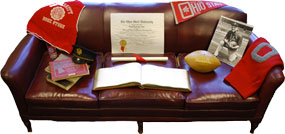
The Archives recently received a Varsity sweater (at bottom of post) originally worn by Carl L. Dennison, an OSU graduate who attended the University roughly 80 years ago.

Using various reference materials, we found out a little more about him:

Dennison matriculated into OSU in the fall of 1928, as a freshman in the College of Engineering. He was a student of engineering until the 1931-1932 academic year, when, according to the student directories, he switched to Commerce. He graduated in June 1933 with a bachelor of science degree in Business Administration.
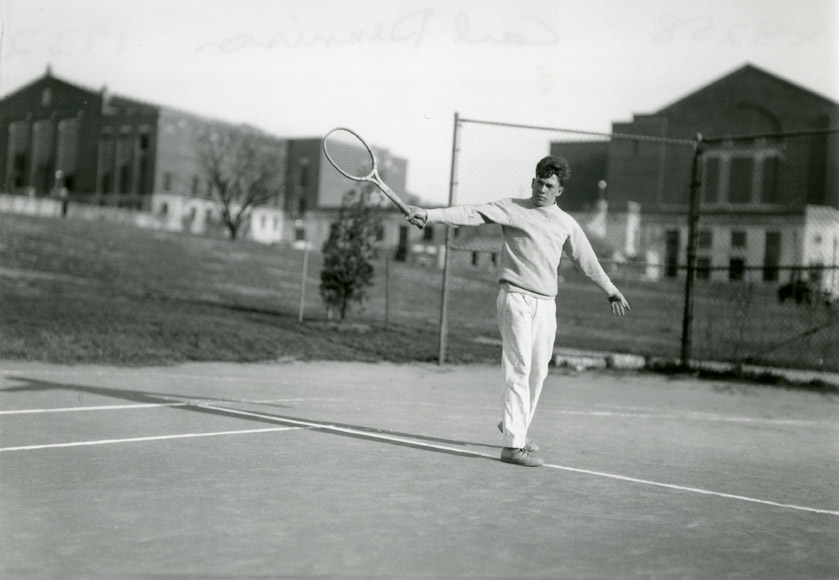
Dennison on the court, 1932

During his time at OSU, he was apparently a very busy young man, at least according to our set of Makios and alumni magazines. He was a member of the fraternity, Phi Kappa Psi, all five years he attended the University. He also was a member of the honorary, Bucket and Dipper, his junior year, and he was a member of the senior honorary, Sphinx, the next year.

From his second year at OSU until he graduated, he played for the men’s tennis team, and was a member of Varsity “O” his last two years on campus. During his first year on the Varsity team, the Makio called Dennison, a former high-school city champion in Youngstown, one of “a promising trio” from that city “wearing Ohio’s State’s colors for the first time.” Two years later, Dennison was playing for the Big Ten title in singles, but lost in straight sets against a member of the University of Chicago team, according to the Makio.

That is where the record ends, unfortunately. We’re grateful, though, to Dennison’s family for donating the sweater, a beautiful artifact from a long-ago era. And we hope you enjoyed learning a little bit more about the man who wore it.


Twelve Days of Buckeyes: Why “Carmen, Ohio” is our alma mater

Fred Cornell, 1915

It’s hard to imagine a home football game not being followed by the team and fans singing OSU’s alma mater, “Carmen, Ohio.” It took years, however, for this ritual to become a steadfast tradition.

Fred Cornell, a member of the Men’s Glee Club in the early 1900s, definitely wrote the lyrics, but it’s unclear how he was inspired to do so. One story has Fred writing the song in the fall of 1902, on the train taking him and the football team from Ann Arbor, after a loss of 86 to 0. Cornell felt that the team and fans needed an inspirational song to lift their spirits.

A more likely account, supported by a 1910 article in the Alumni Monthly, has Fred himself saying that he wrote the piece in the fall of 1903, because the Glee Club was looking for an alma mater. There were several entries submitted by women, and Cornell was urged by several other men to write something.

What’s not in doubt was that it was first performed in 1903 on New Year’s Eve at an off-campus event. The first on-campus presentation was at the Wednesday Convocation, when students returned to campus. It was then sung at football games, but did not have any great popularity at first. The tune also seems to have been undecided for some time, with several different pieces of music used until the Spanish March was finally chosen.

By 1918 “Carmen, Ohio” was played on the chimes at Orton Hall everyday at 4:30, following taps. A phonograph record was produced of the song in 1921.

Twelve Days of Buckeyes: A “Magic Mirror” of OSU history

(We’re still in the holiday spirit, so this post about OSU’s yearbook, the Makio, will open to the tune of “Santa Claus is Coming to Town:”)

It’s seen students when they’re sleeping

It’s seen them while they’re in class

The Makio has had photos of it all

But its time is about to pass

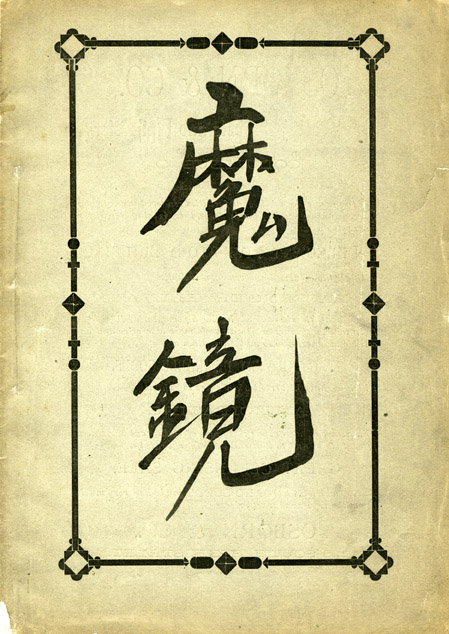
1880 Makio cover

After a day of classes and studying in 1878, three men discussed starting a collegiate annual for Ohio State. The three men were Sidney Short, John Ward and Willis Jones, and their initial idea became what we now know as the Makio.

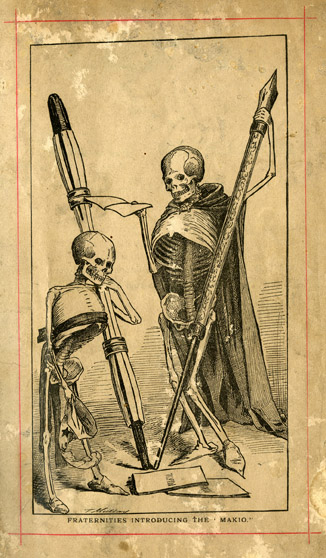
Drawing from 1882 Makio

Overseen by the two fraternities on campus, Phi Gamma Delta and Phi Kappa Psi, the Makio was worked on in secret and completed in the six weeks before commencement. The name Makio, meaning “Magic Mirror,” was translated from Japanese by Prof. Edwin Morse. Prof. Morse and Prof. Thomas Mendenhall collaborated in Japan on the study of such mirrors. The first issue, published in 1880, was 68 pages long, containing no photographs.

The Makio has been the subject of disputes among organizations on campus. In 1882, the Makio staff and the Lantern staff quarreled about it, and in 1883 the founding fraternities disagreed on allowing newly founded fraternities to participate in the publication of the Makio, resulting in two yearbooks being published. In 1896 the yearbook was known as The Scarlet and Gray, but in 1897 it returned to its original name. A junior class Makio Board was formed in 1906, taking over publishing responsibilities from the fraternities. The Makio Board progressed over the years allowing students from all classes to participate.

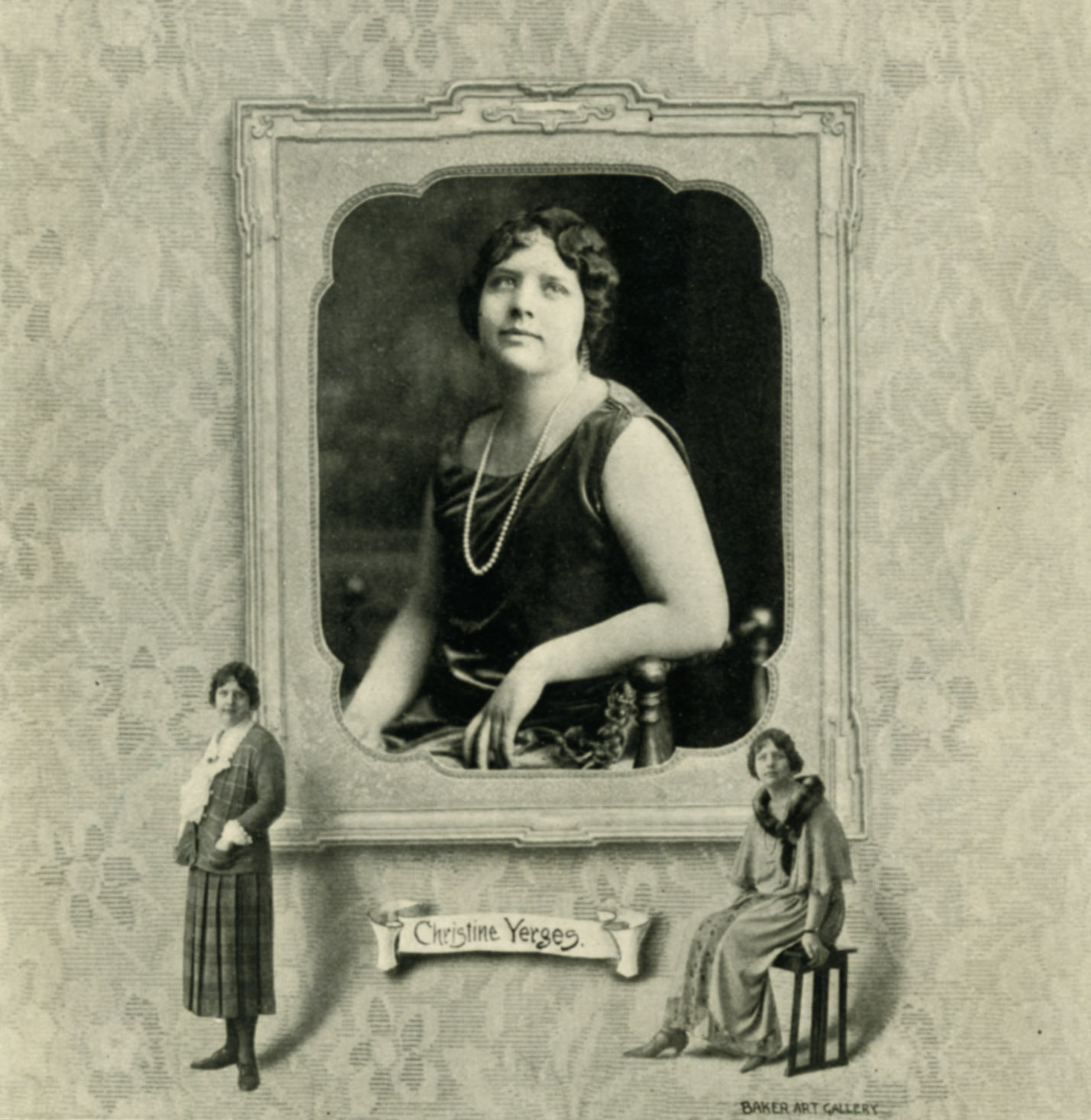
“Magic Mirror Girl”, 1923

The contents of the Makio have also evolved from the first publication. At first, the yearbooks focused on Greek affairs. Essays, satires and political cartoons were included as the popularity of the Makio grew. Photographs were first published in 1887 with the addition of color photos in 1920. Women were highlighted in sections such as “Rosebud,” “Magic Mirror” and Makio Queen when the student body voted for the prettiest and most popular girls on campus.  Audio recordings on vinyl records were included with the 1953 and 1959 Makios.

Since 1880 there have been several years the Makio was not printed. The 1881 issue was the first year the publication was skipped, but it was stopped altogether in 1995. Publishing restarted in 2000. As the article from The Lantern states, the Makio will once again cease to exist.


Older posts Newer posts