From Woody's Couch

Our Playbook on OSU History

Category: Students (page 23 of 32)

Early 20th century art – on football programs?

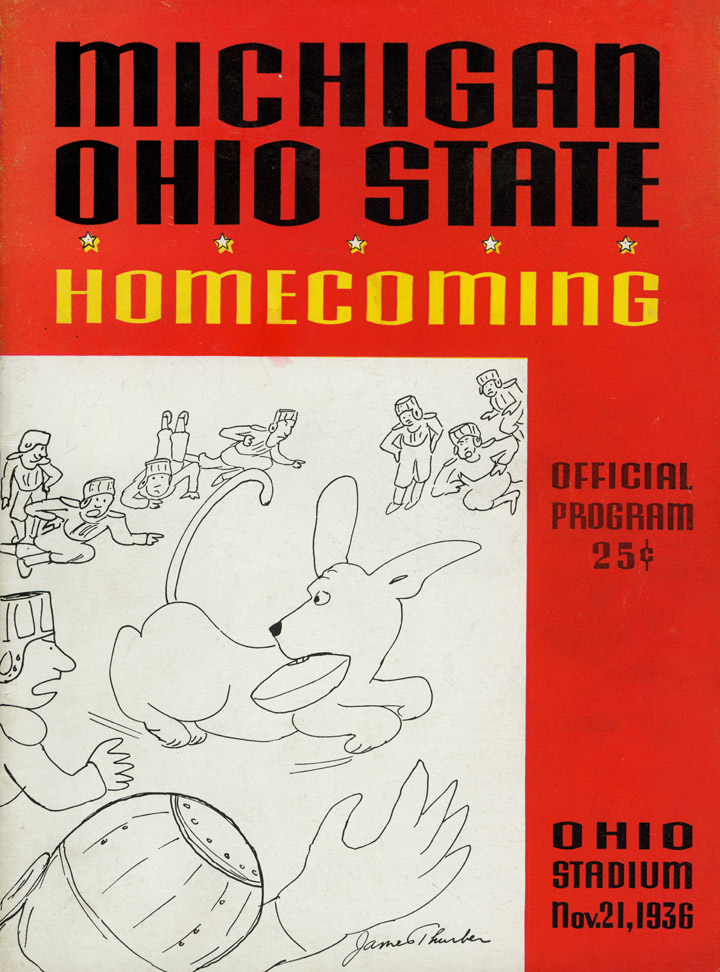
Thurber’s cover art for the 1936 football program

If you’ve ever looked at old OSU football program covers, you’ll notice how arty they were. That’s because they were drawn by actual artists, including two OSU alums who went onto to successful careers using those artistic skills.

James Thurber was one of them, and the one football program cover he drew was actually done after he’d become a well-known author and illustrator. The football program was issued in conjunction with the Nov. 21, 1936, game against Michigan.

At the time of this football program’s debut, James Thurber was associate editor of The New Yorker, and a prominent author, having published two books, “Is Sex Necessary?” and “My Life and Hard Times.” Thurber also was well-known for his illustrations, although they generally received more attention for their humor than their artistic merit.

Thurber was born in Columbus and attended OSU, but withdrew in 1918 before completing his coursework shortly before the onset of World War I. With the outbreak of the war, he became a code clerk for the American Embassy in Paris. In 1926 he relocated to New York to work for the Evening Post, and the following year left to pursue his position at The New Yorker.

Caniff’s cover from 1927

Meanwhile, Milton Caniff has quite a few football program covers that bear his name from his student years at OSU in the late 1920s. During that time he also served as art director of the Makio and the Sundial, an OSU student humor magazine. He graduated in 1930 with a bachelor’s degree in journalism. He later went on to draw “Terry and the Pirates” and later “Steve Canyon,” probably his most famous comic strip. That strip ran for more than 40 years.

Both alumni received honorary degrees from the University.

Want to see how arty those football programs really were? Go here:

https://www.flickr.com/photos/ohio-state-university-archives/sets/

Founder’s Day: ‘A small beginning makes a good ending’

University Hall, 1874

Nearly 140 years ago, the Ohio Agricultural and Mechanical College opened its doors.

On September 17, 1873, seven faculty members greeted the roughly two dozen students who showed up to get a college degree. (Reports vary between 17 and 25 on how many students there actually were.) The college’s sole building—University Hall—was still under construction, with an unfinished roof, no interior doors, and no more than a few benches for students.

There was no formal opening ceremony, nor a dedication. Therefore, it is not surprising that its opening went mostly unnoticed. However, one Ohio newspaper did write, perhaps a bit prophetically, “They say a small beginning makes a good ending.”

Despite the inauspicious beginnings, the University did succeed, and a lot of the credit for that success goes to the outstanding faculty. The Board of Trustees found remarkable individuals – men (and they were all men) who may not have achieved great honors but who recognized the worthiness of the University’s mission and dedicated themselves to the cause. And it was dedication. The faculty undertook significant workloads, not only teaching but donating time as per state requirement. For example, the agriculture professor was required by the state to analyze fertilizer samples—for free—for the general public. The faculty was also required to help with the grounds, including sanitation. On top of all that, many of the original faculty members lived in University Hall along with the students. Despite these conditions, many of these faculty members spent the rest of their careers at Ohio State.

First graduating class, 1878

But what did these professors teach? The focus was science, but the liberal arts were also required as part of the curriculum. Incoming students were required to take an entrance examination in “arithmetic, geography, English grammar, and elementary algebra.” Students also had classes in literature, history, agricultural science, engineering, chemistry, philosophy, and language (Professor Joseph Millikin apparently taught Latin, Greek, French, German, Anglo-Saxon and the Romance languages). From here, you know the story: Ohio State has been accumulating courses and departments—and students—ever since.

In 1878, the college changed its name to The Ohio State University, and the rest, as they say, is history.

For more information about the founding, visit our web exhibit at: http://library.osu.edu/projects/founding/.

Filed by C.N.

North Campus housing grows as four dorms named after war veterans come down

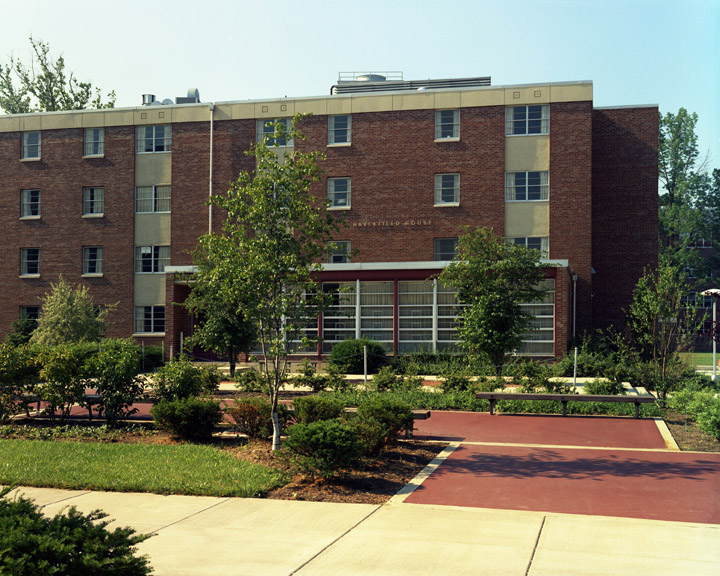
Haverfield House, 1967

As you may have heard, the Board of Trustees recently approved a plan to overhaul North Campus, with particular attention to the residence halls. The $396 million plan is expected to increase campus housing for students, as well as add dining and recreation facilities in the area.  As a result, four existing dorms will be demolished: Blackburn, Haverfield, Nosker, and Scott Houses.  Since they will be gone soon, let’s reflect on their significance:

On April 6, 1962, the Board of Trustees dedicated a group of dorms on North Campus, including the four to be demolished. These buildings were going to alleviate the housing crisis the University found itself in during post-war enrollment boom of the ’50s and ’60s. What is special about these buildings is that they were named in honor of U.S. war veterans who were all Ohio State students or alumni and who had died during one of the major conflicts, from the First World War through the Korean War. The only two buildings on North Campus not named for a veteran are Drackett Tower and North Commons (Taylor, of Taylor Tower fame, was a veteran, but he survived and worked at Ohio State for many years after he left the service). The four dorms to be demolished are named for the following individuals:

Blackburn, 1941


John Thomas Blackburn, of Columbus, was one of four Ohio State men killed in action in 1941 during the attack on Pearl Harbor. He served aboard the U.S.S. Utah. A member of Tau Kappa Epsilon fraternity, he enlisted in the Navy in October 1939.


Haverfield, 1941


A native of Uhrichsville, Ohio, James W. Haverfield graduated from Ohio State in 1930. He was a member of Beta Theta Pi, and active in Scarlet Mask. He enlisted in the Navy in November 1940. He was reported missing in action in 1941 after the attack on Pearl Harbor, and he was declared dead just five months after he was called to active duty. A Navy destroyer escort vessel was named to honor him as well.


Nosker, 1944


William C. “Bill” Nosker played three years on the varsity football team as a guard (1938-1940), and served as class president during his sophomore year (1940). He graduated in 1942 with a bachelor of science degree in Agriculture. In December 1943, he was deployed overseas and flew more than 30 missions before he died after a night-time takeoff on August 15, 1944, in Italy. He was awarded the Bronze Star for a mission over Romania, as well as an Air Medal, issued to those who distinguish themselves during an aerial fight. Nosker’s Air Medal had three oak leaf clusters, signifying that he had received this decoration three times.

Scott, 1941


Robert R. Scott was killed in action in 1941 during the attack on Pearl Harbor, while he was serving on board the U.S.S. California. A native of Massillon, Ohio, Scott was posthumously awarded the Congressional Medal of Honor—the first Ohio State student to be given the honor in either World War.

To learn about the other veterans and administrators the dorms are named for, check out Buckeye Stroll, our interactive map of campus: http://library.osu.edu/buckeye-stroll/.


Filed by C.N.

Older posts Newer posts