From Woody's Couch

Our Playbook on OSU History

Category: People (page 3 of 52)

Happy 86th birthday, Script Ohio!

Written by Maggie Lindner
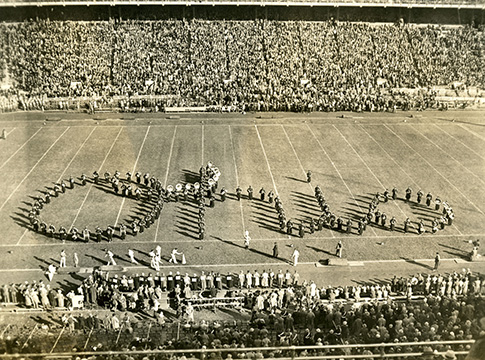
Black and white image of the Ohio Script fully formed for the first time in Ohio State history. The photo is taken from the 50 yard line, with the spectators looking down on the finished feat.

First Script Ohio, Oct. 10, 1936.

On October 10th, 2022, Script Ohio will turn 86 years old. First performed at a 1936 football game against Indiana, which the Buckeyes won 7-0, the formation has become the signature of TBDBITL. Played to the tune of Robert Planquette’s “Le Régiment de Sambre et Meuse”, Script Ohio is ubiquitous for the smooth, continuous flow and precise movements of its 192 members. The tradition began with band Director Eugene Weigel, who took inspiration from the Marquee sign of the Ohio Theatre in Downtown Columbus, which can still be seen today.
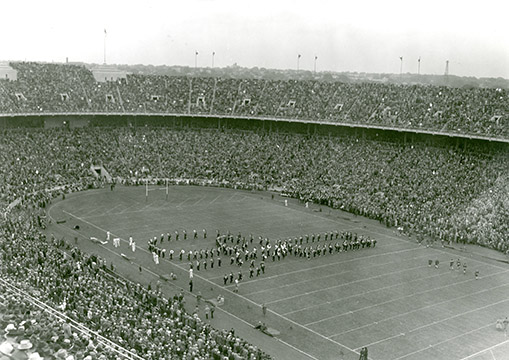
a black and white image of the Ohio State marching band forming the first Script Ohio in 1936. The O is looped through and they begin to create the cursive H.

Forming the first Script Ohio, 1936.

While performing as a member of The Ohio State University marching band is noteworthy on its own, the most honorable position is undoubtedly that of the “i”-dotter. Always a fourth-year sousaphone player (since the fourth performance of Script Ohio), the role of “i”-dotter is so enviable that students have continued to perform with the band for years after graduation just to be eligible. Today, the routine includes high fiving the drum major towards the end of the performance and bowing to the cheering fans on both sides of the ‘Shoe.
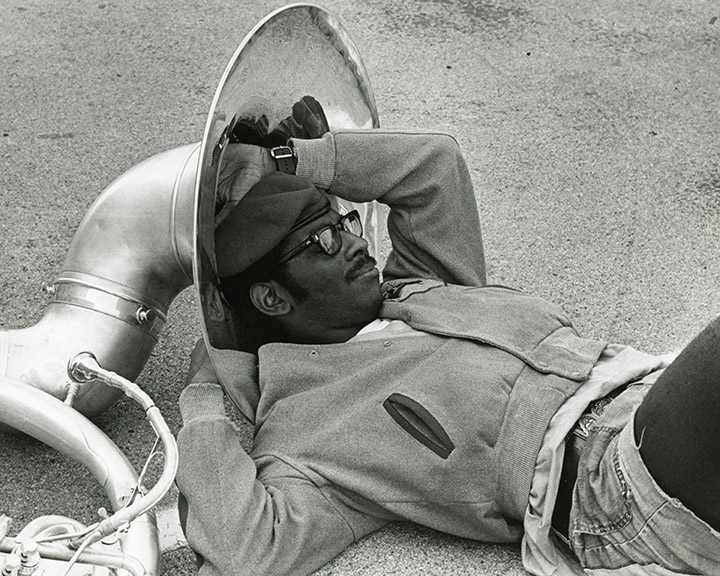
Student rests on a sousaphone, 1973.

However, students are not the only ones presented with the opportunity to dot the “i”. Notable “i”-dotters have included Bob Hope in 1978, Woody Hayes in 1983, and Jack Nicklaus in 2006. The last celebrity “i”-dotter appeared in 2018, the then-100-year-old Ohio State Marching Band alum Anthony Violi. It’s confirmed that no one will guest star in 2022, leaving more opportunities for sousaphone players to have their well-deserved moment in the spotlight.


Sources
Bovenzi, Giustino. “The Unlikely History behind the Legendary ‘Script Ohio.’” Sports Illustrated, Sports Illustrated, 20 Nov. 2015, https://www.si.com/college/2015/11/20/history-behind-ohio-states-legendary-script-ohio-routine.
Gay, Colin. “Ohio State Marching Band to Not Have Guest ‘I-Dotters’ in Script Ohio in 2022.” Yahoo! News, Yahoo!, 22 Aug. 2022, https://news.yahoo.com/ohio-state-marching-band-not-100220699.html.
“Traditions.” The Ohio State University Marching and Athletic Bands, The Ohio State University , https://tbdbitl.osu.edu/marching-band/traditions.
The Built Fem-vironment: Women’s History on Campus in Four Architectural Structures, Part 1: The Gab Room

Written by Sarah Stouffer-Lerch

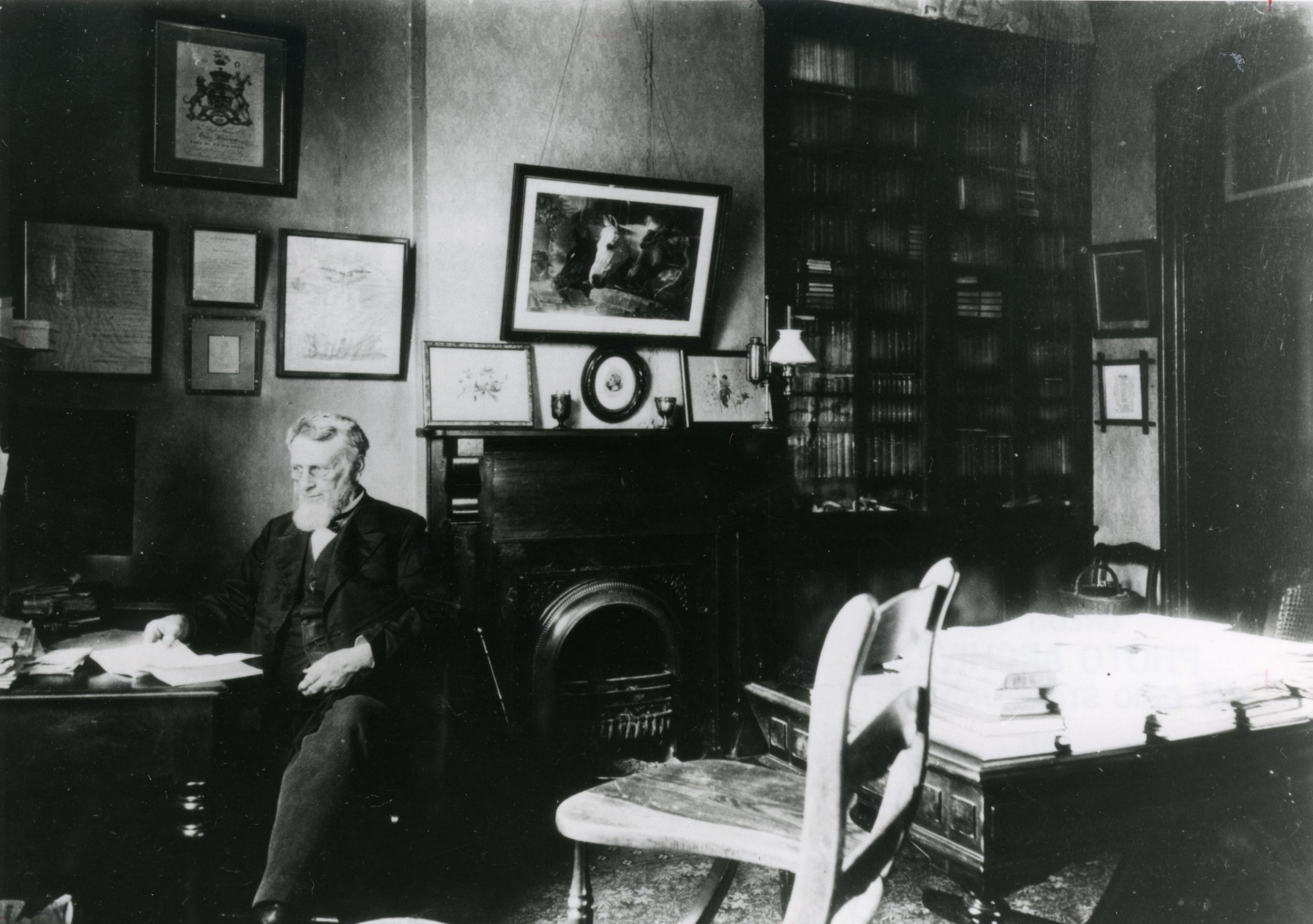
A black and white photograph of Norton Townshend sitting at his desk in 1883. The office features two desks, a fireplace, a large bookshelf, and a many framed images.

Norton Townshend at his desk, 1883

The first women attending Ohio State University did not have guaranteed student housing or a centralized meeting place—luxuries that were often afforded to their male counterparts. Instead, they would need to find the rare rooming house that would grant them boarding or, for those with family nearby, live at home. For those who were able to find lodging, the ability to socialize with other women was limited both because of the lack of a women’s dorm. In addition, Neil Farm, the property on which Ohio State University originally existed, found itself isolated from the main parts of Columbus at the time.

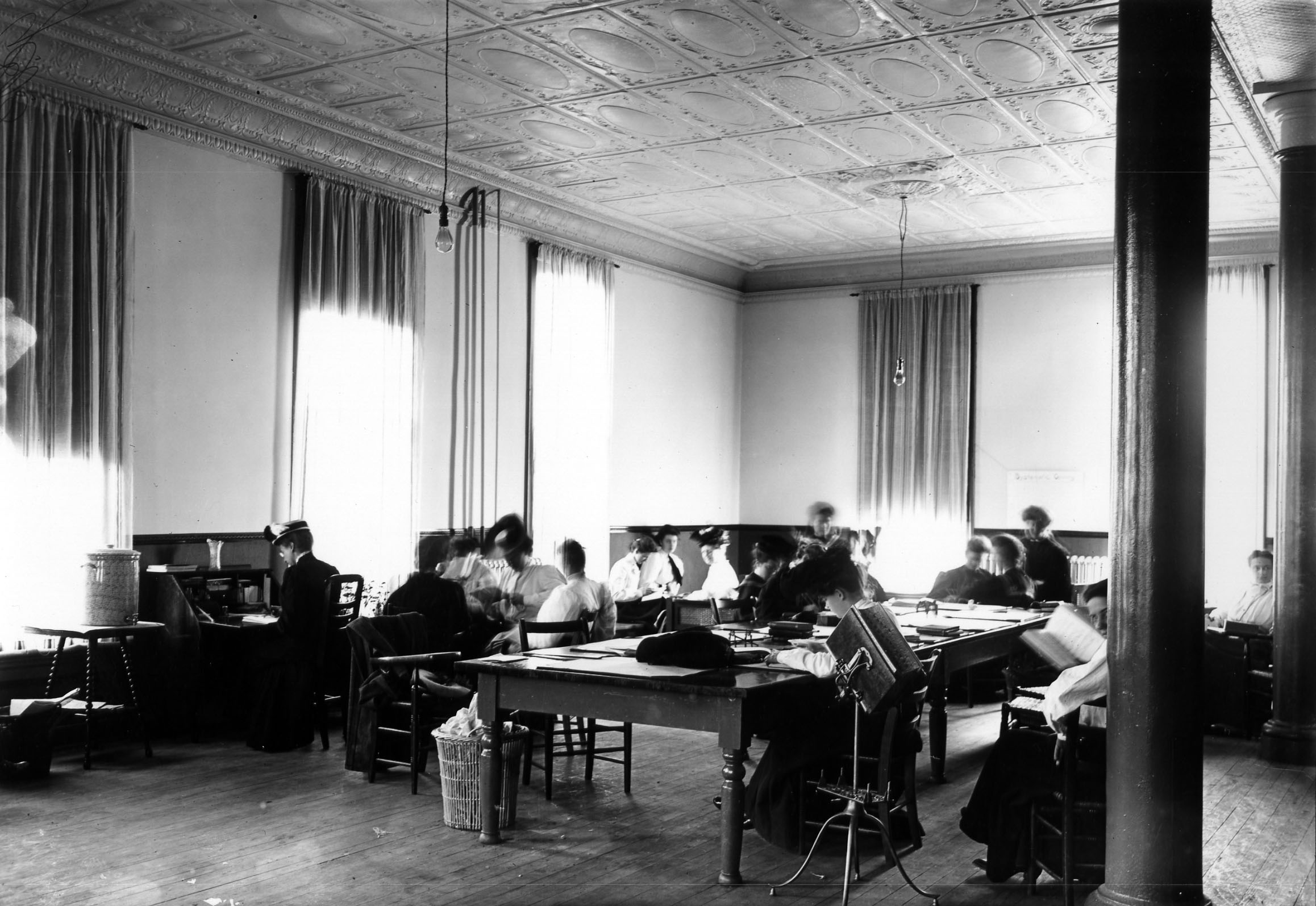
University Hall Gab Room, 1895

Early faculty member Norton Townshend—father of Harriet and Alice, the first two women students at Ohio State University—decided to address the unmet need for a space for women on campus. His office became the first iteration of what became known as the Gab Room, a derogatory name which labeled a designated area for the socialization of women students. Despite the name, University women saw the office as much more than just a physical space. Although the location changed several times as Ohio State grew, the Gab Room remained constant as both a social hang-out spot and, in some regards, a war room for women students to advocate for their equality on campus.

A prime example of advocation in the Gab Room occurred in 1882 when the university’s forty-five women students congregated to sign a petition to the Board of Trustees. They wanted a women’s dormitory, supplying proper room and board for the growing body of women students. Although then-University president Walter Quincy Scott supported the endeavor, the request was denied.

University Hall Gab Room with Mary Brown, 1915

In 1890, the location of the Gab Room moved to Hayes Hall. No University funds were given in order to furnish the room, so the women did their own fundraising. When a water pipe burst in 1892, the women of the Gab Room once again petitioned the university—their pleas were heard and he water issue was quickly resolved.

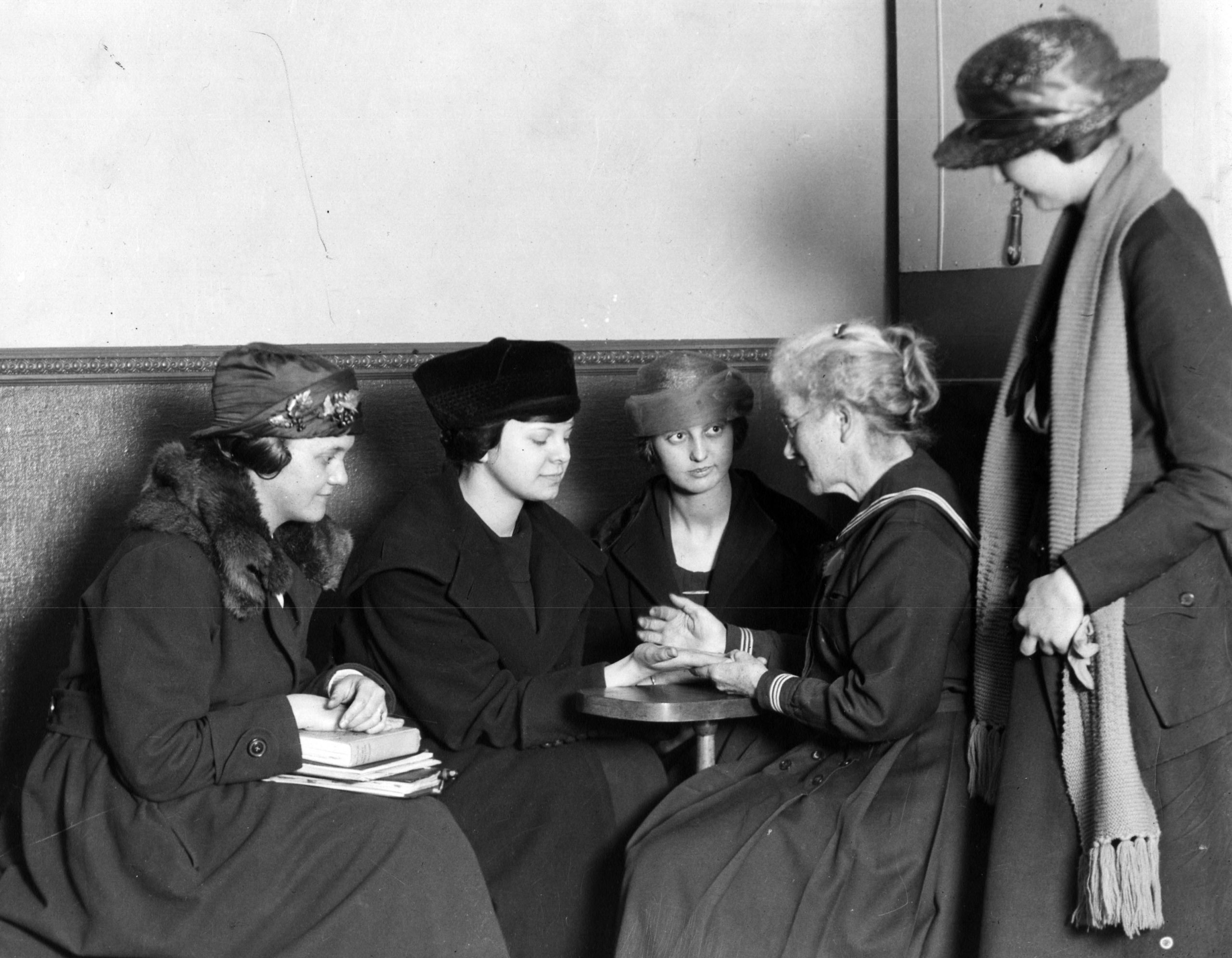
One of the last major functions the Gab Room served was as a rallying point for the Women’s Self-Governing Association (WGSA). In the 1920s, the WGSA found itself fighting for a Women’s Union Building. The WGSA members would invite legislators to the Gab Room, now located on the second floor of University Hall. Before the legislators arrived, the spot was made to look even shabbier than its normal appearance. This campaign continued until 1927 when Pomerene Hall, the university’s Center of Women’s Activities, was built. Ostensibly, Pomerene Hall made the Gab Room redundant, ultimately finding itself cleared for other purposes in the early 1930s.

The Gab Room, 1907

Everything but the Kitchen Sink: One man’s vision leads OSU to “teach all that is worth knowing”

Ohio State is now known as a preeminent American public research university with a broad range of academic disciplines and colleges, but its foundation could have been much more limited. Thanks to the efforts and vision of University founders like Joseph Sullivant, OSU was established with a forward-facing curriculum that helped it produce successful graduates and develop the wide array of degree programs.

Joseph Sullivant, 1878

Originally created with a focus on agriculture and engineering, OSU was established as Ohio Agricultural and Mechanical College. During its formative process, the direction of the university’s curriculum was hotly debated. The government, the agricultural industry, and other existing universities all vied for leverage during this process. Despite these pressures, the university decided on a holistic education devised by Board of Trustees member, Joseph Sullivant.  In a speech delivered to the Board of Trustees in 1871 on the focus of the curriculum, Sullivant laid out his ideals for a school that would not only fulfill the needs of the agricultural industry in the United States, but would also provide a well-rounded education for all students who attended. The manuscript Sullivant wrote of his speech gives us his reasoning for proposing a curriculum that would allow for both academic study and practical training.

Education until that point tended to fall into two extremes, as Sullivant saw it. Classicists, as he called them, believed in education only for intellectual sake, with a disregard for any applicability to real life. On the opposite extreme were those focused on education only insofar as it provides functionality which can convert to material prosperity. Sullivant saw both of these extremes as detrimental to the progress of society, and argued for a more balanced education for students of the future OSU: broader than purely functional studies, while also taking into account applicability to real life. Study of the natural sciences (the sciences of classification, as Sullivant calls them) provides mental training applicable to other areas of learning. Education and mental training allow people of all occupations to

Manuscript of speech, 1871

gain successful practices beyond simple trial and error. A good, practical education “will most fully develop and train all the faculties and secure the ability to perceive, to reason to judge and to act with promptness and decision,” Sullivant argues in his speech. This view of the benefits of a broad, liberal education is quite modern, and can still be seen as the standard in our colleges and universities today.

To accomplish these goals, Sullivant propsed an initial curriculum consisting of six departments at the University: Agriculture, Mechanical Arts, Mathematics and Physics, General and Applied Chemistry, Geology, Mining, and Metallurgy, and Zoology and Natural Science. Ohio State’s focus has obviously expanded greatly since those early days, but looking at these departments shows how broad the initial vision was when considering its original purpose of farming and mechanical engineering. That broad vision, focused on both intellectual training and practical applicability, helped OSU develop into one of the nation’s leading research and liberal arts universities. By instilling in the University from the very beginnings the values of broad education crossing disciplines, Joseph Sullivant helped to ensure the future of American higher education through his proposed curriculum.

Written by Matt McShane

Older posts Newer posts