From Woody's Couch

Our Playbook on OSU History

Category: Alumni (page 7 of 8)

Twelve Days: Bertha Lamme was first female engineering grad

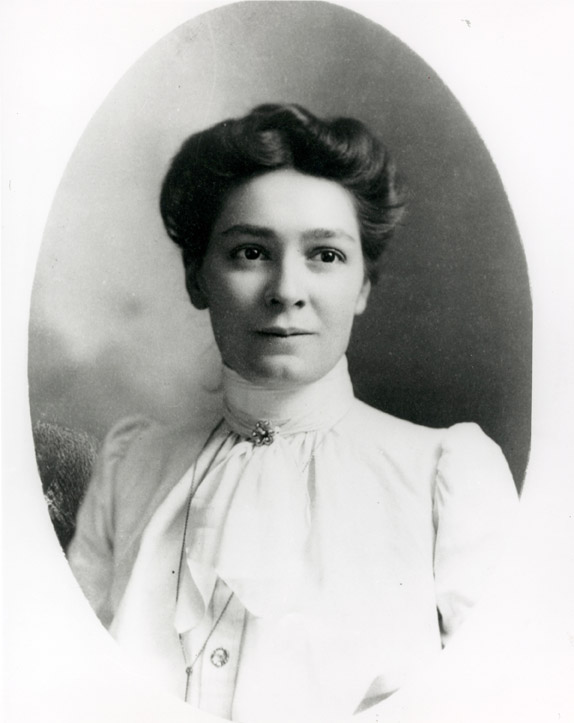
Bertha Lamme at the drawing table, 1892

Bertha Lamme at the drawing table, 1892

Buckeyes who have attended the College of Engineering may already know the name Lamme, since an annual medal the College bestows for meritorious achievement in engineering bears its name. That honor is named after Benjamin Garver Lamme, who received a degree in 1888 in Mechanical Engineering. However, few may know about his sister, Bertha, who was the first woman to graduate from OSU with an engineering degree.

Bertha Aranelle Lamme was born on December 16, 1869, near Springfield, Ohio. She came to Ohio State to study engineering, possibly influenced by her brother. She received a degree in Mechanical Engineering from the Department of Electrical Engineering, in 1893.

Bertha Lamme, 1892

Lamme, 1892

At Westinghouse, she met Russell Feicht, another OSU graduate (’90) and engineer who displayed a 2000-horsepower motor at the 1904 World’s Fair in St. Louis. They married the next year, and Lamme – now Mrs. Feicht – left the company to become a wife and mother.

Though little is known of Bertha Lamme’s own achievements in engineering, she did inspire at least one other woman to enter the science field: Her daughter, Florence, eventually became a physicist with the U.S. Bureau of Mines. Bertha Lamme Feicht died in November 1943 in Pittsburgh. She was 74.

Twelve Days: With Stuckey, it was always safety first

Wilbur Edward Stuckey, 1965

Wilbur Edward Stuckey, 1965

Wilbur Edward Stuckey, better known as “Bill” to many Ohio farmers and students, was all about safety. He lectured on how to prevent Christmas tree fires, sent students out to campus buildings to look for potential accident hazards, and gave helpful tips on how to have fun safely on holidays like Memorial Day. (“Play Safe – Increase the Fun,” was the title of this talk.)

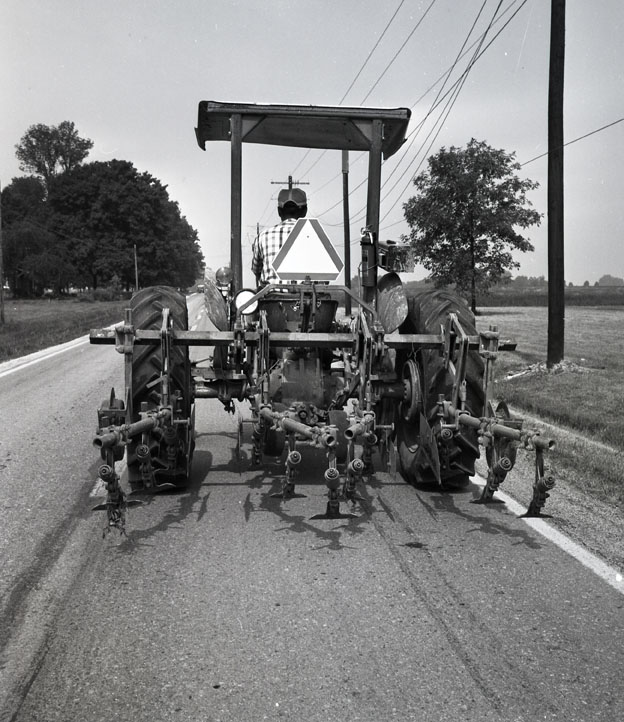
His most recognizable contribution was his steadfast promotion of the orange triangle ‘Slow Moving Vehicle’ sign now found on the backs of tractors, buggies and farm equipment across the nation. Here at the Archives, he’s also known as inventor of “The Convincer,” a wooden contraption that demonstrated the hazards of not wearing a seat belt. 

Stuckey was born February 8, 1911, in Bloomville, Ohio and enrolled in Ohio State in the fall of 1929. As a student, he was involved in Glee Club, the All Agriculture Council, and he was elected as President of the Townshend Agricultural Education Society for his senior year. He graduated from Ohio State with his B.S. in Agriculture in 1933.

"The Convincer"

“The Convincer”, Stuckey’s invention which used an egg on the seat to represent a person. Without the seat belt the egg would hit the box and break. With the seat belt, the egg would not break. The Convincer is held at the Archives.

After graduation, Stuckey accepted a position as a vocational agriculture teacher, but he returned to OSU in 1941 as a faculty member, teaching evening classes in Summit Station, Ohio. He received his Master’s degree Agriculture Education in December 1944, and he continued to serve on the faculty while working in the Division of Safety and Hygiene in the Industrial Commission of Ohio.

In 1955, he began working full-time in OSU’s Extension Service as a farm safety specialist, and he held that position until he retired in 1976.

Tractor with the slow moving vehicle sign on the back

Tractor with the slow moving vehicle sign on the back

Stuckey began tracking farm accidents in 1957, and this research led him to teach farmers and students across the state about the dangers of farm equipment and how to use such equipment more safely. He is credited with reducing the deaths on Ohio farms by half in the time he was safety director. In fact, he spearheaded the movement in the mid-1960s to adopt the “Slow Moving Vehicle” sign.

Stuckey died on January 12, 1981. In 1988, Stuckey was inducted posthumously into the Ohio Agricultural Hall of Fame. That same year, the Ohio Farm and Home Safety Committee established an endowment fund at OSU in his name, designated for research in farm and home safety.

 – Filed by C.N.

OSU alum and acclaimed artist Bellows ‘made good at anything’

George Bellows, c1903

George Bellows, c1903

With the opening of the George Bellows exhibit at the Columbus Museum of Art, we would like to take the opportunity to talk about this OSU alum, who became one of the nation’s most celebrated artists in his relatively short life.

George Bellows was born on Long Island in New York in 1882, but moved with his family to Columbus when he was a child. His father wanted him to become a builder and architect like himself, but Bellows, the son, rebelled. Fellow Ohio State classmate Fred Cornell (the author of Carmen, Ohio) later said of Bellows: “He was rigid in the teachings of his parents. But, in the things that are of the mind, he stepped out for himself… He made good at anything to which he turned his hand.”

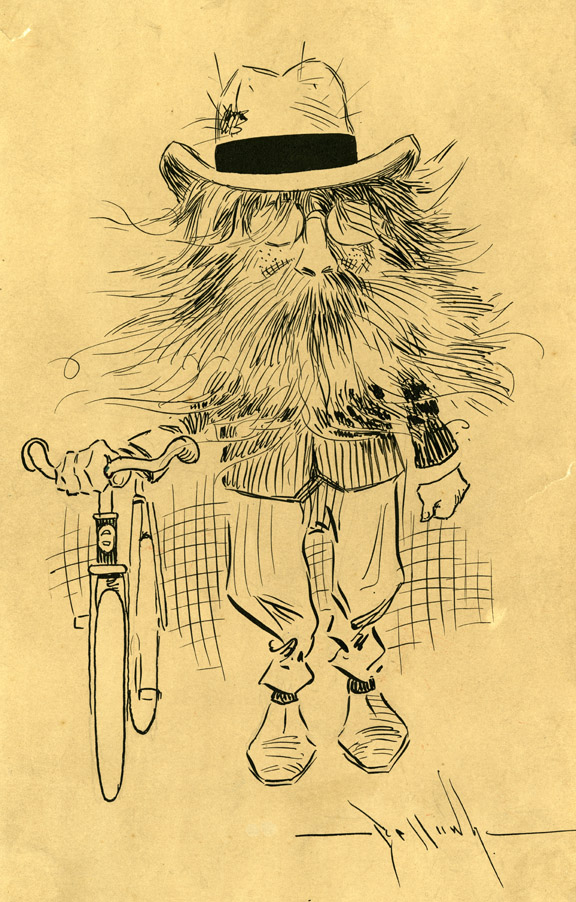
Bellows' sketch of Professor Nathaniel Lord, c1903

Bellows’ sketch of Professor Nathaniel Lord, c1903

Bellows graduated from Central High School before attending Ohio State from 1902 to 1904. Known as “Ho” Bellows to his fellow undergrads, the young artist spent much of his time participating in the Men’s Glee Club and the Baseball and Basketball teams, and he also served as art editor of the Makio, Ohio State’s yearbook. The 1904 Makio in particular bears his mark, with cartoons and illustrations throughout, including some rather entertaining sketches of his professors.

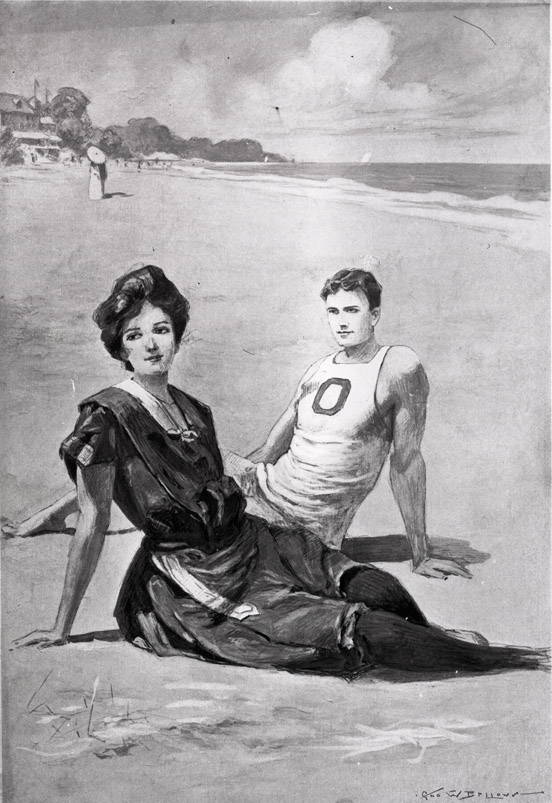
Bellows left Ohio State to attend the New York School of Art under Robert Henri, a leader of the American realism movement. While Columbus gave Bellows his start, New York was undoubtedly where he found his inspiration. There, he also met another art student, Emma Story, whom he later persuaded to marry him. His work developed, and his love of athletic contests of all varieties is recorded on canvas. He painted what he wanted to paint, without regard for fashion, style, artistic formula, the critics or popularity.

"Summer Day" by George Bellows, n.d.

“Summer Day” by George Bellows, n.d.

Sadly, George Bellows passed away all too soon at the age of 42 after an emergency appendectomy in 1925. It did not take long after his death for the museums to start clamoring for his work, and for critics to declare his work as some of the greatest examples of American art in the 20th century.

Last year, OSU Libraries and the Columbus Museum of Art partnered to acquire Bellows’ business ledgers in which he maintained meticulous records of his artistic production, including sales and exhibition showings.

          Filed by C.N.

Older posts Newer posts