From Woody's Couch

Our Playbook on OSU History

Category: Alumni (page 4 of 8)

Twelve Days: Archives donors deliver the goods – in so many ways

(In celebration of the University Archives’ upcoming 50th Anniversary in 2015, we bring you “The Twelve Days of Buckeyes.” This is day 9 in a series of 12 blog posts highlighting the people who were instrumental in the creation and growth of the Archives.)
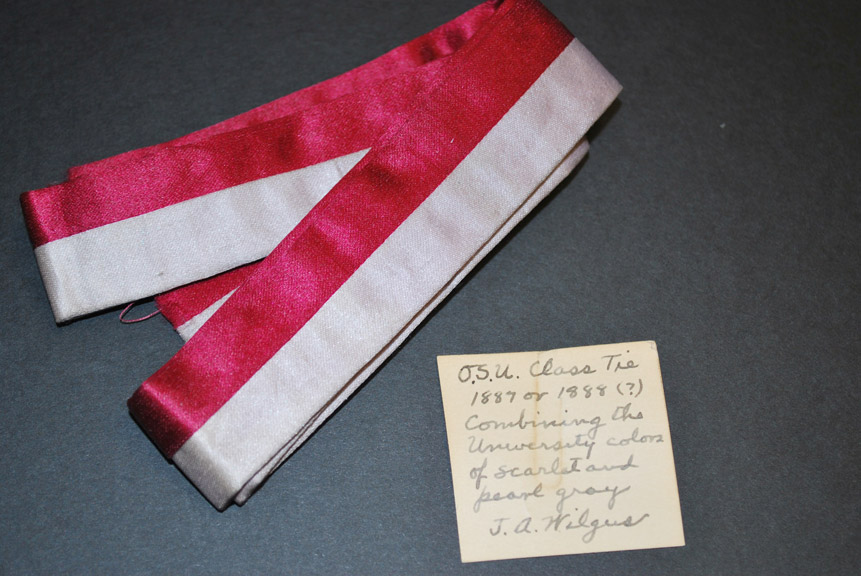
Wilgus' tie, c1887-1888

Wilgus’ tie, c1887-1888

We’d like to focus today on the unsung heroes of Archives everywhere: those individuals who decide the “old stuff” in their lives needs a more permanent home. So they take on the sometimes herculean task of finding just the right place and sending the materials there.

Take, for instance, Peggy Wymore. She has absolutely nothing to do with OSU, except for the important fact that her grandfather, James Alva Wilgus, earned his bachelor’s and master’s degree from OSU (1888 and 1889, respectively). He then spent many years in education, retiring from the State Teachers’ College in Wisconsin in June 1939 as a professor of History and Social Sciences. He died two months later.

Peggy Wymore, donor of Wilgus material

Peggy Wymore

So his OSU materials – the coolest thing is his scarlet-and-gray class tie –survived nearly 75 years, thanks to the Wilgus family, including Peggy, who was the last one to have these items in her possession and who contacted the Archives to see if we would want his things. We sure did. And, in fact, we were so thrilled, we wrote a blog about him.

Luckily for the Archives, there are many people like Ms. Wymore who can’t bear to discard such items as the class tie – an item we had never seen before – and they do the legwork to track down the Archives to ask if we want the materials. They carefully pack these items, often providing much-appreciated detailed explanations, then ship them to the Archives, often at their own expense, from all over the country.

Naddy's ROTC uniform

Naddy’s ROTC uniform

It is the explanation of an ROTC unifom that makes this particular donation stand out. In 2006, John Naddy donated the jacket, pants and hat he wore while he was in ROTC at OSU in the early 1940s. Back then, all male students had to take military science classes; however, at this particular time their training took on extra meaning since war was imminent. For Naddy, as with many young men of his generation, he recounted his story very matter-of-factly in a letter that is so priceless in its charm, and what it divulges about that time period, that we urge you to read it for yourself.

Then, there are the donors for whom it’s a no-brainer on where their precious keepsakes should end up permanently. Arthur “Jerry” Grundies was one such donor. Grundies was a varsity tackle who played OSU football under Coach Francis Schmidt from 1938 to 1940.

Grundie's football uniform

Grundies’ football uniform

Grundies at a 2008 football game

Grundies at a 2008 football game

Grundies didn’t play professionally after college; he went to war instead, serving in the U.S. Army in Italy and North Africa, and earning a Purple Heart and Bronze Star along the way. After the war, he became a sales representative for various oil companies in the region until his retirement. In 2002, Grundies donated his football uniform to the Archives – it’s the earliest version we have and one of the most often displayed items in our collection. He had a strong connection to OSU, so strong that the Archives received holiday cards from him until his death in 2010.

No matter why people donate materials to the Archives, we are extremely grateful that they do. Such artifacts are so helpful in helping us demonstrate through exhibits and tours the history of Ohio State, and we look forward to sharing them with our patrons and visitors for many years to come.

Twelve Days: Bradford had picture-perfect dedication to University photographs

(In celebration of the University Archives’ upcoming 50th Anniversary in 2015, we bring you “The Twelve Days of Buckeyes”. This is day three in a series of 12 blog posts highlighting the people who were instrumental in the creation and growth of the Archives.)

Joseph Bradford, c1883

Joseph Bradford, c1883

When University officials first asked Joseph Bradford to join the faculty, he turned them down. Thank goodness they named him an instructor anyway, or the Archives might not now have photos of the University from its early days.

Bradford was actually a graduate of OSU, earning a degree in Mechanical Engineering in 1883. He was a draftsman with the Pennsylvania Railroad when he was asked by the College of Engineering to organize a course in engineering drawing. Having no interest in being an instructor, he declined the offer. Nevertheless, the Board of Trustees named him an instructor in mechanical and freehand drawing in 1885, with a salary of $1,000 a year.

As a member of the faculty, he taught engineering drawing and architecture, and pioneered instruction in photography, with the first course in “picture-making” offered in the United States in 1890. By 1903 he had published “Photographic Notes for Students in the Ohio State University,” which explained the technical aspects of photography and gave helpful hints on how to be a better photographer.

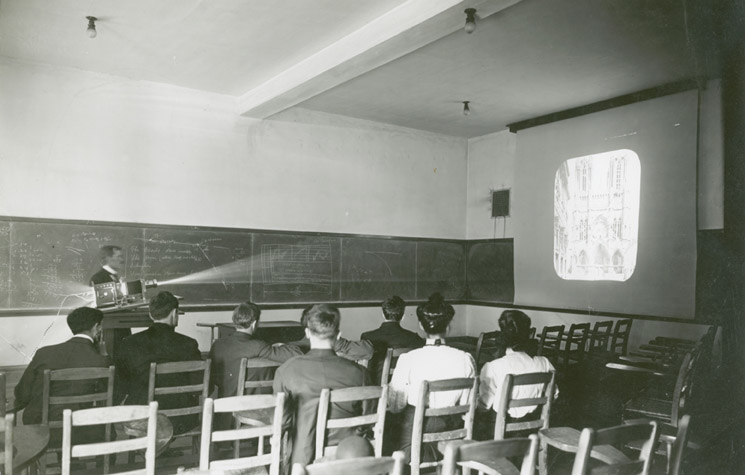
Bradford is shown here teaching a History of Architecture Class using the first electrical lantern slide projector at OSU. This class was held in Hayes Hall in 1895.

Bradford is shown here teaching a History of Architecture Class using the first electrical lantern slide projector at OSU. This class was held in Hayes Hall in 1895.

In 1911, Bradford was named University Architect, and he built an impressive portfolio in that area, designing 40 buildings on campus. His work includes such landmarks as Derby Hall, Jennings Hall (then the Botany and Zoology Building), the Kuhn Honors and Scholars building (then the president’s residence), Starling-Loving Hospital, and Sullivant Hall.

But his love of photography is what makes him special to the Archives.

F.W. Davis, Chair of the Department of Photography, and Joseph Bradford in the Photo History Vault in Brown Hall, 1940

F.W. Davis and Joseph Bradford in the Photo History Vault, 1940

In 1931, Bradford received approval from the Board of Trustees to start a Photographic History Unit in the Department of Photography. The unit’s purpose was to “make a complete photographic pictorial record of the progress of the University, its departments, and changes in its personnel,” according to a February 1931 Alumni Monthly article.

Bradford, who had been associated with the University since 1877 when he matriculated as a freshman, was made Emeritus Professor in 1932 and at that point took full charge of the Photo History Division. Bradford worked tirelessly organizing, filing and cataloging historical University photographs. He collected the earliest images from local photographers while also soliciting photographs from University staff and former students. By 1935, Bradford had accumulating about 16,000 prints and negatives. This collection was to eventually become the beginning of the University Archives’ photographs collection.

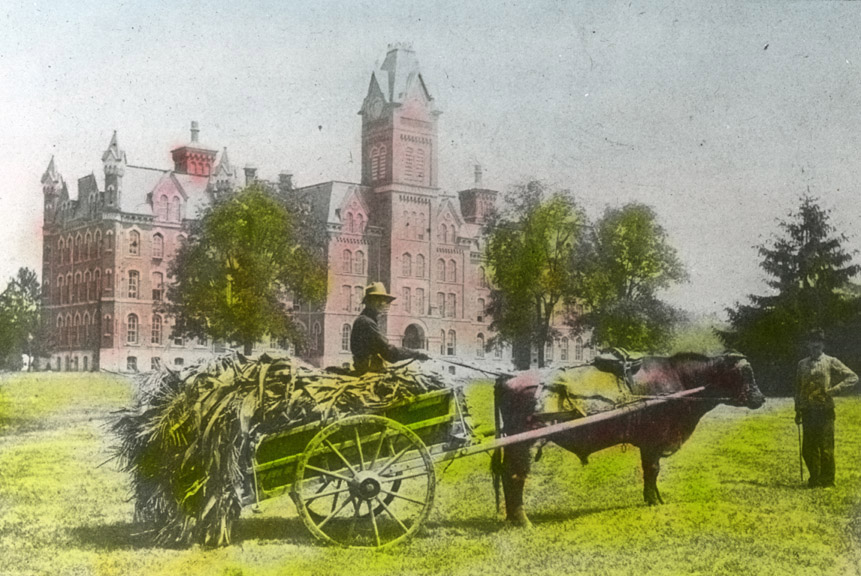
A hand-colored glass slide from Bradford's collection.

A hand-colored glass slide from Bradford’s collection.

Bradford also used his own campus photographs, even coloring some of them by hand. He was well known for giving his “Campus Memories” presentation, a Lantern slide show, which highlighted the early history of the University and included photos of buildings, geography, athletics, events, faculty and classrooms. You can see a sampling of the images from his Campus Memories slide show on the Archives’ Flickr gallery.

Bradford died in 1944. However, the Department of Photography continued to add to the collection he had worked so hard to build, photographing the buildings, faculty and grounds of the University.

In 1972 the photographic archives became part of the University Archives and now contains more than two million photographs depicting the history of the University from 1870 to the present time. Because of Bradford’s love of photography and his obvious dedication to the University, we can witness the enormous growth of a campus through his extensive collection of photos that are housed here at the Archives.

Alumni Weekend: An early class’s tale of reconnecting

Olive Branch Jones, 1912

Olive Branch Jones, 1912

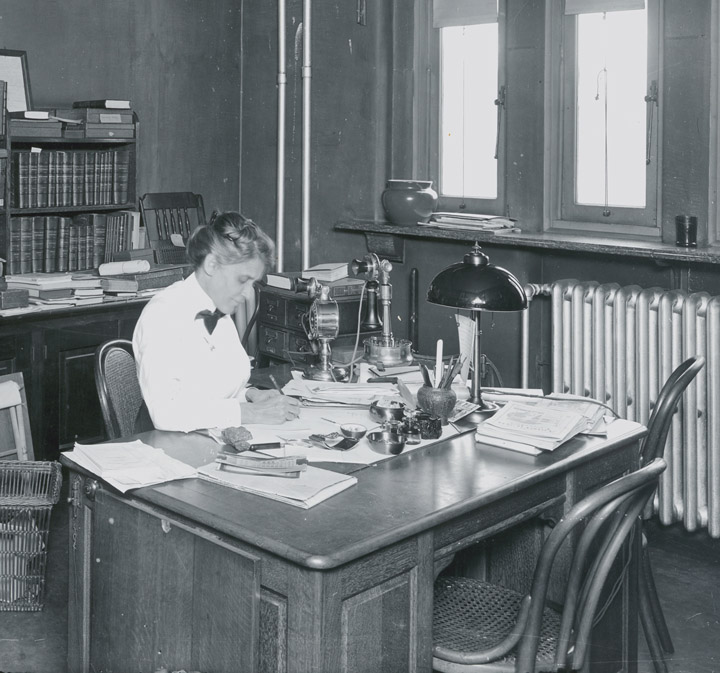
Today, with the vast number of students who graduate every year, it would be unthinkable for a class to gather in one publication the updates on lives and recollections from school days of its various members. But given the well-organized nature of the University’s librarian, it was almost pulled off for the Class of 1887’s 25th reunion.

In 1912, when the Class of 1887 was about to celebrate its 25th anniversary of graduation, Olive Branch Jones – by then the first full-time librarian for her alma mater, OSU – took on the task with a friend to publish a report on members of the class of 1887. It was actually that class’s treasurer, Joseph S. Myers, who had written to Jones telling her his plans of having a “history of ’87 prepared in this 25th Anniversary Year” and to have a sort of questionnaire sent out to all the 21 graduates. Myers and a fellow classmate, Joe Taylor, both agreed that they thought Jones, a fellow class member, could handle this job best.

Questionnaire for 1887 reunion; (Click to view larger version)

Questionnaire for 1887 reunion

For some reason, however, Jones was unable to pull it off. Maybe it was because it was the year before the then-main library was to open, and she was too busy as University Librarian preparing for that event.

But the questionnaire remains, and it is quite a relic of a bygone era. Respondents are asked what political party they belong to (Progressive or Reactionary), what church they belong to and whether they are a woman suffragist, among other things.

And Jones did receive some interesting letters from alumni, who were unable to attend the reunion but wanted to update their classmates on their current lives. One alumna, Daisy M. Scott, had for some time been a math teacher at North High School in Columbus, although there was one year when she was sent to Central and East high schools “to extricate some of their students from difficulties algebraic.” Joe Taylor marched down memory lane at first in his letter, then veered into waxing philosophic about the past: “…we don’t live there any more; we can’t stay in that familiar and peaceless place, the undergrad campus; a place so stripped of yesterdays … I am more able to say this because I have not achieved what we call great success; my own today is a very modest affair; yet so it seems, no doubt, to each of us.”

Heavy stuff. Luckily, for the class members who showed up at the actual reunion, the mood appeared to be much lighter. Along with discussions about a report, various letters were exchanged between Jones and Lucretia McPherson, wife of then-Graduate School Dean William McPherson, in which they decided also to hold a garden party in celebration. Roughly 50 people, including graduates’ family members and former faculty, apparently gathered on June 10, 1912, after which Lucretia McPherson wrote to Jones that it was “one of the most worthwhile parties, for the guests seemed to be so truly happy to see one another.”

Reunion group in front of University Hall, 1912

Reunion group in front of University Hall, 1912

– Filed by B.T.
Note: This information came from the Director of Libraries collection at the University Archives in a folder called “Class of 1887: 25th Anniversary: Correspondence for 1912 (Olive Jones)”

Older posts Newer posts