

(In celebration of the University Archives’ upcoming 50th Anniversary in 2015, we bring you “The Twelve Days of Buckeyes”. This is day two in a series of 12 blog posts highlighting the people who were instrumental in the creation and growth of the Archives.)

James Pollard, 1959
Though James Pollard’s main expertise was in journalism, his most important impact on OSU was because of his interest in history. Particularly OSU history, which would make sense since he was a three-time graduate of the University (B.A. 1916, M.A. 1917 and Ph.D. 1939).
Pollard first served as a Political Science teaching assistant from 1920-21, then Director of Ohio State’s News Bureau from 1923-33. He was an Associate Professor of Journalism from 1932-38, and Director and Professor of Journalism from 1938-58. Finally, he served as University Historian from 1958 until his retirement in 1965. After his retirement, however, he continued to work part-time as a consultant for the Office of Educational Services.
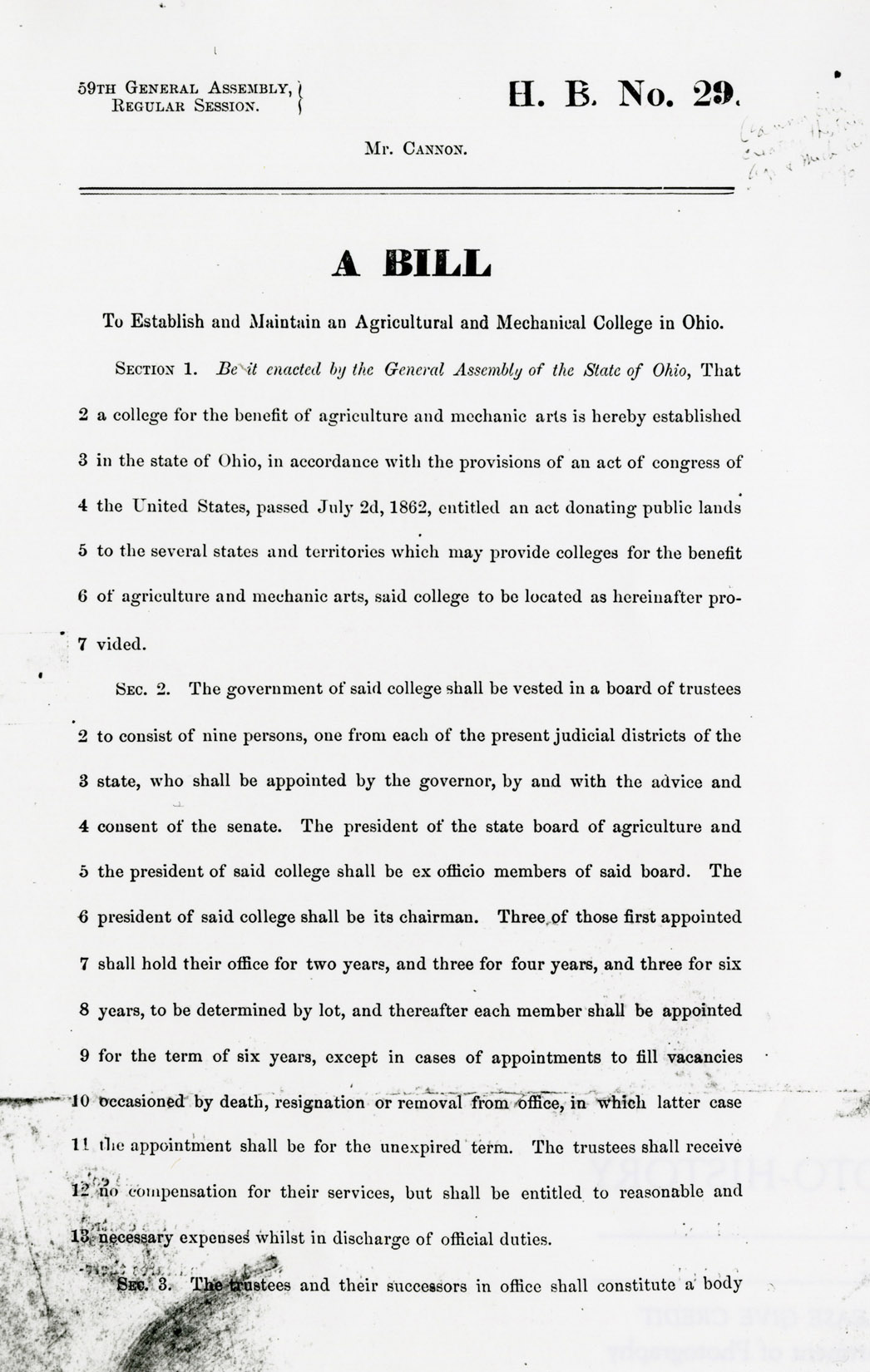
Along the way, Pollard wrote many articles and books, but he was especially interested in the history of OSU. In 1952, his book, History of the Ohio State University, 1873-1948 was published. It chronicled the formation of the Ohio Agricultural and Mechanical College, and its growth and development up to 1948. Soon after, Pollard also wrote biographies on former University Presidents Howard Bevis and William Oxley Thompson. By 1959, Pollard published yet another book about the University, this time about the history of athletics. Ohio State Athletics, 1879-1959 discussed how athletics were established at the university as well as how individual sports were developed.

Pollard (right), goes through files in the Administration Building, 1960
Pollard was not only interested in writing about OSU history, but – and the Archives staff is eternally thankful for this – he was interested in preserving its history. To write his books on OSU history, he had gone through correspondence and other historical documents that were spread all over the University at the time in vaults, basements and attics. Pollard knew that in such places, these unique materials would deteriorate with age. In one basement, in fact, he found records whose boxes had collapsed, and the contents were spilled in a heap on a damp floor. In another, he found a collection of records that had become shredded by the gnawing teeth of rats setting up house in them, according to a September 1960 Alumni Monthly article.
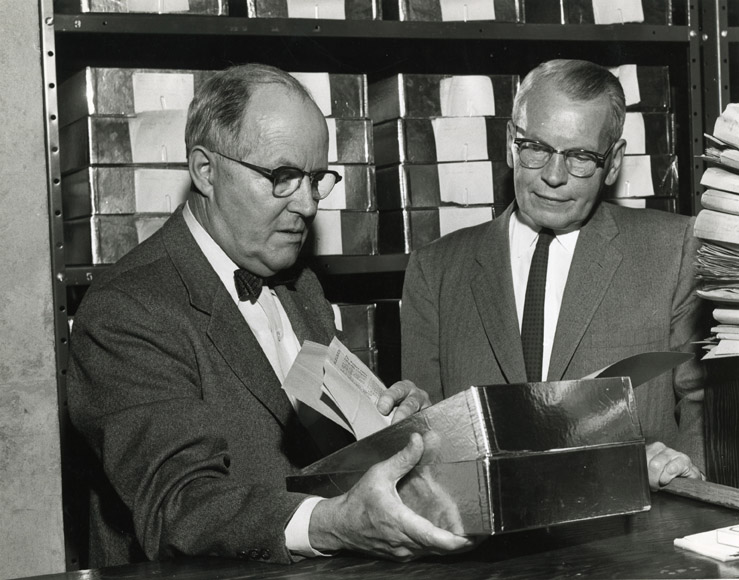
Pollard and Frederic Heimberger, Vice President for Instruction and Research, go through University Records stored at the Main Library, 1960
It took Pollard two years, but he finally convinced the administration to establish an archives where he could store and organize University materials, to be located on the top floor of the Thompson Library. His first task was to go through old file cabinets in the basement of Bricker Hall (then known as the Administration Building). There, he retrieved 24 file drawers of what would become the William Oxley Thompson Papers, now one of the most frequently used collections here at the Archives.





Recent Comments