From Woody's Couch

Our Playbook on OSU History

Category: Departments (page 4 of 16)

Twelve Days: Kleberg’s true colors shine through as a donor

(In celebration of the University Archives’ upcoming 50th Anniversary in 2015, we bring you “The Twelve Days of Buckeyes.” This is day 10 in a series of 12 blog posts highlighting the people who were instrumental in the creation and growth of the Archives.)
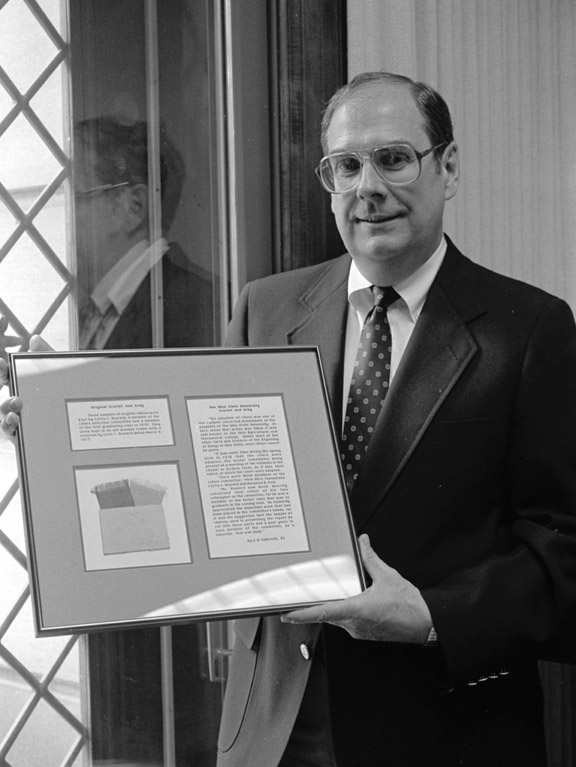
John Kleberg with the scarlet and gray ribbons, 1989

John Kleberg with the scarlet and gray ribbons, 1989

There is nothing more synonymous with being a Buckeye than the colors Scarlet and Gray. And the person Buckeyes can thank for preserving the earliest beginnings of those OSU colors is John Kleberg.

First, a little background on Kleberg: He came to OSU in 1973 as associate director of Public Safety, taking charge of the operations side of the Campus Police unit. In 1981, he was appointed as director of the University’s internal audit unit in the Office of Business and Finance.

Although his background is in law enforcement, he has been heavily involved in preserving OSU history since his retirement in 2000 as assistant vice president of Business and Finance. (He returned in 2001 as Special Assistant to the Vice President of Student Affairs.) For instance, he’s served on the committee that coordinated the program to record, preserve and restore works of art on campus. He’s also spent much of his university-related time after retirement in raising money and awareness for the historic Cooke Castle on Gibraltar Island in Put-in-Bay.

Cooke Castle was built by Jay Cooke, the Civil War financier who bought Gibraltar Island in 1864. There, the family entertained such dignitaries as Supreme Court Chief Justice Salmon P. Chase, President Rutherford B. Hayes and General William Tecumseh Sherman. In 1925, Cooke’s daughter, Laura Barney, sold Gibraltar Island to then-OSU Board of Trustees member, Julius Stone, who immediately donated the property to the University to house a lake research facility that would become Stone Lab.

Cooke Castle, 2001

Cooke Castle, 2001

Kleberg has worked tirelessly to restore the historic Cooke Castle, and in fact, with his help, the first floor of the Castle, which had been closed for a number of years, is now open to the public at certain times. The Archives also has benefited from Kleberg’s interest in Cooke Castle; three years ago, he gave us a number of materials he’d gathered on Jay Cooke.

Kleberg has given a myriad of items to the Archives over the years. They often represent the more mundane history of a large educational institution – an old class microscope he picked up at a University surplus auction or two police badges from the Department of Public Safety.

Then, there was the truly one-of-a-kind historical artifact he donated that makes him a standout among donors: the original scarlet-and-gray ribbons that adorned the diplomas of the first graduating class in 1878.
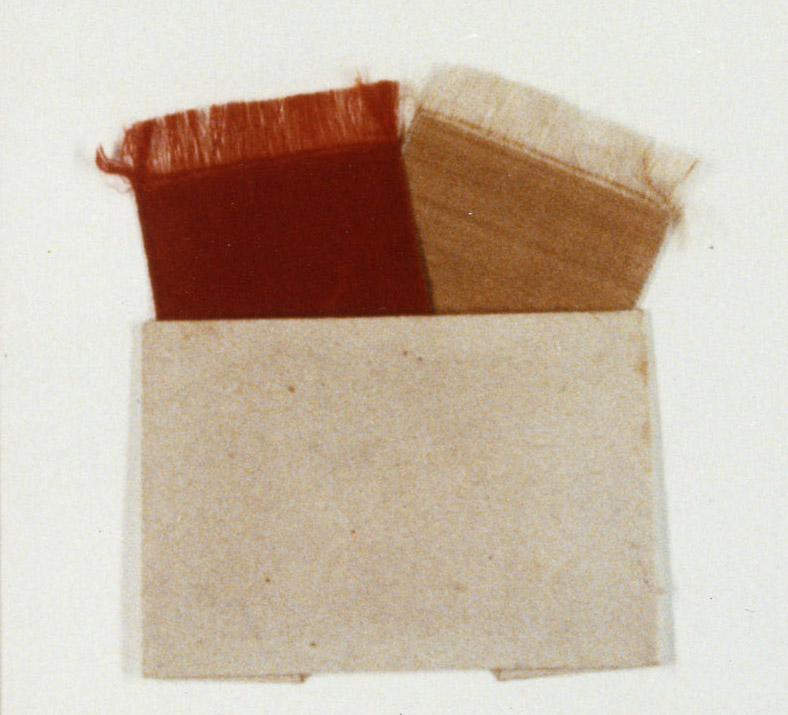
Original scarlet and gray ribbons

The original scarlet and gray ribbons

When it was almost time for Commencement that year, the class assigned a committee of three to pick out a pair of sample ribbons to determine which color of ribbons would be tied around the diplomas. The original pair of scarlet-and-gray ribbons they chose were cut into three parts, and a section was given to each committee member as a memento. Years later, one of the members – Curtis Howard – found his and presented them to the University in a frame with a letter attached to the back explaining their significance. They were hung in Sullivant Hall, but as sometimes unfortunately happens, the framed ribbons went missing at one point.

In the late 1980s, a gentleman identifying himself only as an attorney representing an estate in Florida, showed up in Kleberg’s office with the ribbons and some documentation. Kleberg did some subsequent research and determined they were most probably part of the original ribbons. And then, he made sure they made it to the Archives.

Without his dedication to preserving OSU history, those ribbons may have ended up in Kleberg’s wastepaper basket, and Buckeyes would not have these priceless reminders of how we became so devoted to Scarlet and Gray. So for all his contributions to OSU, we give him a hearty thanks from the Archives!
Twelve Days: Archives donors deliver the goods – in so many ways

(In celebration of the University Archives’ upcoming 50th Anniversary in 2015, we bring you “The Twelve Days of Buckeyes.” This is day 9 in a series of 12 blog posts highlighting the people who were instrumental in the creation and growth of the Archives.)

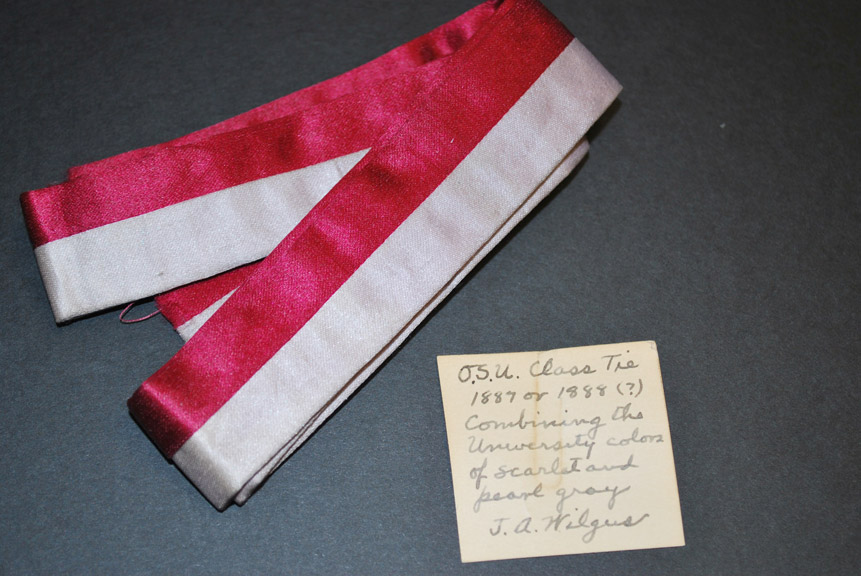
Wilgus' tie, c1887-1888

Wilgus’ tie, c1887-1888

We’d like to focus today on the unsung heroes of Archives everywhere: those individuals who decide the “old stuff” in their lives needs a more permanent home. So they take on the sometimes herculean task of finding just the right place and sending the materials there.

Take, for instance, Peggy Wymore. She has absolutely nothing to do with OSU, except for the important fact that her grandfather, James Alva Wilgus, earned his bachelor’s and master’s degree from OSU (1888 and 1889, respectively). He then spent many years in education, retiring from the State Teachers’ College in Wisconsin in June 1939 as a professor of History and Social Sciences. He died two months later.

Peggy Wymore, donor of Wilgus material

Peggy Wymore

So his OSU materials – the coolest thing is his scarlet-and-gray class tie –survived nearly 75 years, thanks to the Wilgus family, including Peggy, who was the last one to have these items in her possession and who contacted the Archives to see if we would want his things. We sure did. And, in fact, we were so thrilled, we wrote a blog about him.

Luckily for the Archives, there are many people like Ms. Wymore who can’t bear to discard such items as the class tie – an item we had never seen before – and they do the legwork to track down the Archives to ask if we want the materials. They carefully pack these items, often providing much-appreciated detailed explanations, then ship them to the Archives, often at their own expense, from all over the country.

Naddy's ROTC uniform

Naddy’s ROTC uniform

It is the explanation of an ROTC unifom that makes this particular donation stand out. In 2006, John Naddy donated the jacket, pants and hat he wore while he was in ROTC at OSU in the early 1940s. Back then, all male students had to take military science classes; however, at this particular time their training took on extra meaning since war was imminent. For Naddy, as with many young men of his generation, he recounted his story very matter-of-factly in a letter that is so priceless in its charm, and what it divulges about that time period, that we urge you to read it for yourself.

Then, there are the donors for whom it’s a no-brainer on where their precious keepsakes should end up permanently. Arthur “Jerry” Grundies was one such donor. Grundies was a varsity tackle who played OSU football under Coach Francis Schmidt from 1938 to 1940.

Grundie's football uniform

Grundies’ football uniform

Grundies at a 2008 football game

Grundies at a 2008 football game

Grundies didn’t play professionally after college; he went to war instead, serving in the U.S. Army in Italy and North Africa, and earning a Purple Heart and Bronze Star along the way. After the war, he became a sales representative for various oil companies in the region until his retirement. In 2002, Grundies donated his football uniform to the Archives – it’s the earliest version we have and one of the most often displayed items in our collection. He had a strong connection to OSU, so strong that the Archives received holiday cards from him until his death in 2010.

No matter why people donate materials to the Archives, we are extremely grateful that they do. Such artifacts are so helpful in helping us demonstrate through exhibits and tours the history of Ohio State, and we look forward to sharing them with our patrons and visitors for many years to come.

Twelve Days: From production to preservation, film pioneer left his mark on Archives

(In celebration of the University Archives’ upcoming 50th Anniversary in 2015, we bring you “The Twelve Days of Buckeyes.” This is day 8 in a series of 12 blog posts highlighting the people who were instrumental in the creation and growth of the Archives.)

Robert Wagner, 1961

Robert Wagner, 1961

The University Archives was in its infancy when Robert W. Wagner became Chair of the Department of Photography and Cinema in 1966. But Wagner’s leadership in the development of using motion picture film as an effective tool in communication and teaching, would ultimately lead to enriching the Archives’ audiovisual collections to what they are today.

First, a little background: Wagner came to Ohio State as an undergraduate and received three degrees from the University: his bachelor’s in 1940, a master’s in 1941 and a PhD in 1953. He began his career at Ohio State in 1941, as an assistant in the former Bureau of Educational Research.  He became a faculty member of photography in 1946, and then chaired the Department of Photography and Cinema from 1966 to 1974.

Wagner was noted as a “film-television educator whose contributions to curriculum, technique and professionalism have been recognized throughout the world.” Not only were hundreds of educational films – now housed in the Archives – produced under his chairmanship, Wagner also had an intense interest in the work archivists did in preserving photographs and motion picture film.

In 1968, Wagner presented a paper at a meeting of the Society of American Archivists regarding preservation concerns and dangers of nitrate-based films. (Nitrate film, produced from the 1880s to the 1950s on 35mm film, was made with a cellulose nitrate base, which is highly flammable and sometimes explosive under certain circumstances.)

“Today, at this moment, the record of a whole field of human effort is on fire: yet so few people are concerned that the remains are likely to crumble to a foul-smelling brown dust before the holocaust can be made public, let alone put out or even controlled….If we fail to plan for the future as well as the past, we shall perpetuate and accelerate the loss of our film and television heritage”.

Wagner’s compelling and persuasive presentation must have given archivists of the time a lot to think about.

1983

1983

Though his numerous achievements in teaching, film production and research throughout his career could have made for a comfortable retirement, Wagner’s story did not end there. Far from it.

Wagner gained the title of “emeritus professor” in 1984 and continued his quest of film education, believing that every film, video or photography studio or study center in major universities should include a course or seminar on the topic of the preservation of media. He pursued this topic, teaching film preservation workshops to graduate students and to librarians.

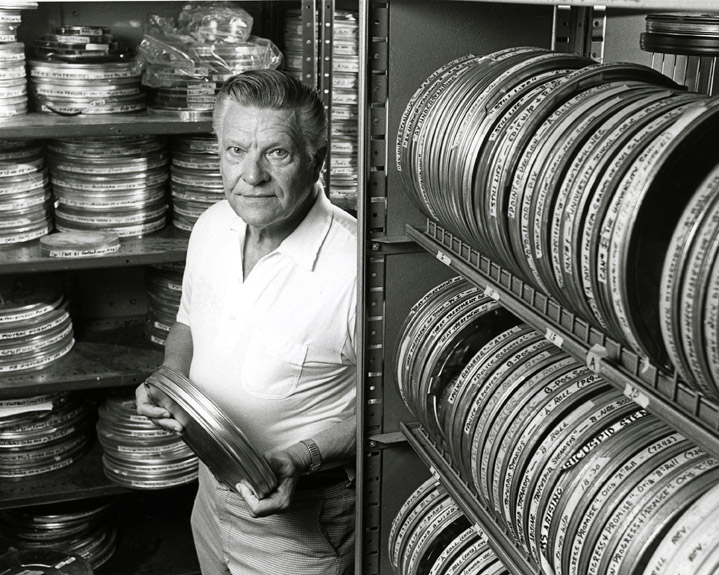
More than a decade after retirement, Wagner became a volunteer for the University Archives and the Byrd Polar Research Center Archival Program. He spent many hours hunched over a small manual film viewer, watching and describing early color film shot during Admiral Richard E. Byrd’s Expedition in Antarctica in the 1930s. Consequently, he later assisted the Polar Curator in secure a grant to preserve the expedition films.

1987

1987

He also worked with the University Archives’ collection of Photography and Cinema motion picture films, describing and transcribing them so that they would be more accessible to researchers. Working tirelessly to document the physical condition of the film in the Archives, he passed this information along to staff to continue the legacy. He also frequently served as the Archives’ consultant on audiovisual resources, and often visited the Archives to work with patrons interested in film.

On many occasions, Wagner served as mentor to Archives staff members, educating them on the identification, handling, and preservation of film. In a memorable display of hands-on teaching, he showed an Archives staff member how quickly a small piece of nitrate film could burst into flames (in the Archives parking lot, of course).

The Archives staff is eternally grateful for the contributions made from this great film pioneer. We leave you with one of his quotes:

“The worthy though unrewarding task is to protect and perpetuate our motion picture heritage – a form of human communication, creating expression and historic documentation so unique to the United States that cinema has almost become our second “language.” The job is to preserve this heritage on film, this visual literature for our time and for the future.” – Robert W. Wagner, The American Archivist, 1969

We could not have said it better.

Wagner died on February 7, 2011.

You can find several films from the Department of Photography and Cinema on the Libraries Knowledge Bank.

Older posts Newer posts