From Woody's Couch

Our Playbook on OSU History

Category: Departments (page 15 of 16)

Home Ec students fight against exclusion

Wilhelmina Styles, 1932

Wilhelmina Styles, 1932

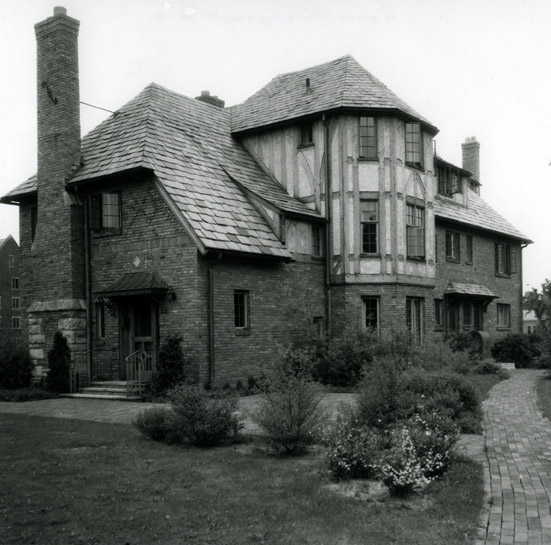
In 1921, the Department of Home Economics established a Home Management House to teach women students how to run an efficient home, as well as life skills, such as finances, nutrition, and child care. Students received credit for instruction in the laboratory center, where they lived together for roughly six weeks in a staged home environment.

Ten years later, Wilhelmina J. Styles, an African-American student, requested permission in May 1931 to seek admittance for practical training in the House for the autumn quarter. She was refused admission. (Although there was no set rule barring African-American students from campus housing, they instead lived in boarding houses or private homes.) Despite protests from local officials, business leaders and religious organizations, then-OSU President George Rightmire supported the decision; Styles was asked to substitute another Home Ec course for the home-management graduation requirement.

Doris Weaver, 1933
Doris Weaver, 1933

Home Management House, 1937

Home Management House, 1937

In May 1932, Doris Weaver applied for a reservation in the House and was accepted for the autumn quarter. Subsequently, after learning Weaver was African-American, the department withdrew Weaver’s confirmation for participation in the House.

Then, Ohio Rep. Chester K. Gillespie, the only African American in the Ohio General Assembly at the time, intervened on Weaver’s behalf with a series of letters to Rightmire. He also asked that the state legislature begin an investigation for possible discrimination. Shortly after, the OSU Interracial Council – made up of student representatives of the YMCA, YWCA, International Club and Council of Women, among others – filed a protest in support of Gillespie’s charges discrimination based on race.
President Rightmire, 1932

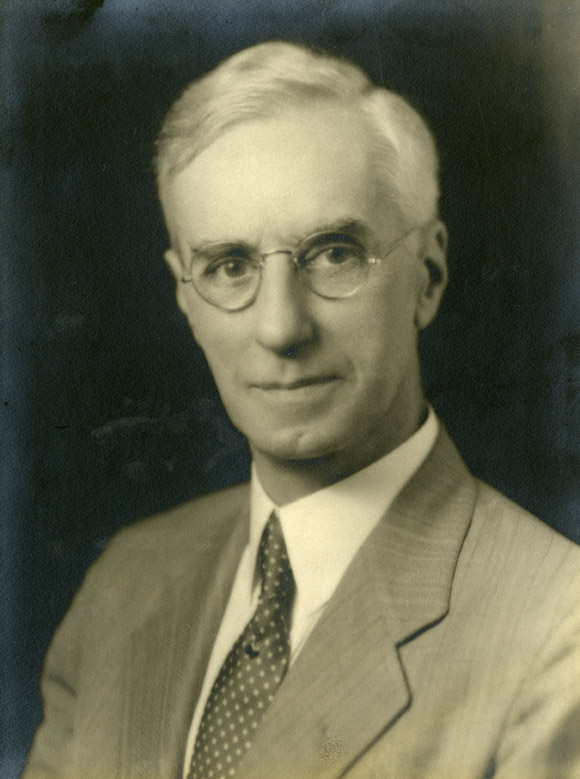
President Rightmire, 1932

At a subsequent hearing before a House committee, Rightmire denied barring Weaver from the House because of her race. He said she had been offered exclusive use of part of the house but had refused the offer.

Gillespie then threatened to revoke funding to OSU because African-American students were not allowed to participate equally in the House program. Eventually, Weaver’s case went to the Ohio Supreme Court, which supported Rightmire’s assertion that Weaver was not being denied equal opportunity since she and other African-American students were offered exclusive use of certain sections of the house.

The ruling did not deter Weaver from continuing her studies; she received a bachelor’s degree in Home Economics in March 1933 and went on to earn a master’s degree in 1936. According to a 1981 interview, she taught at Wilberforce University for seven years – along with Wilhelmina Styles – in that university’s Department of Home Economics.

For more information on these women and other African-American students’ experiences at OSU, please see Pamela Pritchard’s 1982 dissertation: “The Negro Experience at the Ohio State University in the First Sixty-Five Years, 1873:1938, with Special Emphasis on Negroes in the College of Education.”


Twelve Days of Buckeyes: “3” apparently is a charm for the chemistry department

1887_chemistry_1_fire_damage

Chemistry Building #1 after fire, 1887

OSU’s chemistry department got off to a rocky start: Originally housed on the third floor of University Hall, it was soon moved to a newly constructed building on the site of, most recently, Brown Hall. When a fire started in the department’s new building in 1887, the whole structure burned down because of a lack of water to extinguish the flames.

The next chemistry building was built two years later on the site of the present Derby Hall. It burned down in 1904. A recounting of the incident said there were “ludicrous happenings due to excitement” that occurred that night.

Chemistry Building #2, 1904

Chemistry Building #2, 1904

Apparently, the firefighters were afraid of the chemicals housed in the building, so they did not try to put out the flames (whether or not the chemicals were a threat is not known). However, that did not stop students from entering the burning building and attempting to save the contents, including bottles of distilled water.

The third chemistry building, now known as Derby Hall, was rebuilt in 1906 on the site of its predecessor. It, too, caught fire soon after it was completed; however, the building was saved. Its first addition was, of course, a fire-proof storage shed for the chemicals. No doubt this helped to break the curse.


Filed by C.N.

Not so long ago, in an OSU engineering lab nearby…

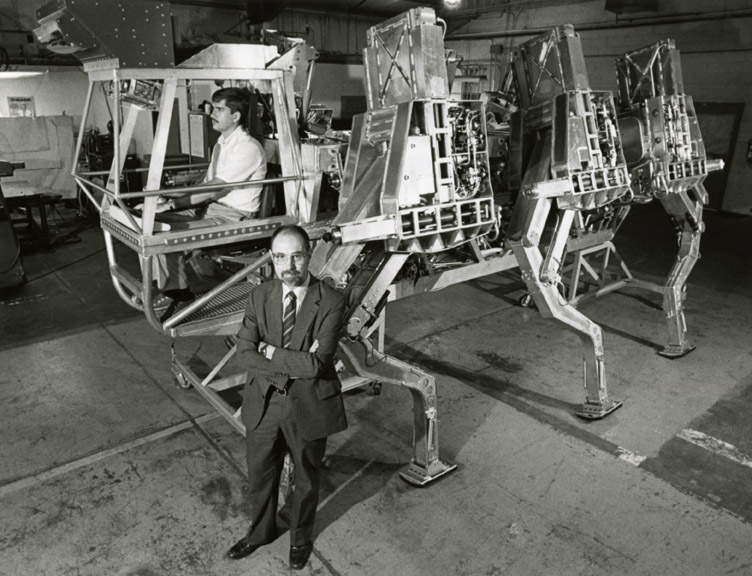
What do you get when you combine 20 years of research, $5 million, and a Star Wars Imperial all-terrain vehicle? Ohio State’s Adaptive Suspension Vehicle (ASV), nicknamed the “Walker.”   Developed by electrical engineer Robert McGhee and mechanical engineer Kenneth Waldron, along with a 60-member team of students and technical assistants, the ‘Walker’ was developed under a research contract from the Defense Advanced Projects Research Agency (DARPA).

Robert McGhee with the “Walker”, 1985

The ASV was 17 feet long, 8 feet wide, and 10.5 feet high, and had six legs to support its three-ton aluminum body.  It was designed to carry cargo for industrial and military applications over rough, mountainous, icy or muddy terrain, and was capable of crossing 9-foot-wide ditches or 7-foot-high walls.  A forward mounted radar system scanned the terrain ahead, and fed that data, along with instructions from the operator’s joystick, into the 16 onboard computers that coordinated and controlled the ASV’s legs. From there, the computers moved each leg individually across its individual axes of motion (up and down, forward and back, and closer or farther from the ASV’s body).

According to press clippings here at the Archives, McGhee, the developer, had long held an interest in the relationship between living creatures and machines, and the inspiration for the ASV came from the legs of a horse named Teddy he had bought for his daughter’s 10th birthday. Much of what McGhee learned from his time as an engineer and from Teddy went into the design of the ASV.

Research testing, 1986

After difficulties with cold-weather tests, DARPA began to lose interest in the ASV.  After failing to win a competition for an autonomous rover for NASA, Ohio State later began exploring the vehicle’s use in the logging industry. Unfortunately, that’s where the paper trail ends here at the Archives. If anyone knows the rest of the story, give us a shout!

Older posts Newer posts