From Woody's Couch

Our Playbook on OSU History

Category: Campus locations (page 7 of 9)

On its 100th birthday, we celebrate Thompson Library’s humble beginnings

Olive Jones, 1900

Olive Jones, 1900

It’s hard to imagine what the Oval would be like without Thompson Library towering over its west end, but if the University’s first full-time librarian had had her way, the campus’ main library would have been located away from its apex, near where the Faculty Club now stands. Fortunately, former OSU President James Canfield convinced her otherwise:


 “I was much interested in what Mr. Reeder told me of the proposed library building and in what you write about it: but you must not let it go off campus,” he wrote in a 1908 letter to Olive Branch Jones when he was Librarian of Columbia University. During his 1895-1899 tenure as OSU President, he had proposed putting the library in its current position, since it would be the heart of the University and deserved a central location. 
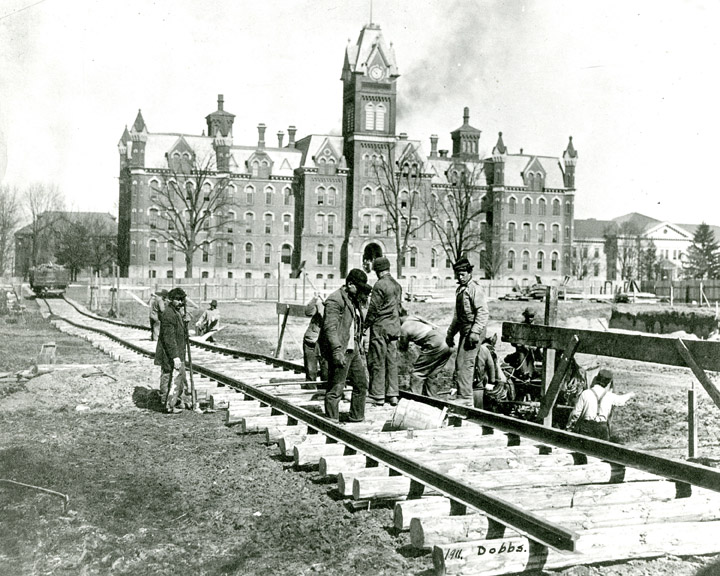
 

Main Library construction, 1911

Main Library construction, 1911

 The Board of Trustees agreed with him, and in 1913 what was then known as the “New Library” opened. It cost $314,515 to build. To get the heavy stone and other construction materials to the site, the construction company used a railroad spur, which had been built in 1909 from the Hocking Valley Railway to the University’s power plant. It was used to transport coal and other materials to the power plant, first at Brown Hall and later at the McCracken Power Plant. It ran down the middle of what is now Woody Hayes Drive from Olentangy River Road.


 (Today, a median filled with flower beds occupies the space taken by the tracks, which also were used to transport passenger cars for football games, particularly OSU vs. Michigan. The last vestiges of the railroad disappeared in 1970 when the power plant transitioned to natural gas from coal, and the spur was removed as part of the 315 highway construction project, which had originally been the path of the main railroad.)


Library, 1915

Library, 1915

 Before the “New Library” opened – on Jan. 6, 1913 – an ambulance from the Department of Animal Husbandry was used to move about 100,000 books to Thompson from Orton Library, which served up until that point as the main library. When it opened, the library had only three floors, two elevators, and no electric lighting. It was officially named the William Oxley Thompson Memorial Library, in honor of the fifth president of the university, in 1951, when its 11-story stacks were built. The Thompson Library now contains roughly 6 million volumes.


Filed by C.N.
OSU poured efforts into cleanup, reconstruction after 1913 flood

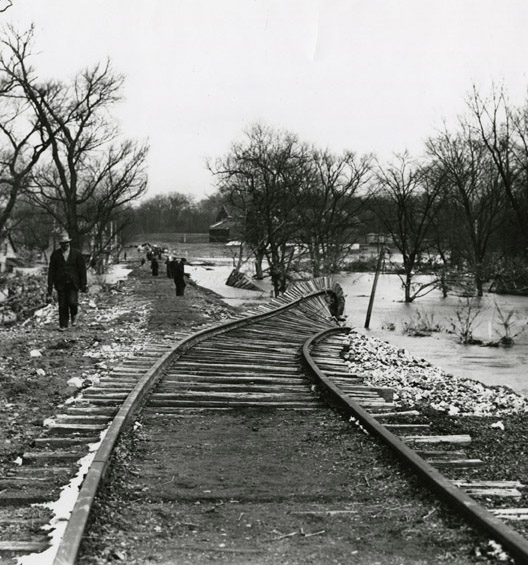
Railroad damage from flood, 1913

Railroad damage from flood, 1913

Cities with rivers flowing through them have always been subject to flooding, and with two rivers that meet downtown – the Olentangy and Scioto – Columbus is no exception. The year 1913 sticks out in particular, however, for the amount of destruction and loss of life caused by such a weather event. Statewide, the flood killed nearly 500 people and destroyed or damaged 40,000 homes. It is why it is still considered Ohio’s most significant weather disaster.

In Columbus, flood-warning bells began ringing on March 24, which was Easter Sunday. River waters had started rising the day before and did not start receding until March 27. All totaled, 88 Columbus residents died, and thousands were rendered homeless. Damage was extensive, with only one bridge (Rich Street) linking Columbus’ West Side to the rest of the city.

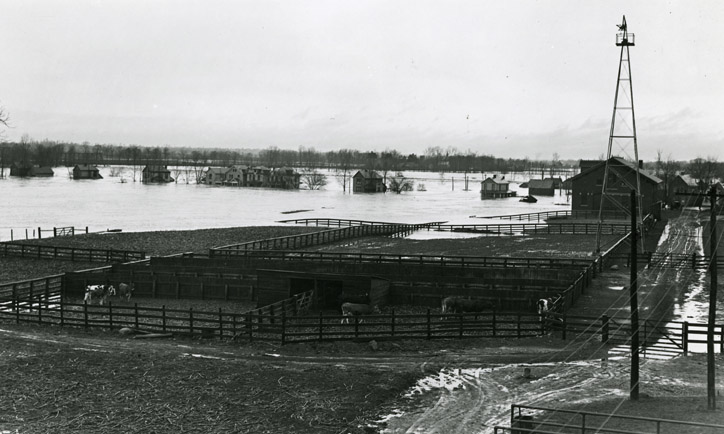
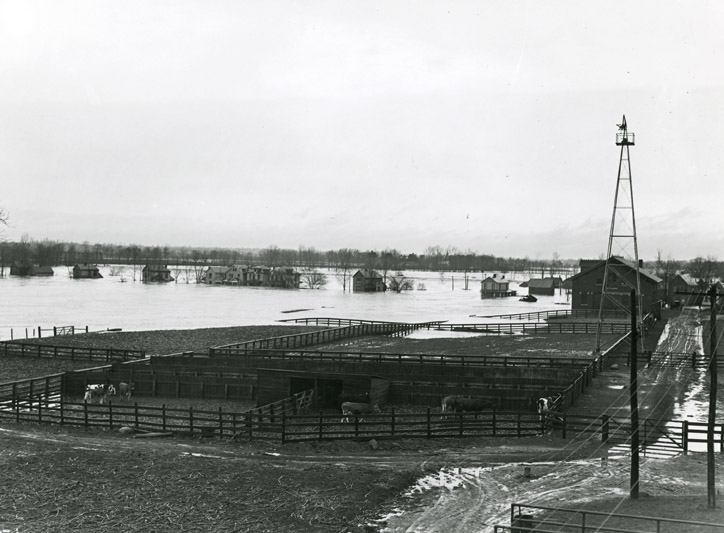
Campus came through relatively unscathed: The water reached the foundations of a few agriculture buildings at the corner of Neil and Woodruff Avenues, but all of the livestock survived, and overall damages were estimated at less than $10,000. The week after the flood, the University closed only that Wednesday – because of a lack of city water – but classes did not resume normally for at least another week after that because of ongoing relief efforts.

Flood waters on campus

Flood waters on campus

University President William Oxley Thompson first offered the service of the University students in the military science program, who would work under the supervision of University Commandant George L. Converse. The student cadets worked 24-hour shifts to evacuate families from their flooded homes, mostly on the West Side. In addition, University female staff members and students worked to prepare meals, gather and distribute clothing and necessities, and help organize relief efforts. Instead of holding classes, some professors took students to help with relief efforts

Indeed, President Thompson encouraged them by organizing two days devoted to volunteer work, saying that such circumstances only come about once in a generation, and that teaching civic responsibility was certainly one of the finer points of higher education. Students continued to volunteer after the floods had receded and the clean-up had begun.

Later, student arts groups, such as Strollers, organized performances to help raise money for those affected. Meanwhile, the College of Engineering faculty and students began making plans to aid in repairing the levee and rerouting the Scioto River. Faculty in the Department of Forestry also lobbied the state legislature to encourage forest conservation and reforestation to prevent future flooding.

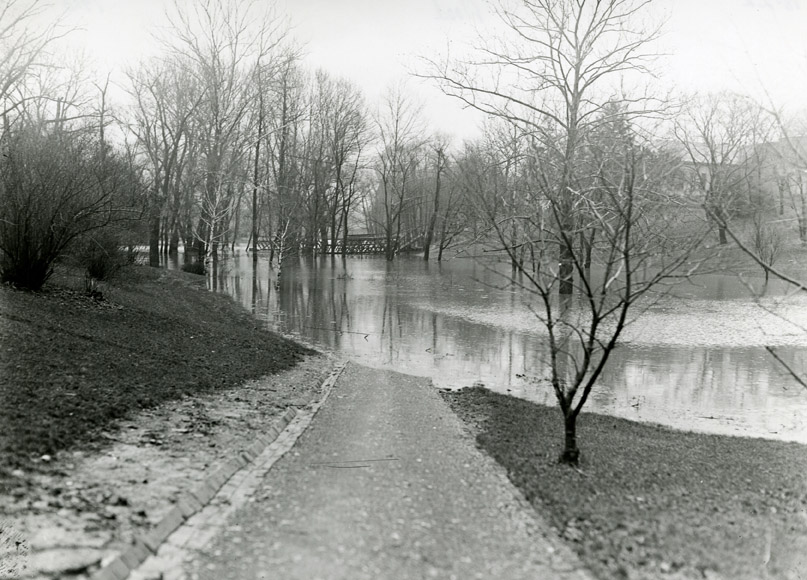
Flood covering pathway to Mirror Lake

Flood covering pathway to Mirror Lake

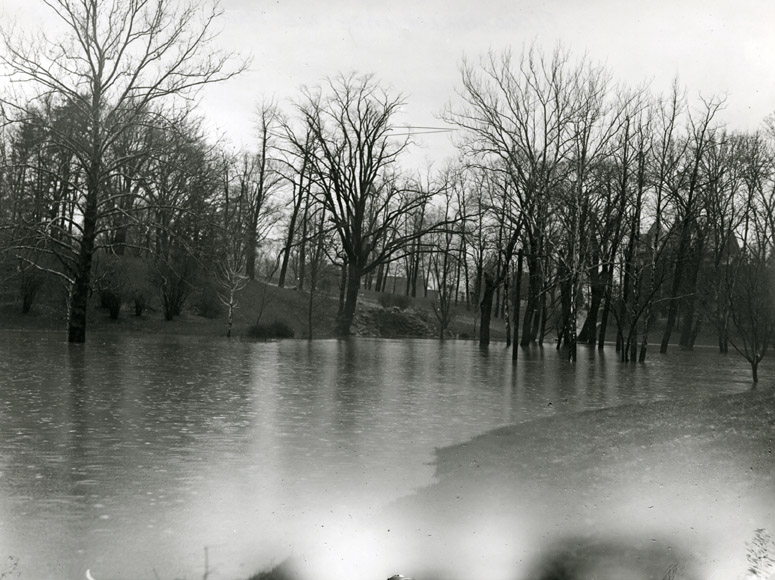
Mirror Lake flooding

Mirror Lake flooding

Damage to railroad, 1913

Damage to railroad

Filed by C.N.

A River Runs Through It: The Olentangy’s place in campus history

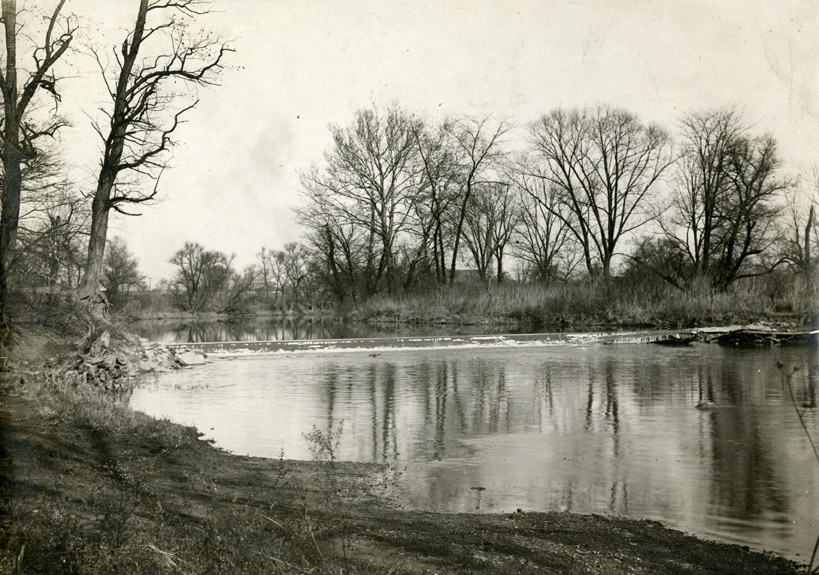
Olentangy River, 1913

The waterway we know as the Olentangy was called the Whetstone River by early settlers, and the Delaware Indians had a permanent camp just north of the present campus on its floodplains.

At the time the Board of Trustees purchased the Neil Farm in 1870 for the future site of campus, the Olentangy had a significantly different pattern; in fact, it flowed right through the area now occupied by Ohio Stadium. There was also a marsh, measuring about six acres, in the southwest section of the University’s original land purchase.

Much of the land on either side of the river was a natural flood plain, which supplied nutrients to the farmland, but could prove dangerous for people and livestock after heavy rains. Because of such flooding, the University and the State of Ohio have made a number of significant changes to the area around the river.

As early as 1884, the Board of Trustees set aside funds to repair a damaged levee. In 1879 the University drew up plans for “improving” the river; the plan included a dam north of campus, but the University did not own the land—yet. The University spent $607 to purchase about 12 acres; the Ohio General Assembly then gave a further $1,500 for the river project.  The dam was then built.

In March 1913, however, much of the west side of Columbus, and vast portions of the University’s farmland were flooded. Nearly 500 people lost their lives, and 100,000 lost their homes to the floods. No one on campus was hurt, and no livestock was lost, but the University was still affected.

Flooding on campus, March 1913

Just before the flood, most students had gone home for Easter, returned to campus Monday, and flooding began on Tuesday. On Wednesday, classes were cancelled, and for the next few days professors took their classes all over the city to assist in relief efforts. Students in home-economics classes prepared meals, residents of the women’s dorms sorted clothing and served meals.  OSU President William Oxley Thompson and Commandant George Converse volunteered male students in the University’s military science courses to assist the Ohio National Guard Troops throughout the city. Others helped with the clean-up. Damages on campus were said to have been close to $10,000, plus the $3,000 cost of keeping the power plant operating.

The University attempted to fix the recurrent flooding problem by rerouting the river, which then created a spot to build the Ohio Stadium. But the problem of flooding was far from over: significant floods occurred again in 1922, prompting the creation of a dike in 1923 along the river (along where Cannon Drive now runs). The river was also widened, as part of a WPA project. The result is what you see today—but not for long.

Flooding in 1922

Dike being built next to Olentangy, 1923


The Olentangy River restoration project, part of the One University Framework Plan, is set to restore the river to its natural flow and reconstruct some of the wetlands on the west bank. To accomplish this, the 5th Avenue dam, which was originally built to serve the University Power Plant, will be removed.

Filed by C.N.

Older posts Newer posts