From Woody's Couch

Our Playbook on OSU History

Category: Oval (page 2 of 2)

On its 100th birthday, we celebrate Thompson Library’s humble beginnings

Olive Jones, 1900

Olive Jones, 1900

It’s hard to imagine what the Oval would be like without Thompson Library towering over its west end, but if the University’s first full-time librarian had had her way, the campus’ main library would have been located away from its apex, near where the Faculty Club now stands. Fortunately, former OSU President James Canfield convinced her otherwise:


 “I was much interested in what Mr. Reeder told me of the proposed library building and in what you write about it: but you must not let it go off campus,” he wrote in a 1908 letter to Olive Branch Jones when he was Librarian of Columbia University. During his 1895-1899 tenure as OSU President, he had proposed putting the library in its current position, since it would be the heart of the University and deserved a central location. 
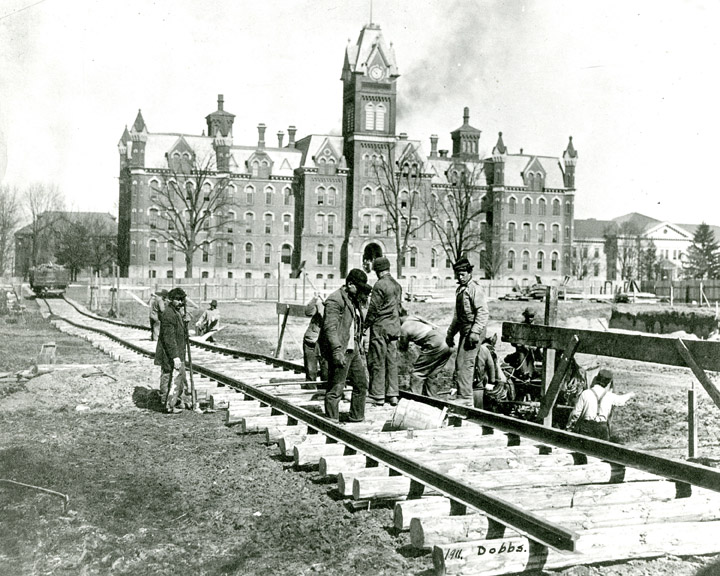
 

Main Library construction, 1911

Main Library construction, 1911

 The Board of Trustees agreed with him, and in 1913 what was then known as the “New Library” opened. It cost $314,515 to build. To get the heavy stone and other construction materials to the site, the construction company used a railroad spur, which had been built in 1909 from the Hocking Valley Railway to the University’s power plant. It was used to transport coal and other materials to the power plant, first at Brown Hall and later at the McCracken Power Plant. It ran down the middle of what is now Woody Hayes Drive from Olentangy River Road.


 (Today, a median filled with flower beds occupies the space taken by the tracks, which also were used to transport passenger cars for football games, particularly OSU vs. Michigan. The last vestiges of the railroad disappeared in 1970 when the power plant transitioned to natural gas from coal, and the spur was removed as part of the 315 highway construction project, which had originally been the path of the main railroad.)


Library, 1915

Library, 1915

 Before the “New Library” opened – on Jan. 6, 1913 – an ambulance from the Department of Animal Husbandry was used to move about 100,000 books to Thompson from Orton Library, which served up until that point as the main library. When it opened, the library had only three floors, two elevators, and no electric lighting. It was officially named the William Oxley Thompson Memorial Library, in honor of the fifth president of the university, in 1951, when its 11-story stacks were built. The Thompson Library now contains roughly 6 million volumes.


Filed by C.N.

Spring is in the air: Evolution of the Oval

University Hall, 1897

It may come as a surprise to many, but the Oval was not in the original campus design. It was, as Shakespeare would have put it, a happy accident.  The original campus design was that of an English country manor: University Hall was set on the highest point, and a long curving drive ran diagonally across what is now the Oval towards present-day Page Hall, where the drive met High Street.  It was not until the 1890s – some two decades after the University opened – that the Oval began to take shape.

In 1890 the second chemistry building (the first had burned down, and yes, the second one also would  fall victim to fire) was built on the site of Derby Hall. In 1891 construction began on both Hayes Hall and Orton Hall. The Botany Building already stood on the site of the Faculty Club. So the North and South sides of the Oval were beginning to take shape. It should also be mentioned that several of the faculty members had homes on the grounds, including one that would have stood on the Oval today.

In 1893 the master plan proposed by Captain Herman Haerlin was the first to propose an open space on campus with no roads running through it. However, this space was described as a “quadrangle.” This plan was further aided by the completion of several new buildings: Townshend Hall, Biological Hall (on the site of Hagerty Hall), and the Armory. The roads on the North and South sides of the space were changed to connect all of the buildings, so now there were two roads linking High Street and Neil Avenue in a roughly circular shape.

In 1901 the end of the Oval closest to High Street was reshaped, giving it a more curved appearance, and making the Oval an oval. The diagonal drive that cut across the space was removed in 1912, the same year the Thompson Library was completed.

So, the Oval has changed little since 1901, which largely explains how it got its name. The first reference to “the oval” came in 1910. From 1912-1913 it was usually referred to as “the campus oval.” From 1913 to 1920 it was back to “the oval.” Note that it was not capitalized until 1920.

Oval, 1916

The Oval, prior to the Long Walk, 1913


In 1914 many of the walks on the Oval were repaved, and it was at that time that the Long Walk was constructed (the “long walk” was first mentioned in 1919 and capitalized, also beginning in 1920). Another major transformation occurred in the 1970s: the roads around the Oval were made pedestrian-only walkways. This explains how you can now walk out the front doors of University, Bricker, Orton, and Hagerty Halls without getting hit by a car.

Filed by C.N.

Newer posts