From Woody's Couch

Our Playbook on OSU History

Category: Buildings (page 6 of 25)

Block “O” manager was ‘letter’-winner in many ways

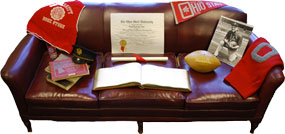
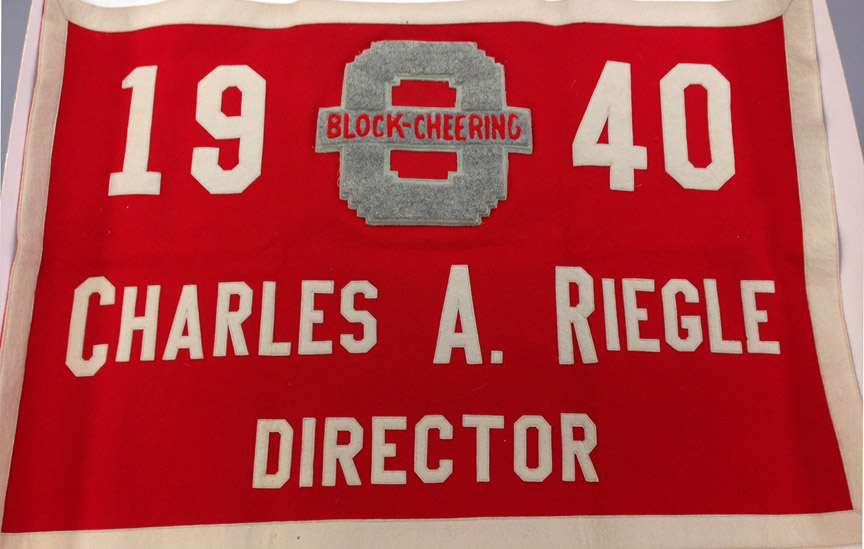
bannerRecently, the Archives received a scrapbook, a Varsity sweater, a Block “O” banner and several other items from the family of Charles Riegle, a student who earned a bachelor of science degree in Agriculture in 1941. Not only are we excited about this very kind donation because of the cool artifacts we received, but because we learned about this extraordinary student who truly was a man of many talents.
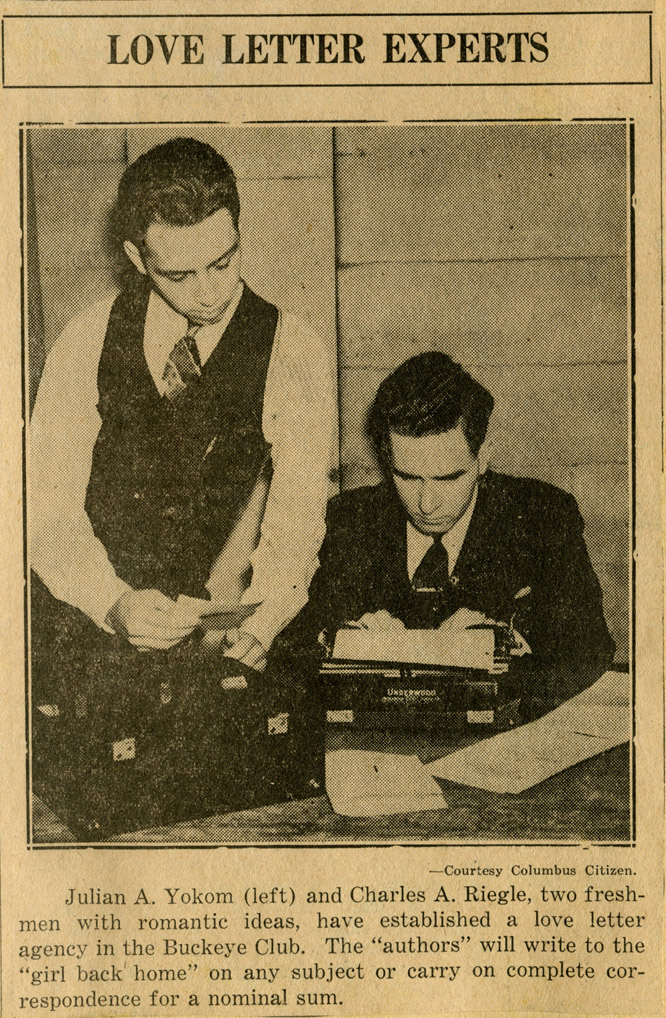
1938_reigle_yokom_newsclippingFirst, there was the letter-writing business he started with a friend in order to make money for school. Today, letters written home or to a significant other or even a family member are a rarity since communication mostly relies on texts, sometimes emails, and if you’re lucky, a phone call. Back in the 1930s, though, letter-writing was a prime means of communication. Some students, though, apparently were too busy to write home, so Riegle and a friend started a business writing letters for them. While clients had to supply their own stamps, Riegle and fellow freshman Julian A. Yokom charged 10 cents per 50 words. Riegle and Yokom’s motto was, “Give Us a Chance and the Girl Back Home a Break.” While some customers wanted letters written home to “doting parents,” most preferred a letter home to a sweetheart. And in that department, Riegle and Yokom might even use their word expertise to “break off relations with a girlfriend tactfully but don’t know how to do it,” according to a 1938 Lantern article on the pair.

In addition to his letter-writing business, Riegle also was a member of the OSU Cheerleading Squad, The Buckeye Club, the Men’s Dormitory Association and Gamma Sigma Delta, an honorary society for agriculture students. Being a member the Buckeye Club actually meant that Riegle lived in the Stadium Scholarship Dorms, which at that time were for male students who couldn’t otherwise afford to go to college (hence, the letter-writing business).

Charles Riegle, Cheerleading, c.1939-40

Charles Riegle in his OSU Cheerleading uniform, c1939

And of course, he was a very dedicated member of Block “O.” During the 1938-39 academic year, Riegle became Junior Manager of the Cheering Section and by the following year became Manager. Riegle managed three juniors, six sophomores, and six freshmen, while the cheering section had a total of roughly 1,200 men and women wearing scarlet capes against a grey background to create the impression of a block “O.” Each person would participate in different cheers while holding up different colored cards and singing along to certain songs and yells. There were 30 designs and 10 were used in a single game. By the end of the season, 3,000 cards were used. For his role as manager, Riegle received a Varsity “O” sweater in 1940.

Riegle’s energy and management skills served him well after his time at OSU: He joined the military and served in three wars: World War II, the Korean War, where he worked after the war on the establishment of the De-Militarized Zone between North and South Koreas; and the Vietnam War. He retired in 1968 as a U.S. Army Colonel and died several years later.

We very much appreciate the kind donation made by Dwight and Mary Helen Tuuri of the materials once owned by Riegle. It is because of people like the Tuuris that we have such wonderful stories to tell about OSU history, so we thank them very much!
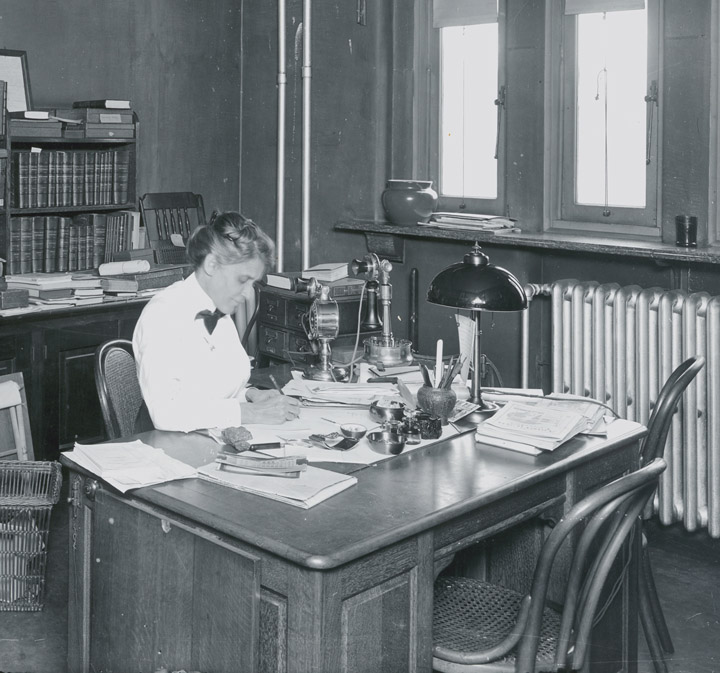
Alumni Weekend: An early class’s tale of reconnecting

Olive Branch Jones, 1912

Olive Branch Jones, 1912

Today, with the vast number of students who graduate every year, it would be unthinkable for a class to gather in one publication the updates on lives and recollections from school days of its various members. But given the well-organized nature of the University’s librarian, it was almost pulled off for the Class of 1887’s 25th reunion.

In 1912, when the Class of 1887 was about to celebrate its 25th anniversary of graduation, Olive Branch Jones – by then the first full-time librarian for her alma mater, OSU – took on the task with a friend to publish a report on members of the class of 1887. It was actually that class’s treasurer, Joseph S. Myers, who had written to Jones telling her his plans of having a “history of ’87 prepared in this 25th Anniversary Year” and to have a sort of questionnaire sent out to all the 21 graduates. Myers and a fellow classmate, Joe Taylor, both agreed that they thought Jones, a fellow class member, could handle this job best.

Questionnaire for 1887 reunion; (Click to view larger version)

Questionnaire for 1887 reunion

For some reason, however, Jones was unable to pull it off. Maybe it was because it was the year before the then-main library was to open, and she was too busy as University Librarian preparing for that event.

But the questionnaire remains, and it is quite a relic of a bygone era. Respondents are asked what political party they belong to (Progressive or Reactionary), what church they belong to and whether they are a woman suffragist, among other things.

And Jones did receive some interesting letters from alumni, who were unable to attend the reunion but wanted to update their classmates on their current lives. One alumna, Daisy M. Scott, had for some time been a math teacher at North High School in Columbus, although there was one year when she was sent to Central and East high schools “to extricate some of their students from difficulties algebraic.” Joe Taylor marched down memory lane at first in his letter, then veered into waxing philosophic about the past: “…we don’t live there any more; we can’t stay in that familiar and peaceless place, the undergrad campus; a place so stripped of yesterdays … I am more able to say this because I have not achieved what we call great success; my own today is a very modest affair; yet so it seems, no doubt, to each of us.”

Heavy stuff. Luckily, for the class members who showed up at the actual reunion, the mood appeared to be much lighter. Along with discussions about a report, various letters were exchanged between Jones and Lucretia McPherson, wife of then-Graduate School Dean William McPherson, in which they decided also to hold a garden party in celebration. Roughly 50 people, including graduates’ family members and former faculty, apparently gathered on June 10, 1912, after which Lucretia McPherson wrote to Jones that it was “one of the most worthwhile parties, for the guests seemed to be so truly happy to see one another.”

Reunion group in front of University Hall, 1912

Reunion group in front of University Hall, 1912

– Filed by B.T.
Note: This information came from the Director of Libraries collection at the University Archives in a folder called “Class of 1887: 25th Anniversary: Correspondence for 1912 (Olive Jones)”

Famed OSU botanist left behind captivating photos and career

The Archives recently received a small donation of material that belonged to a former OSU professor who was regarded as “one of the greatest botanists of his day.”

John Henry Schaffner came to the University in 1897 as an assistant in Botany, and served as head of the Department of Botany from 1908 to 1918. Later in his career, he went on to make a radical discovery in in the field of Botany that brought admiration from scientists worldwide. But more about that in a bit.

Early on in Schaffner’s tenure at OSU, he took the following photographs, which depict a very different view of campus.

Oval from Armory, 1899

This first photograph was taken from the top of the Armory in 1899. (The Armory was situated at the site where the Wexner Center sits today.) What we now think of the Oval did not quite exist yet, and as you can see, a house sat at the east end. In 1902, the house was moved to the north edge of today’s Mershon Auditorium and became the home to OSU athletics. It was aptly named the “Athletic House.”

To the left of the house is Biological Hall, which was built in 1898 for the departments of Anatomy and Physiology, and Botany and Zoology. The Biology Building was torn down in 1923 to make way for the current Hagerty Hall building.

To the right is Orton Hall, and the old Botanical Hall, which is where Schaffner spent much of his time in teaching and research.

1899_campus_view_from_southeast1

John H. Schaffner, 1900

John H. Schaffner, 1900

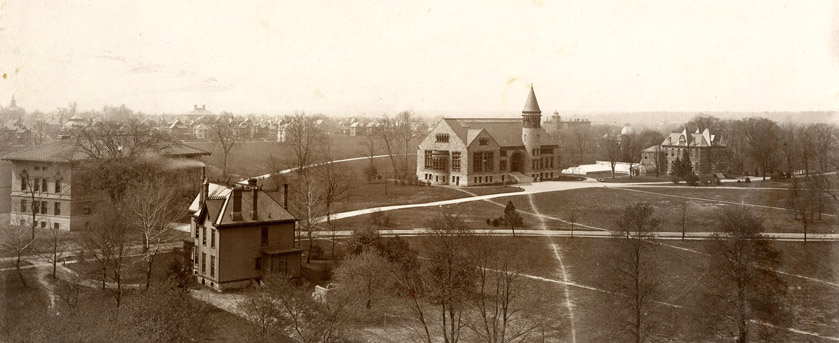
This panorama photo shows a view of campus from the southeast end, looking northwest. You can see the back side of Orton Hall towards the right, as well as McMillin Observatory, which was situated on the southwest side of Mirror Lake.  The observatory, which opened in 1896, was torn down in 1976.

But, what are even more interesting than Schaffner’s photographs, are his background and research interests. Schaffner was widely known among scientists for his botanical discoveries, and as a prolific writer of books and scientific papers. He was also renowned for his help in overthrowing the thought that the sex of plants was hereditary.

Yes, you heard right.

An Alumni Monthly article from October 1928 noted that Schaffner’s most important discovery is that the sex of the plant may be changed:

“Professor Schaffner found that by controlling the conditions in which a plant developed he could change the entire sex of the plant. The further development of this discovery will lead to many radical changes in the treatment of plant life.”

Schaffner read his paper describing this discovery in 1926 at a convention of botanists in Ithaca, New York, and it was widely acclaimed by scientists in many countries.

Schaffner died on January 27, 1939.

(Special thanks to Bob Cody, Schaffner’s grandson, who donated the campus photographs to the University Archives.)

Older posts Newer posts