From Woody's Couch

Our Playbook on OSU History

Category: Buildings (page 21 of 25)

Twelve Days of Buckeyes: First telephone line at OSU

Mendenhall, 1874

Ohio State was lucky in its early days to have Prof. Thomas C. Mendenhall on staff. Mendenhall, the first physics professor at what was then called the Ohio Agricultural and Mechanical College, reportedly used Alexander Graham Bell’s first experimental telephone and he and students from his department were involved in the construction of the first telephone line in the state of Ohio. The line ran from his laboratory on campus to his residence on High Street.  Subsequently, the first transmission of speech by the use of electricity in Ohio was between Mendenhall’s residence and his lab. This was circa 1878, although Mendenhall in his later account of the early days of the campus did not give an exact date.
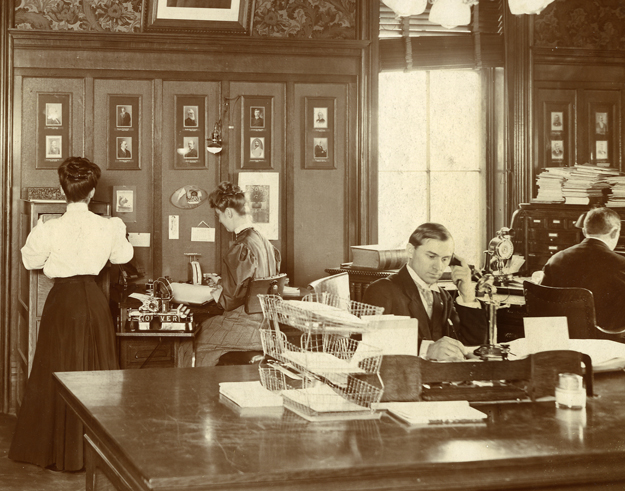
Telephone in University Hall, 1907

Pretty cool, huh? Even so, ten years later, there appeared to be only one telephone on campus. A “Personal Note” in an 1888 issue of the Lantern said “The Faculty still monopolize the telephone.”

And in light of the recent electronically issued emergency alerts that have been issued by OSU Police, here’s another interesting tidbit: the first Emergency phones, with a direct line to the police department, were placed throughout campus in Autumn Quarter of 1972, and were used that quarter approximately 25 times.



Twelve Days of Buckeyes: First home for men’s basketball

(You can tell we’re really getting into the holiday spirit here because this post begins to the first lines of the tune, “Rudolph, the Red-nosed Reindeer:”)

You know St. John Arena and Schottenstein Center

Where watching OSU hoops just doesn’t get better

But do you recall?

The first place Ohio State played basketball?

Armory, 1918

The program’s first home was actually the Armory, a massive brick building that used to stand just about where the Wexner Center is, but was razed in 1959 after a huge fire. The  Armory was home to OSU’s men’s basketball team from 1898 until 1919.

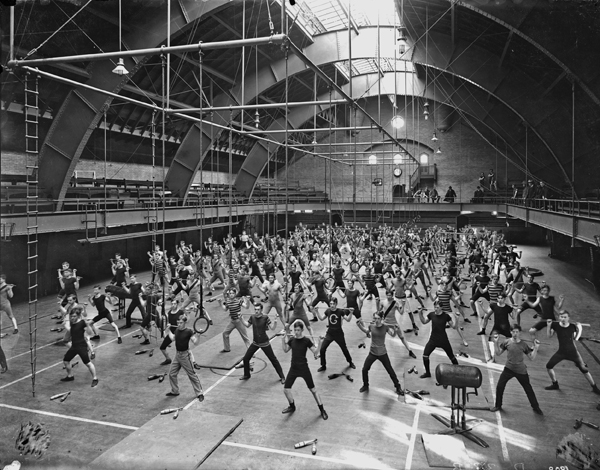
Also known as Drill Hall or the Gymnasium, the Armory was built in 1897 at a cost of $115,000. For many years the Armory was home to the Department of Military Science and the men’s gymnasium, and it hosted events such as campus dances, commencement and intermural sports. The exterior was designed much like a medieval castle, including turrets at each corner of the building.

Men's physical education class in the Armory, 1908

In 1918 the University received an official order to allow the military to take over the entire building because of World War I, and the basketball team was left without a place to practice or hold home games. A few home games were then held at Indianola Park (a long-gone amusement park located on High Street just north of the Giant Eagle in Clintonville). In 1919 the basketball team continued to have complications with its use of the Armory and started the season late in January continuing until March. During the team’s time in Armory, the Buckeyes had an overall record of 178-104.

In 1920 the team moved to the Coliseum at the Ohio State Fairgrounds. Built in 1918, the Coliseum was also known as “the Barn” and continues to be the site for high school basketball playoff games. With the ability to seat more than 6,000 fans, the Coliseum drew the largest crowds ever to watch Ohio State Basketball games.

Basketball game in the Coliseum, 1948

It is also noted that school interest and spirit in basketball grew immensely.

During its stretch at the Coliseum, the team played in five national title games, including the first-ever such matchup in 1939 against the University of Oregon in which the Buckeyes lost 33-46. With an overall record of 403-334 and six Big Ten Conference titles, the Buckeyes stopped playing at the Coliseum in 1956, after St. John Arena was built.


Twelve Days of Buckeyes: Late to class? Give yourself a demerit!

A chemistry class in 1885

With its current focus on selective admissions, OSU can boast of a student body dedicated to scholarly pursuits; when Ohio State was first opened in 1873, the University relied on demerits to keep students academically focused. It was a pretty simple system:

The penalty for an unexcused absence from class or from drill was four demerits; an unexcused failure in recitation got you two demerits; and for each unexcused tardiness, one demerit was assigned. If a student received ten demerits in a single term, twenty-five demerits in the first two terms or thirty in the first year, the parents were notified. Expulsion was the price to pay for twenty demerits received in the first term, thirty-five in the first two terms, or forty during the year.

There’s no record of how many demerits were issued; the system was abolished fifteen years later, except for preparatory classes. OSU’s third president, William H. Scott, wrote at the time: “This action by no means exempts students from accountability; but instead of having a definite penalty measured out by law for each delinquency, they must answer for any abuse of their liberty to the teacher in whose class the delinquency occurs.”

Orton, 1875

That’s according to James Pollard’s 1959 history of OSU, where he also recounts how little misbehavior there was in general. According to Pollard, OSU President Edward Orton apparently was impressed by the dearth of mayhem on campus: “We have been happily free during our short history from the relics of barbarism that still survive in so many colleges in the shape of hazing and the reckless destruction of property.”

North Dorm students, 1889

Not counting the North Dorm, of course. Several OSU Alumni Monthly articles have recounted stories of OSU’s first residence hall, where male students lived, and its collegiate atmosphere: Stolen pigs appearing in dorm rooms, firecrackers set off in the house, coal scuttles tossed down the stairs at night. Apparently, it also was common in the dorm to shoot out of the window. Aiming seems to have been optional – in one incident, a horse was hit, so then-University President Edward Orton ordered all of the boys to produce their weapons in order to match bullet to the gun. It was, to his chagrin, and the detriment of justice, that every boy in residence produced a .32 caliber revolver.


Older posts Newer posts