From Woody's Couch

Our Playbook on OSU History

Category: Buildings (page 19 of 25)

Bleeds Scarlet and Grey: Col. George L. Converse

Col. George L. Converse, n.d.

The Reserve Officers’ Training programs for the Army, Navy and Air Force are such fixtures at OSU that it would be difficult to imagine the campus without them. There was a time, however, when there was no such thing as the ROTC program. With the help of George Converse, and several other OSU leaders, the national ROTC program was created and the OSU program flourished.

Converse, who grew up on a farm near present-day Cleveland Avenue, enrolled as a freshman at OSU at age 17, in 1874. After his first quarter, however, he received an appointment to West Point, and eventually graduated in 1880. Two years later, he was a member of the 3rd U.S. Cavalry in Wyoming, when his company was sent to Arizona to combat the uprising by the Apaches, led by Geronimo. In one battle, Converse was shot in the eye and had to ride on horseback for 40 miles to receive medical treatment. The bullet was never extracted, and the rest of his life he wore a black eye patch. University lore said that he could see more with his single eye than most men could see with two.

Due to his injury, he retired from active duty in 1884 and returned to Columbus. He was later called back to serve in the Spanish American War, but returned again to Ohio State in 1900 to serve as the University’s first Commandant of Cadets in the Department of Military Science. He held that position, as well as a professorship and subsequently chairmanship, of that department for 18 years. During his tenure, enrollment grew from 400 to almost 3,000 students. Commandant Converse, whom students affectionately referred to as “Commy,” also gave regular Thursday morning talks to male freshmen. (On Wednesday mornings, the freshmen listened to President William Oxley Thompson.)

Converse Hall, 1949

With the outbreak of World War I, Converse returned to active-duty status, this time as examining officer for all Ohio officer training camps. During that period, as he continued his teaching duties at OSU, he also co-authored the Ohio Plan, along with Pres. Thompson, Gen. Edward Orton Jr. (professor of ceramic engineering) and OSU alumnus Ralph D. Mershon. That plan, which outlined university civilian training programs, became part of the 1916 National Defense Act, which established the ROTC as a national program.

In 1918, he left OSU when the military promoted him to district inspector, overseeing officer training camps in Ohio, Indiana, West Virginia and Kentucky. In 1920, he retired from the military—for good—and returned with his wife, Effie, to their house on Neil Avenue. (Effie had served as interim Dean of Women during the 1918-19 academic year.) He died on November 16, 1946.

Five years before he died, ground broke on the ROTC building, on February 17, 1941. In 1973, the Board of Trustees voted to re-name the building after Converse, who had served longer than any other Commandant at OSU.

Filed by C.N.
“Buckeye Stroll” now in the Apple App Store

Want to learn OSU history? There’s an app for that.

Buckeye Stroll, OSU’s online historical campus tour, is now available in Apple’s mobile application store for the  iPhone, iPad and iPod Touch. Download the application, and with a GPS-enabled device, you can learn about OSU history as you walk around campus. Nearly 100 buildings are featured, with photographs and brief histories. The tour was created through a collaboration of the Libraries’ Web Implementation Team and the University Archives. Buckeye Stroll also is available on the Libraries’ web site at: http://library.osu.edu/buckeye-stroll

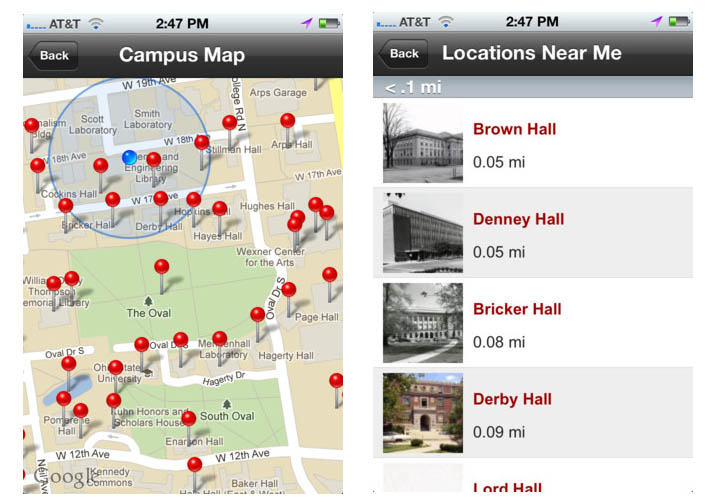
Here are a few screen shots from Buckeye Stroll:

The Buckeye Stroll application will locate you on the map and display your position as you walk across campus (left screen shot). It will also sort the buildings by proximity to your location (right).


A place of their own: Oxley Hall, the first women’s dorm

Oxley Hall, 1910

It may be hard to believe, but for many years in OSU’s early history, no female students lived on campus. Girls were expected to take rooms with local families or to live in boarding houses. Eventually, however, OSU women did get a dorm of their own: Oxley Hall.

The building was designed by a woman, who was an OSU alumna, to boot. Florence Kenyon Hayden was a former OSU student who had studied with then-University Architect Joseph Bradford. Her work was so good that Bradford suggested her to the Board of Trustees as the architect for the women’s dorm.

She got the job, although the trustees assigned her a male partner- Wilbur T. Mills – to complete the project. In a 1970 Columbus Dispatch interview, she said that she became fed up with Mills, locked him out of the office, and submitted her final plans for approval within the month. So apparently what we see today is Kenyon Hayden’s vision, although both she and Mills are listed as the official architectural team. After marrying a physician, she began designing medical facilities, for which she later gained some national attention.

Oxley Hall residents, 1931

Construction began on the building in 1907; it was built in the English Renaissance style with a Spanish tile roof, brick exterior and limestone trim. The cost of the original structure is listed as $66,490.85.

Residents moved into the building in September 1908 and took a vote on what to name their new home. The Board of Trustees accepted their recommendation, and on November 20, 1908, officially named the building for President William Oxley Thompson’s mother (her maiden name, which is where he got his middle name).

Some fun facts about living in Oxley Hall as a co-ed: A single room cost $1.75 per week in room and board; residing in a double room cost $1.50. The girls did have staff to cook and to clean the public areas of the house. There were mandatory quiet hours Monday-Thursday from

1950s

7:30 p.m. until 6:30 am. Girls could have callers on Sundays from noon-3 p.m., and from 5-10 p.m.; men were never allowed beyond the first-floor receiving rooms. Residents also had curfews, though those became less restrictive as the years progressed.

The building served as a dormitory until 1967, when it was decided that it was unsuitable as a residence hall and was leased to the University Research Foundation. The building was remodeled in 1989, and in 1991 the Department of International Affairs moved in, where it remains to this day.

Filed by C.N.

Older posts Newer posts