From Woody's Couch

Our Playbook on OSU History

Category: Buildings (page 18 of 25)

This Week in OSU History: ‘Dynamo’ takes over presidency

James Canfield, 1897

It turns out E. Gordon Gee is not the University’s first president who could be mistaken for a human sparkplug. Back in 1895, OSU’s fourth president was elected – James Canfield – and he was considered quite the “human dynamo,” too.

Canfield was born in Delaware, Ohio, in 1847, but his family soon moved to New York City, where he grew up and attended school. He graduated from Williams College, and briefly practiced law in that “state up north” before taking a teaching position at the University of Kansas in 1877, which he held for 14 years. His teaching focus was English, History, Civics and Political Science, and he became a sought-after orator.

In 1891 Canfield accepted the Chancellorship at the University of Nebraska, and four years later – on April 11, 1895 – he was elected President of Ohio State. The Board of Trustees knew his reputation as a “human dynamo,” so it should have come as no surprise to them that Canfield immediately went to work once in office.

One of Canfield’s first acts as president was to establish a lab in 1895 near Lake Erie (the precursor to Stone Lab. Under his leadership, enrollment surpassed 1,000 (1897), and the Power Plant and Armory were built. The University also added Domestic Science, Commerce and Administration courses to the curriculum.

Canfield Hall, 1940s

Canfield was by all accounts a very “take charge” person. According to the University’s 75-year history, he once stopped to ask the janitors and scrub-women why they were not on their hands and knees, scrubbing the floor. So it is no wonder that his administration was also marked with conflict – particularly over Canfield’s attempt to form a partnership between OSU and a Columbus medical college. It turns out the University did end up partnering with the Starling Loving Hospital—shortly after Canfield left office. The move ultimately led to the formation of OSU’s Medical Center.

Canfield resigned his post in 1899 to become the Librarian at Columbia University. He died in 1909.

In 1940, Canfield Hall was named as a tribute to him and his daughter, the novelist Dorothy Canfield Fisher.


Filed by C.N.


Spring is in the air: Evolution of the Oval

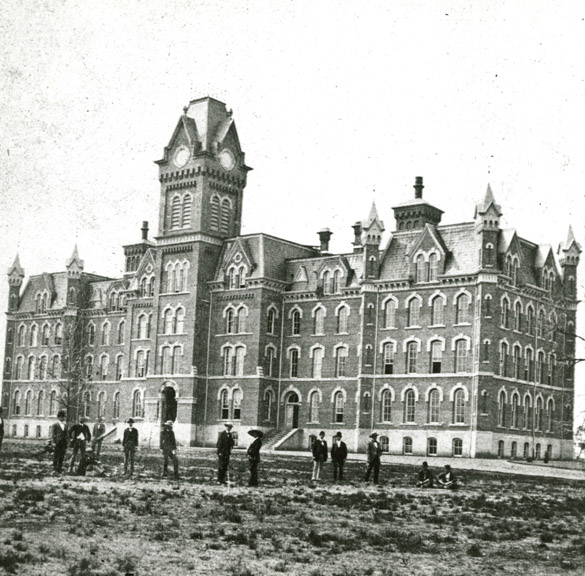
University Hall, 1897

It may come as a surprise to many, but the Oval was not in the original campus design. It was, as Shakespeare would have put it, a happy accident.  The original campus design was that of an English country manor: University Hall was set on the highest point, and a long curving drive ran diagonally across what is now the Oval towards present-day Page Hall, where the drive met High Street.  It was not until the 1890s – some two decades after the University opened – that the Oval began to take shape.

In 1890 the second chemistry building (the first had burned down, and yes, the second one also would  fall victim to fire) was built on the site of Derby Hall. In 1891 construction began on both Hayes Hall and Orton Hall. The Botany Building already stood on the site of the Faculty Club. So the North and South sides of the Oval were beginning to take shape. It should also be mentioned that several of the faculty members had homes on the grounds, including one that would have stood on the Oval today.

In 1893 the master plan proposed by Captain Herman Haerlin was the first to propose an open space on campus with no roads running through it. However, this space was described as a “quadrangle.” This plan was further aided by the completion of several new buildings: Townshend Hall, Biological Hall (on the site of Hagerty Hall), and the Armory. The roads on the North and South sides of the space were changed to connect all of the buildings, so now there were two roads linking High Street and Neil Avenue in a roughly circular shape.

In 1901 the end of the Oval closest to High Street was reshaped, giving it a more curved appearance, and making the Oval an oval. The diagonal drive that cut across the space was removed in 1912, the same year the Thompson Library was completed.

So, the Oval has changed little since 1901, which largely explains how it got its name. The first reference to “the oval” came in 1910. From 1912-1913 it was usually referred to as “the campus oval.” From 1913 to 1920 it was back to “the oval.” Note that it was not capitalized until 1920.

Oval, 1916

The Oval, prior to the Long Walk, 1913


In 1914 many of the walks on the Oval were repaved, and it was at that time that the Long Walk was constructed (the “long walk” was first mentioned in 1919 and capitalized, also beginning in 1920). Another major transformation occurred in the 1970s: the roads around the Oval were made pedestrian-only walkways. This explains how you can now walk out the front doors of University, Bricker, Orton, and Hagerty Halls without getting hit by a car.

Filed by C.N.

March Madness Part I: The offbeat side of OSU

The NCAA Men’s Basketball Tournament is about to begin, and there will definitely be times when collectively we might say, “That didn’t just happen, did it?” So we thought we’d tell a few stories from OSU’s past to elicit a similar response of disbelief:

Saints and Sinners

University Hall, 1874

It may be hard to imagine but when the University first opened, there were only seven faculty members and about two dozen students. More incredibly, many of the first faculty members resided in University Hall, along with many of the college’s first male students. The faculty’s quarters were mostly on the upper floors, known as the “Saints’ Roost,” and many of the students lived in the cellar, otherwise known as “Purgatory.” Of course, sharing close quarters was bound to lead to some disturbances. One former student’s account mentioned that residents of Purgatory occasionally made their way up the stairs at night; they formed a line and the leader would tap on certain faculty members’ doors at odd hours of the night. When the unsuspecting faculty member opened the door, the line would start forward and each passing student would hit the Saint with a pillow until he shut the door. Sounds like fun, huh? Clearly, the Internet had not yet been invented.

The Chemistry Building curse?

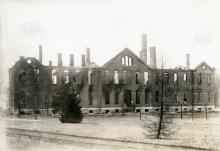
Chemistry Building #1 fire damage, 1887

OSU’s chemistry department got off to a rocky start: Originally housed on the third floor of University Hall, it was soon moved to a newly constructed building on the site of, most recently, Brown Hall. When a fire started in the building in 1887, the whole structure burned down because of a lack of water to extinguish the flames.

The next chemistry building was built two years later on the site of the present Derby Hall.

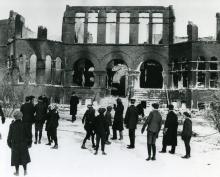
Chemistry Building #2 fire damage, 1904

It burned down in 1904. A recounting of the incident said there were “ludicrous happenings due to excitement” that occurred that night.

Apparently the firefighters were afraid of the chemicals housed in the building, so they did not try to put out the flames (whether or not the chemicals were a threat is not known). However, that did not stop students from entering the burning building and attempting to save the contents, including bottles of distilled water.

The third chemistry building, now known as Derby Hall, was rebuilt in 1906 on the site of its predecessor. It too, caught fire soon after it was completed; however the building was saved. Its first addition was, of course, a fire-proof storage shed for the chemicals. No doubt this helped to break the curse.

Hairy men in dresses

Scarlet Mask group

It’s likely someone has written a thesis about why people laugh when men dress up in women’s clothing. The entertainment method surely worked for OSU audiences during the first half of the 20th century, given the long run of a student acting group called Scarlet Mask. The men’s musical comedy club that later evolved into an honorary dramatic organization was started in 1919 by a group of five OSU students. Most of the plays were comedies, and they were a source of entertainment for students and local residents before the advent of television. Some of the early plays (prior to 1925) were penned by none other than humorist James Thurber. One of the group’s signature pieces was to have very big, hairy men—such as members of the football team—come out on stage dressed in frilly women’s clothing. Another key member was Milton Caniff, creator of long-running comic strips, “Terry and the Pirates” and “Steve Canyon.” Who knows? If he had not become a renowned cartoonist, he might have his career on stage. The Scarlet Mask Club disbanded in the 1930s, primarily due to a lack of funding, but the club was periodically resurrected for the next decade or so. Its last run ended in 1953.

Older posts Newer posts