From Woody's Couch

Our Playbook on OSU History

Category: Buildings (page 15 of 25)

Twelve Days of Buckeyes: OSU’s 8th President left lasting legacy

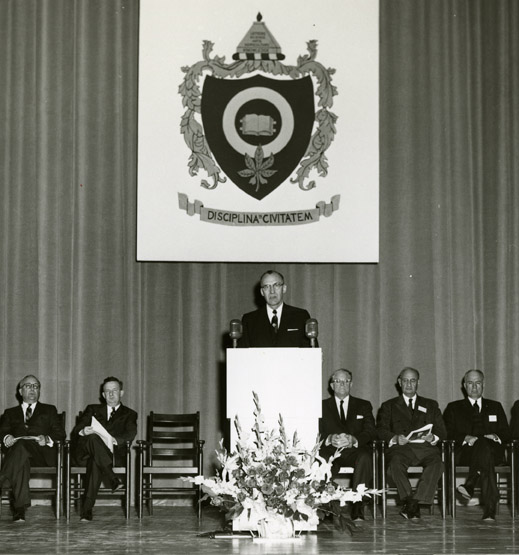
Fawcett speaking during his Inauguration, 1957

President No. 8 for Ohio State was Novice G. Fawcett, a native of Gambier, Ohio, who was born in 1909. He had never served in higher education until he was tapped as president in 1957, but his skills as a public school system administrator helped him move the university forward significantly and allowed him to weather a number of significant crises during his 16-year term.

After attending Kenyon College (where he graduated in 1931), Fawcett earned a master’s degree in education from OSU in 1937.  At the same time, he served as the superintendent of schools in Gambier. A year later, he became superintendent of schools for Defiance, Ohio, then for Bexley, Ohio, in 1943.  In 1947, he became assistant superintendent for Akron and became superintendent for Columbus Public Schools in 1949. Fawcett served with then-OSU President Howard Bevis on the Ohio Committee on Expanding Student Population before his inauguration as OSU President on April 29, 1957.

When Fawcett assumed his duties as president of OSU, 21,000 students attended the Columbus campus, $2 million was spent on research annually, and buildings and equipment were valued at $88 million. In his inaugural address, “Toward a New Level of Greatness,” he laid out an ambitious plan to move the University forward in a number of ways, such as research, continuing education, administrative improvement and the use of new technologies in the classroom. When he retired in 1972, 50,000 students attended OSU’s main and new regional campuses, $26 million was spent annually on research, and the value of buildings and equipment neared $400 million.

Fawcett’s term was also a time of significant social disruption and turbulence on campus.  Among the subjects of student demonstrations were discrimination in university housing and off-campus housing, the “Speaker’s Rule,” which restricted who could speak on campus, and was considered an abridgement of free speech. Women’s rights, minority rights, and the Vietnam War also were key topics of dissent.

Speaker’s Rule Demonstration, 1965

One of the highlights of Fawcett’s tenure was the creation of the Office of Continuing Education, which was originally housed at the Center for Tomorrow on Olentangy River Road. To honor Fawcett’s role in creating this division, and for his legacy at the University as a whole, the building was renamed the Novice G. Fawcett Center for Tomorrow in June 1972, two months before Fawcett left office.

Fawcett Center, 1975

Fawcett died in 1998; he was 79 years old.

1970
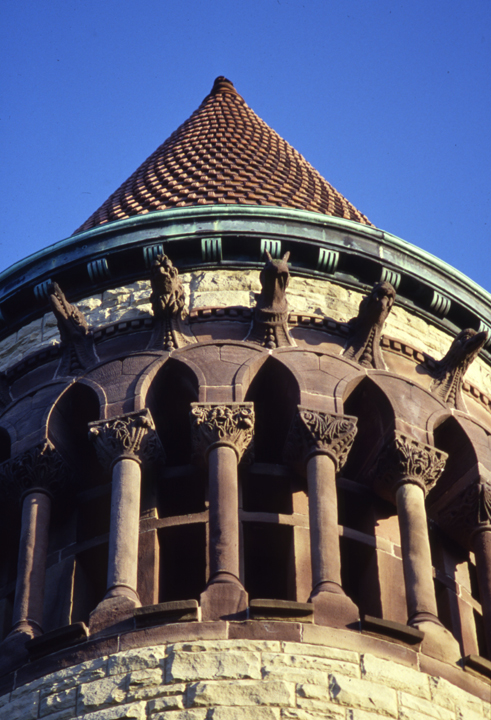
Twelve Days of Buckeyes: Orton Hall’s 12 chimes have rung for nearly a century

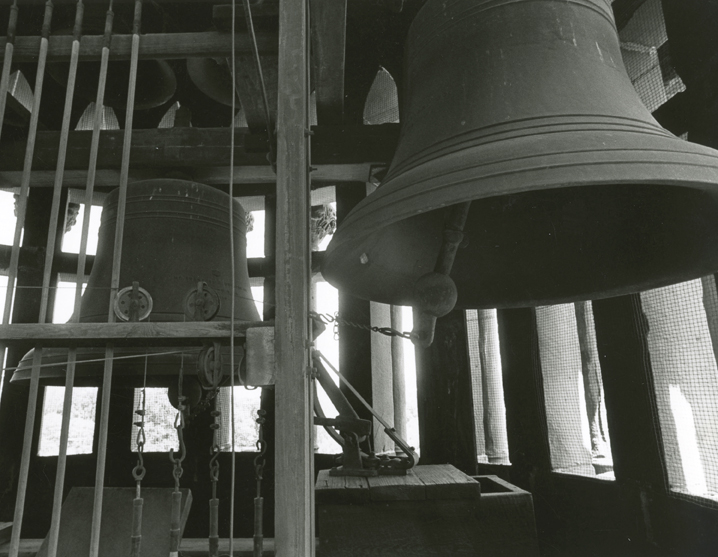
Orton Bell Tower

When we were deciding what the focuses would be for our “Twelve Days of Buckeyes” posts this year, the first one was easy: For the 12th day, we have to talk about the dozen chimes on top of Orton Hall.

The building, which opened in 1893, was more than two decades old before the chimes were installed. They were a memorial gift from the classes of 1906-11, 1913 and 1914, and they were dedicated on June 15, 1915, at the Spring Commencement ceremony, where OSU Pres. William Oxley Thompson officially accepted them as a gift.

Did you know they cost roughly $8,000 and weigh a total of 7.5 tons? The smallest of the bells weighs 550 pounds, while the largest weighs 3,550 pounds. Total cost of installation was $94.68.

At first, they were rung by hand, but thanks to another gift of $5,000 from the classes of 1919 and 1920, electric strikers were installed to activate the chimes on the outside of each bell.

The musical serenades that walkers hear as they traverse the Oval also were done by hand, first by faculty members, then by School of Music students. However, whoever played the chimes had to walk up 80 feet worth of stairs twice a day to activate clappers that hit the inside of the bells. In 1987, a fully automated system was installed.

The bells sit outside of Orton Hall prior to installation, 1915

Inside the bell tower, 1985

OSU professor aimed to prove “We are not alone”

J. Allen Hynek, 1954

We are taking a little break from “Fridays filled with Fun Football Facts” to look at the bigger picture – a much bigger picture, according to Josef Allen Hynek, a former OSU professor, whose research inspired the Steven Spielberg film, “Close Encounters of the Third Kind.” Hynek was an astronomer who conducted independent research into Unidentified Flying Objects, or UFOs. Here’s his story:

Hynek was born on May 1, 1910, in Chicago to Czechoslovakian parents. He went on to attend the University of Chicago; he graduated with honors and was valedictorian of the class of 1931, and then went on to receive his Ph.D. in 1935. He came to Ohio State later that year as an instructor of astronomy, and he later taught in the Department of Physics.

During World War II, Hynek was granted a leave of absence to work at Johns Hopkins University, where he was reported as developing “proximity fuses” in its applied physics laboratory. In November 1950, he was named OSU’s Assistant Dean of the Graduate School. During that appointment, Dr. Hynek continued to teach both astronomy and physics, and to act as Director of the McMillin Observatory on campus. Hynek became well-known for his research with rockets, leading to more time away from campus on government projects. He resigned from Ohio State in January 1960, to take over leadership of Northwestern University’s Department of Astronomy.

Hynek inside OSU’s McMillan Observatory, 1940s

Dr. Hynek went on to pen The UFO Experience, which was published in 1972. In that book, Hynek describes three types of UFO encounters. The first kind is one in which a UFO appears, but leaves no evidence; the second kind is one in which a UFO leaves physical evidence, such as broken branches or burns. The third kind is one in which contact is made. In 1977 Steven Spielberg released his multi-million dollar movie inspired by Dr. Hynek’s book. Hynek was a technical advisor for the movie and made a cameo appearance.  The movie has grossed $300 million worldwide so far.

It seems that all of the publicity surrounding Dr. Hynek’s work ultimately embarrassed Northwestern University administrators, who called for his Center for UFO Studies to be kept entirely separate from the university. Hynek ultimately retired from Northwestern in 1978 and moved to Arizona to continue his work. He passed away in 1986.

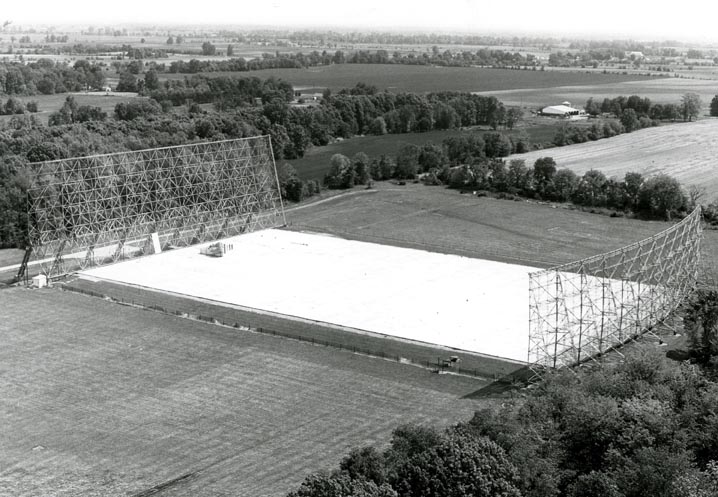
Now, while we are on the subject of space and extraterrestrials, did you also know that OSU was also looking for life on other planets? Beginning in 1973, Ohio State’s radio telescope has been scanning for radio emissions from space as part of a project called “Big Ear,” the name of the telescope.

“Big Ear”, 1982

The Big Ear telescope was located on land leased from the Ohio Wesleyan University, near Perkins Observatory in Delaware, and was a joint project between Ohio State and Ohio Wesleyan. At the time, it was the only radio observatory in the world to continuously search for signals from space. The project was ultimately terminated when Ohio Wesleyan sold the land in 1996 to the Delaware Country Club so the club could extend its golf course. As for the big question: Did they hear anything? Scientists said that they did receive some signals. However, E.T. will now have to use another telescope to call for a ride home.

Filed by C.N.

Older posts Newer posts