From Woody's Couch

Our Playbook on OSU History

Category: Archival resources (page 4 of 14)

Twelve Days: For Woody Hayes and others, the Archives aims to ‘pay it forward’

(In celebration of the University Archives’ upcoming 50th Anniversary in 2015, we bring you “The Twelve Days of Buckeyes.” This is the last of a series of 12 blog posts highlighting the people who were instrumental in the creation and growth of the Archives. Stay tuned for more posts and other announcements related to our anniversary celebration next year.)

Woody Hayes, 1963

Woody Hayes, 1963

It’s been nearly 30 years since Woody Hayes’ death, yet his legacy is still very much alive for many people. Even OSU students who hadn’t yet been born when he died in 1987 know about Hayes. And although many these days can’t name many details – such as the fact that he still has the most national championships of any OSU football coach – they almost invariably can recall that he was some kind of an important figure at the University.

We would like to think that the Archives contributes a little to this continuing legacy.

The Archives has housed the Woody Hayes Papers since 1990, when his widow, Anne, donated them to the University. The collection includes papers, books, awards, memorabilia, photos and other effects.

Anne Hayes, n.d.

Anne Hayes, n.d.

Though it is larger than most, the collection of roughly 75 boxes is very similar to the dozens of faculty and staff collections housed here. Each collection’s materials document the careers of the people who have worked at OSU. Like many of these collections, though, Hayes’ goes beyond mere documentation of a career. His materials reflect a person whose job title was coach, but whose contributions to the University and community went far beyond that. Consider:

– Photos from his own U.S. Navy service during World War II. In these, Hayes is incredibly young but already shows leadership skills that would he would use for 27 years as OSU football coach. (He achieved the rank of Lt. Commander and was in charge of both a patrol boat in the Palau Islands and a destroyer escort.)

Hayes, (center), with two unidentified men, n.d.

Hayes, (center), with two unidentified men during WWII

– A wooden clock with a plate inscribed “Bryant-Foust Crippled Children’s Day Award presented to Woody Hayes…,” given to him in 1986. Hayes was a big supporter of charities that involved children and regularly visited patients at Columbus’ Children’s Hospital.

Letter from Richard Nixon, 1979

Letter from Richard Nixon, 1979

Correspondence with VIPs that include the likes of Bob Hope and Richard Nixon, both of whom Hayes considered friends. Nixon even gave the eulogy at Hayes’ funeral.

Hayes at 1986 commencement

Hayes at 1986 commencement

– A videotape of Hayes’ speech at the 1986 Winter Commencement ceremony, just a year before he died. It shows a frail, elderly but grateful man who was still spurring people to “pay it forward.”

As Hayes’ encouraged, we at the Archives hope we can “pay it forward” to the community by not only preserving such materials but making them available to researchers, classes and the community for years to come.

To learn more about Woody Hayes, please see our web exhibit commemorating the anniversary of his 100th birthday

You can also read a transcript of his Commencement speech.
 

Twelve Days: Goerler’s dedication to OSU, its history, still endures

(In celebration of the University Archives’ upcoming 50th Anniversary in 2015, we bring you “The Twelve Days of Buckeyes.” This is day 11 in a series of 12 blog posts highlighting the people who were instrumental in the creation and growth of the Archives.)

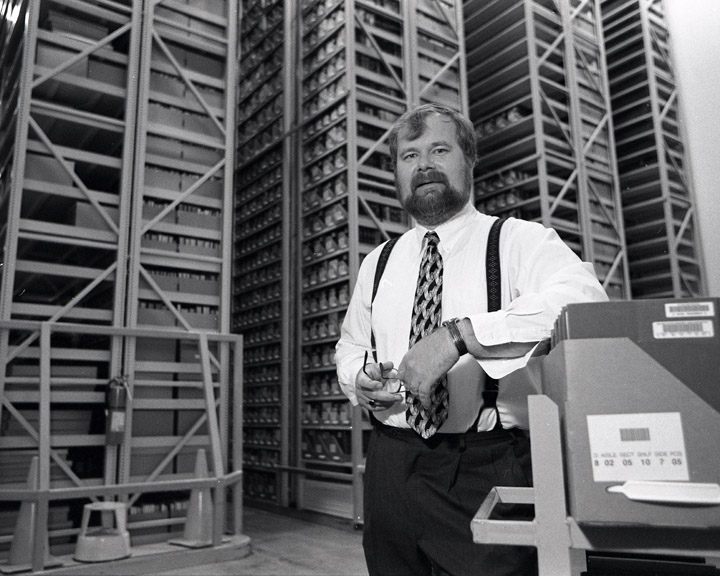
Goerler in the University Archives/Book Depository stacks, 1998

Goerler in the University Archives/Book Depository stacks, 1998

When Raimund Goerler began his career as University Archivist in 1978, there were approximately 3,500 cubic feet of OSU historical materials spread among five rooms of Converse Hall. The Archives shared space with ROTC areas, such as the shooting range, that were not so friendly to quiet research. By the time he retired in 2010, the Archives included roughly 15,000 cubic feet of materials, housed in the Book Depository, a state-of-the art, climate-controlled compact shelving facility on Kenny Road.

It was partly because of Goerler that the Archives made the move. When the Libraries was planning to construct a building for the overflow of books from Thompson and departmental libraries in the late 1980s, Goerler suggested the Archives be included in the space. Despite how slowly the wheels of bureaucracy usually move at such a large institution, it apparently took a mere 24 hours for the powers-that-be to determine how good an idea it was and approve the addition, according to a 2011 oral history interview with then-Libraries Director William Studer.

Goerler and Ruth Owens, 1989

Goerler and Ruth Owens, 1989

The Archives moved to the Book Depository when it opened in 1995. The facility houses not only University records, but also high-profile University Archives collections like the Jesse Owens Papers and the Woody Hayes Papers, which Goerler was responsible for bringing to the Archives. And Goerler helped found two other valuable special collections: the Byrd Polar Research Center Archival Program in 1990 and the Ohio Congressional Archives in 1998. (That collection started with the John Glenn Archives.) Both collections are housed at the Depository.

Goerler also started the University Archives’ oral history program, capturing reflections and recollections of hundreds of Ohio State University faculty, staff, and students, and at least four of its former presidents.  He and his wife, Sharon, generously created an endowment to support the Archives’ oral history program. He began an OSU History class to teach undergraduate students more about their university (now there’s usually a waitlist), and he made countless presentations to alumni clubs throughout the nation while serving as University Archivist.

book_coverHis contributions were not limited to the Archives: He served as Associate Director of Special Collection for the Libraries from 2000 to 2010, and he was interim director of the Libraries in 2009, a pivotal period that included the completion of the renovation of Thompson Library and the seismic move of its staff and collections from their temporary digs on Ackerman Road back into the newly renovated building.

Throughout his career, Goerler authored a number of articles and books related to OSU history and polar history. His most notable – for the University Archives – is The Ohio State University – An Illustrated History, published in 2011 and now in its third printing. The book is an essential resource for researchers, (and the Archives staff when there’s a quick reference question to answer), and an ongoing source of income for the Archives: Goerler generously directed the royalties of the book to the University Archives.

Twelve Days: Kleberg’s true colors shine through as a donor

(In celebration of the University Archives’ upcoming 50th Anniversary in 2015, we bring you “The Twelve Days of Buckeyes.” This is day 10 in a series of 12 blog posts highlighting the people who were instrumental in the creation and growth of the Archives.)

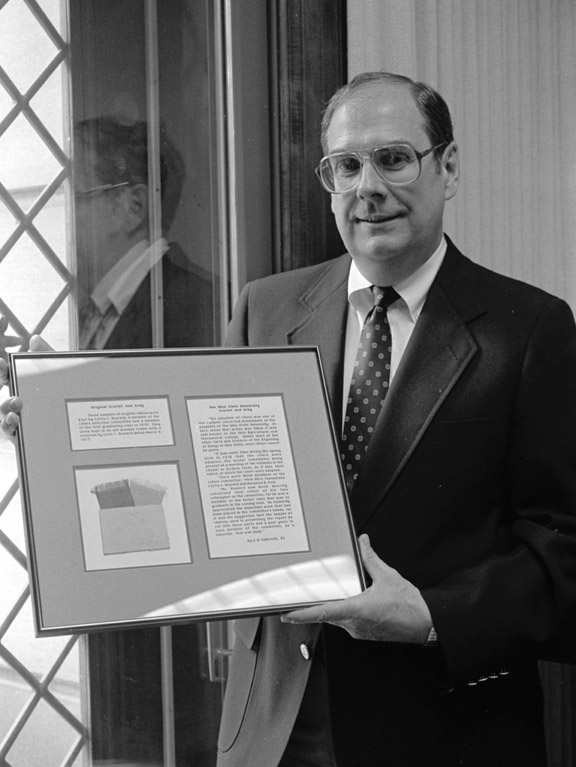
John Kleberg with the scarlet and gray ribbons, 1989

John Kleberg with the scarlet and gray ribbons, 1989

There is nothing more synonymous with being a Buckeye than the colors Scarlet and Gray. And the person Buckeyes can thank for preserving the earliest beginnings of those OSU colors is John Kleberg.

First, a little background on Kleberg: He came to OSU in 1973 as associate director of Public Safety, taking charge of the operations side of the Campus Police unit. In 1981, he was appointed as director of the University’s internal audit unit in the Office of Business and Finance.

Although his background is in law enforcement, he has been heavily involved in preserving OSU history since his retirement in 2000 as assistant vice president of Business and Finance. (He returned in 2001 as Special Assistant to the Vice President of Student Affairs.) For instance, he’s served on the committee that coordinated the program to record, preserve and restore works of art on campus. He’s also spent much of his university-related time after retirement in raising money and awareness for the historic Cooke Castle on Gibraltar Island in Put-in-Bay.

Cooke Castle was built by Jay Cooke, the Civil War financier who bought Gibraltar Island in 1864. There, the family entertained such dignitaries as Supreme Court Chief Justice Salmon P. Chase, President Rutherford B. Hayes and General William Tecumseh Sherman. In 1925, Cooke’s daughter, Laura Barney, sold Gibraltar Island to then-OSU Board of Trustees member, Julius Stone, who immediately donated the property to the University to house a lake research facility that would become Stone Lab.

Cooke Castle, 2001

Cooke Castle, 2001

Kleberg has worked tirelessly to restore the historic Cooke Castle, and in fact, with his help, the first floor of the Castle, which had been closed for a number of years, is now open to the public at certain times. The Archives also has benefited from Kleberg’s interest in Cooke Castle; three years ago, he gave us a number of materials he’d gathered on Jay Cooke.

Kleberg has given a myriad of items to the Archives over the years. They often represent the more mundane history of a large educational institution – an old class microscope he picked up at a University surplus auction or two police badges from the Department of Public Safety.

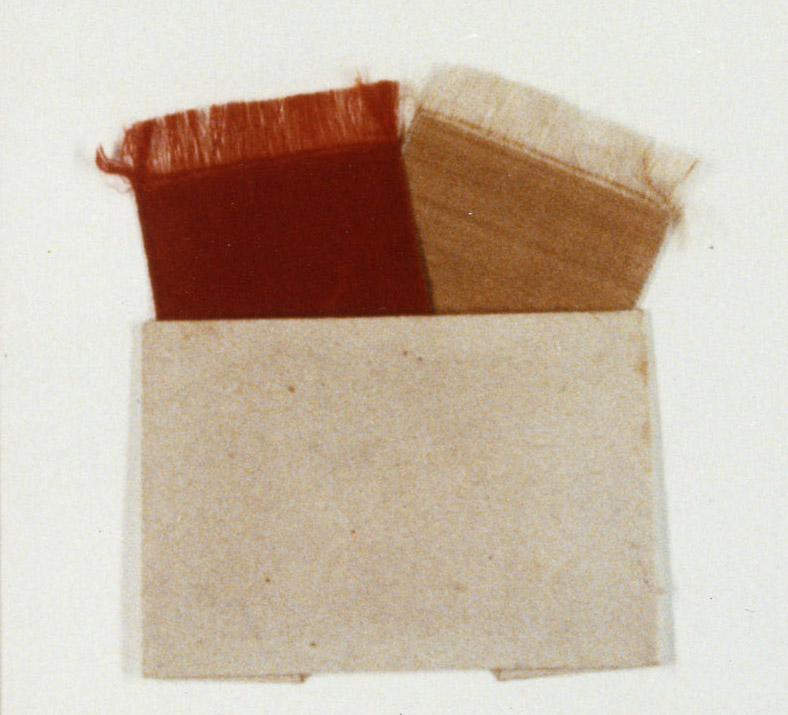
Then, there was the truly one-of-a-kind historical artifact he donated that makes him a standout among donors: the original scarlet-and-gray ribbons that adorned the diplomas of the first graduating class in 1878.

Original scarlet and gray ribbons

The original scarlet and gray ribbons

When it was almost time for Commencement that year, the class assigned a committee of three to pick out a pair of sample ribbons to determine which color of ribbons would be tied around the diplomas. The original pair of scarlet-and-gray ribbons they chose were cut into three parts, and a section was given to each committee member as a memento. Years later, one of the members – Curtis Howard – found his and presented them to the University in a frame with a letter attached to the back explaining their significance. They were hung in Sullivant Hall, but as sometimes unfortunately happens, the framed ribbons went missing at one point.

In the late 1980s, a gentleman identifying himself only as an attorney representing an estate in Florida, showed up in Kleberg’s office with the ribbons and some documentation. Kleberg did some subsequent research and determined they were most probably part of the original ribbons. And then, he made sure they made it to the Archives.

Without his dedication to preserving OSU history, those ribbons may have ended up in Kleberg’s wastepaper basket, and Buckeyes would not have these priceless reminders of how we became so devoted to Scarlet and Gray. So for all his contributions to OSU, we give him a hearty thanks from the Archives!

Older posts Newer posts