From Woody's Couch

Our Playbook on OSU History

Author: haire.14@osu.edu (page 9 of 13)

In remembrance: Charlotte Remenyik, OSU fencing coach

We were saddened to hear of the death of former OSU fencing coach, Charlotte Remenyik, on December 21, 2011.

Remenyik gives a coaching tip to a fencing student, 1981

Her success as a coach at OSU was just the tip of the iceberg of what was a fascinating life:

Remenyik was born on Sept. 5, 1934, in Hungary, an only child to parents of the upper middle class of that country. She learned to fence at a young age. In an interview conducted by OSU Quest in 1981 she said: “I love sabre fencing the best…Although they don’t allow women to compete in sabre or epée, only foil, that is what I grew up with in Hungary—in Transylvania. My cousins, all boys, would come home from military school on vacation, and they would practice their sabre fencing. I was the youngest cousin and the only girl, and they would say, ‘No, Charlotte, you cannot do that. You are a girl, and you are too small.’ I guess that irked me enough to go out and learn sabre.”

Remenyik was just five years old when World War II broke out in Europe. When the war ended, the Russians occupied Hungary, and “we ended up on the wrong side of the peace treaty,” she said in a 2001 OSU Archives oral history interview. “That changed life drastically. During the war, we had shortages of food, bombings and air-raids, but life until 1945 was pretty good for me. [The change] started when I was declared the enemy of the state because of my birth, because of my family.”

Remenyik fled Hungary after the revolution in 1956. When she arrived in Chicago with her husband she knew she wanted to teach fencing, but she had only a high school education and spoke only Hungarian. “My husband got a job in Chicago in a factory and I also worked in the same factory for a while,” she recounted in the oral history interview. “Later I advanced to the office because I knew how to add, subtract, multiply and divide.  I did payroll.  Didn’t need to speak a lot of English. Chicago was like outer Siberia as far as fencing was concerned.”

She quickly learned English, though, and set about getting an education that would make teaching fencing a reality. Remenyik received her associate’s degree from W.R. Harper College in Illinois in 1971, then she went to Northwestern University where she received her bachelor’s degree in physical education in 1973. All the while Remenyik continued to compete throughout the Midwest, including ranking 11th at the U.S. Olympic Trials in 1972. After graduation she became the women’s fencing coach at Northwestern, where her team won championships under her leadership for five years. The Remenyik Open competition at Northwestern is named in her honor.
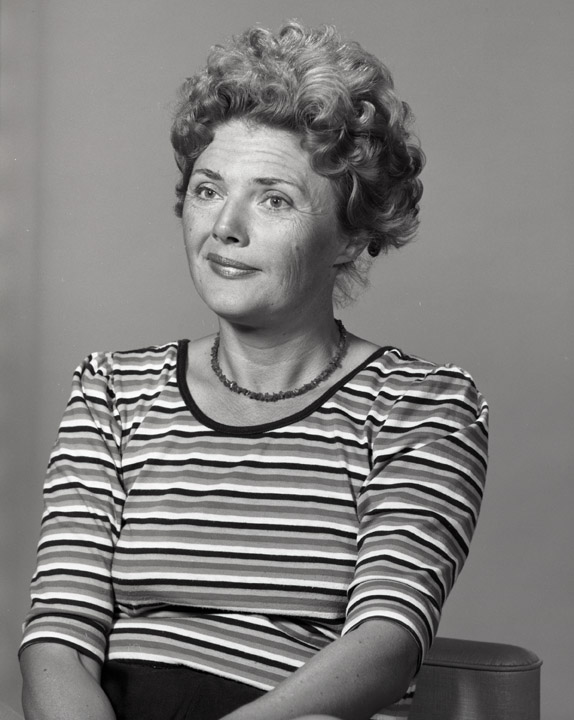
1984 portrait of Remenyik

In 1978 Charlotte Remenyik came to Ohio State to coach the OSU women, which a few years later would include her daughter, Csilla. In the fall of 1980 she made OSU history by becoming the first woman to coach a men’s varsity team—and as the first woman to coach both the men and the women concurrently. Both teams did very well, even though at that time many of the men were recruited from the beginning fencing classes at OSU. The women’s team, on the other hand, had scholarships, which attracted top fencers to OSU. Under Remenyik’s leadership from 1981 to 1984, the women won the Big Ten title each year, and the men placed third in the 1985 Big Ten Championships. In all, her programs turned out sixteen All-Americans. She also served on the NCAA Sports Committee for Fencing (1981-86), designing the format for the women’s NCAA championships. It was later used as the model for the men’s championships.
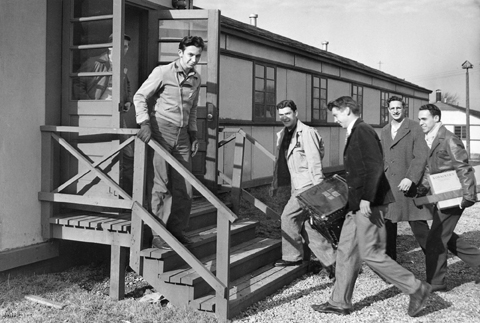
First Buckeye Village residents: WWII veterans

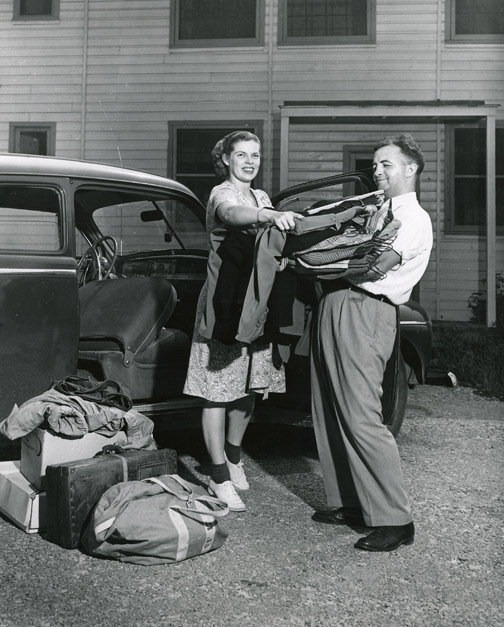
Veterans moving into GI Village, 1946

When World War II ended, young veterans taking advantage of federal financial support for getting a college degree, flooded university campuses, including Ohio State. The influx created a housing crisis here:

  • a huge debate raged over whether the women who occupied Baker Hall during the war should be kicked out for the men to live there again;
  • men were bunked all the way out at Port Columbus and were transported to campus by bus;
  • 185 trailers sat on the state fairgrounds, mostly occupied by married students who could not find accommodations elsewhere.

State Fairgrounds trailer park, 1946

Needless to say, OSU had a problem.

In honor of Veterans’ Day, we thought we would post something about the G.I. or Veterans’ Village, which we now recognize as Buckeye Village on Olentangy River Road. The G.I. Village got its start after WWII, when OSU was going through a housing crisis. There were already men bunked at the Stadium and at Port Columbus. There were arguments as to whether men or women would occupy Baker Hall and other dorms. There were also 185 trailers parked at the State fairgrounds as of May, 1947, mostly

The solution was a number of housing projects, the largest of which was the GI Village, which would house 810 men in barracks-like emergency housing units. Using federal grants, the T-shaped structures were built on University-owned farm land – where Buckeye Village stands today – and ready for occupancy before autumn quarter of

GI Village couple

1947. At the same time, another project to put student housing under the west side of Ohio Stadium was also in progress; that project added yet another 390 beds for men.

It was not until the autumn of 1948 that apartment-style accommodations for married veterans were available. These facilities were also built at the GI Village, and were in high demand: 800 applications were received for the 152 family housing units in 1947. An additional 200 units were available the following spring. Rent for the students was between $29 and $43 per month and was based on the size of the unit. The units also came partially furnished, and were awarded based on the veteran’s present housing conditions and number of years at the University and in service.

Filed by C.N.


Pomerene’s ‘palatial feel’ to be restored

Pomerene Hall, 1927

The state’s Controlling Board has given the go-ahead for a make-over of Pomerene Hall, which served for many years as Ohio State’s women students’ union. (See Columbus Dispatch article link below.)

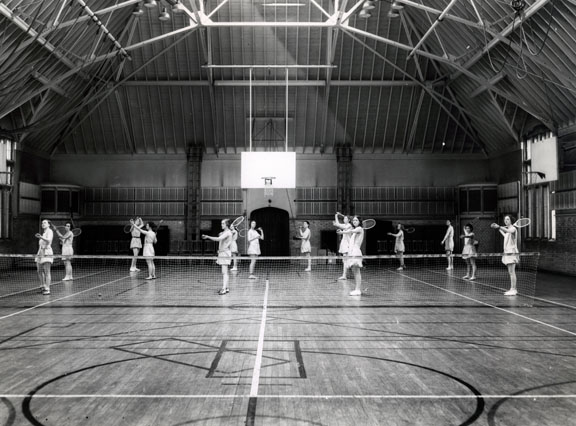
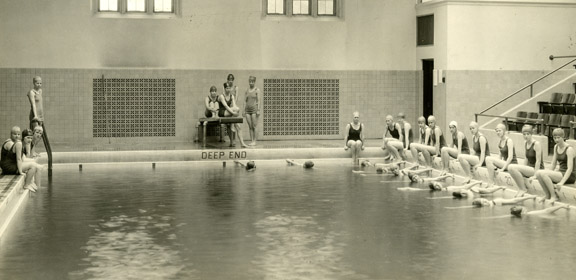
Designed by architecture professor Howard Dwight Smith, Pomerene was built in two phases. The 1922 section contained a gymnasium, where women’s physical education classes were held, and social rooms. A second phase in 1927 added a natatorium, lounges, a kitchen and refectory. The Dean of Women’s offices also were housed there, as were lounges, meeting rooms and a food-service unit called the Refectory. The building was named after Frank Pomerene, an 1891 graduate and one-time member of the Board of Trustees.

Pomerene Hall dining room, c1940s

The Refectory’s first home had been in Campbell Hall, but it was moved to Pomerene when the second building opened. In addition to serving food, the eatery served as a laboratory for students in the Institutional Management Division of the School of Home Economics. Agnes Skinner Smith managed the Refectory for more than 40 years, until she retired in 1968.

Following the construction of the Ohio Union in 1951, Pomerene Hall lost most of its original functions; however, many of he women’s physical education classes were held there until the late 1970s when an addition to the Larkins recreation center was built, allowing for more men’s and women’s locker room space.


Since then, Pomerene has housed various University programs and offices, including the School of Physical Activity and Educational Services. That department moved in 2006 to the then-new RPAC building.

Tennis class, 1932

Pomerene Hall swimming pool, n.d.


Here’s the Dispatch article link: 

http://www.dispatch.com/content/blogs/the-eteam/2011/10/ohio-state-renovation.html


Older posts Newer posts