From Woody's Couch

Our Playbook on OSU History

Author: drobik.5@osu.edu (page 53 of 62)

“Buckeye Stroll” now in the Apple App Store

Want to learn OSU history? There’s an app for that.

Buckeye Stroll, OSU’s online historical campus tour, is now available in Apple’s mobile application store for the  iPhone, iPad and iPod Touch. Download the application, and with a GPS-enabled device, you can learn about OSU history as you walk around campus. Nearly 100 buildings are featured, with photographs and brief histories. The tour was created through a collaboration of the Libraries’ Web Implementation Team and the University Archives. Buckeye Stroll also is available on the Libraries’ web site at: http://library.osu.edu/buckeye-stroll

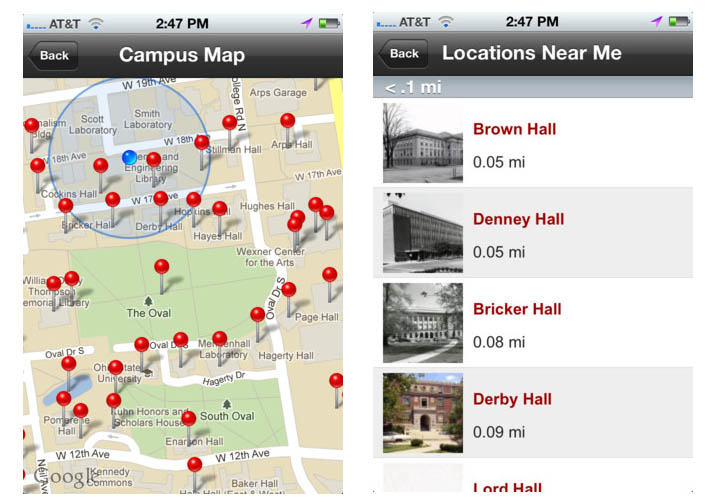
Here are a few screen shots from Buckeye Stroll:

The Buckeye Stroll application will locate you on the map and display your position as you walk across campus (left screen shot). It will also sort the buildings by proximity to your location (right).


Twelve Days of Buckeyes: Win or lose, we’ll always be nuts about OSU

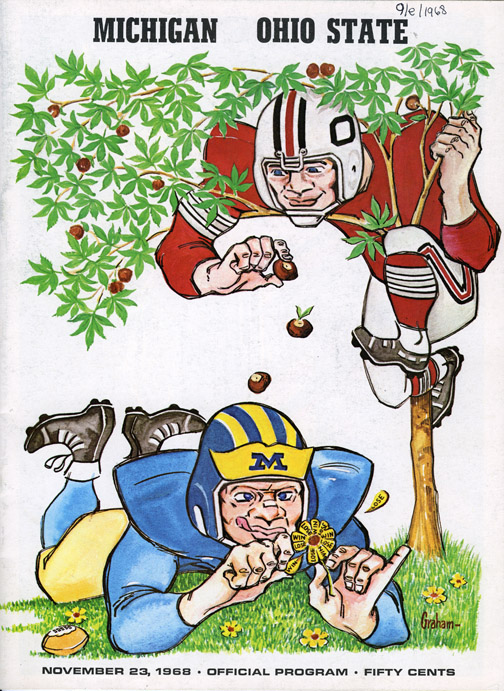
Football program cover, 1968

How often have you said you’re going to go watch the Buckeyes play [fill-in-the-blank-sport]? Though the term “Buckeye” has been around for hundreds of years, the nickname for Ohio State athletic teams has a much shorter history.

The nickname in English derives from the Native-American term, “Hetuck,” which can be translated as eye of the buck. Native Americans apparently first made the reference when they saw a procession of settlers in 1788. Ohioans have been referred to as Buckeyes as far back as when William Henry Harrison was running for president in 1840.

And here at OSU, in terms of sports, “Buckeye” has been used as an intramural sports team name since about 1900. A short article in a 1902 issue of The Lantern concerns an intramural baseball game in which one team apparently was less than experienced at the sport:

“The Buckeye and Columbia clubs played a game of ball on the University diamond Saturday afternoon, and as a result the former now heads the Boarding House League. The score was 8 to 4. The victory was mainly due to the fact that a number of the Columbia players failed to understand the various hits sent in their direction, all these misplays being in evidence in the score.”
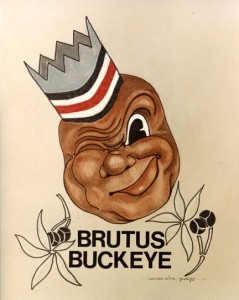
1975

The first time “Buckeyes” shows up in The Lantern when talking about Varsity sports isn’t until 1951 when, again, baseball is the subject:

“The Buckeye baseball team treated home fans to a double victory over the week end with wins over Dayton University and Bowling Green. Friday the Buckeyes trounced the Flyers, 15-1, and followed with a win over the Bowling Green Falcons in a Saturday game.”

So it might be surprising that “Buckeyes” has been used regularly for only about 60 years, but is it really hard to believe that the first Lantern article in which it appears is about not just one but two OSU victories?

You may play sports for OSU, cheer the teams on or you might not pay any attention to them at all. It doesn’t matter. Being a Buckeye can mean different things to different people, but it still means a lot. We hope you have enjoyed this season’s version of “Twelve Days of Buckeyes,” and that your new year is a happy and successful one.



Twelve Days of Buckeyes: Why “Carmen, Ohio” is our alma mater

Fred Cornell, 1915

It’s hard to imagine a home football game not being followed by the team and fans singing OSU’s alma mater, “Carmen, Ohio.” It took years, however, for this ritual to become a steadfast tradition.

Fred Cornell, a member of the Men’s Glee Club in the early 1900s, definitely wrote the lyrics, but it’s unclear how he was inspired to do so. One story has Fred writing the song in the fall of 1902, on the train taking him and the football team from Ann Arbor, after a loss of 86 to 0. Cornell felt that the team and fans needed an inspirational song to lift their spirits.

A more likely account, supported by a 1910 article in the Alumni Monthly, has Fred himself saying that he wrote the piece in the fall of 1903, because the Glee Club was looking for an alma mater. There were several entries submitted by women, and Cornell was urged by several other men to write something.

What’s not in doubt was that it was first performed in 1903 on New Year’s Eve at an off-campus event. The first on-campus presentation was at the Wednesday Convocation, when students returned to campus. It was then sung at football games, but did not have any great popularity at first. The tune also seems to have been undecided for some time, with several different pieces of music used until the Spanish March was finally chosen.

By 1918 “Carmen, Ohio” was played on the chimes at Orton Hall everyday at 4:30, following taps. A phonograph record was produced of the song in 1921.

Older posts Newer posts