From Woody's Couch

Our Playbook on OSU History

Author: drobik.5@osu.edu (page 52 of 62)

Bleeds Scarlet and Grey: Col. George L. Converse

Col. George L. Converse, n.d.

The Reserve Officers’ Training programs for the Army, Navy and Air Force are such fixtures at OSU that it would be difficult to imagine the campus without them. There was a time, however, when there was no such thing as the ROTC program. With the help of George Converse, and several other OSU leaders, the national ROTC program was created and the OSU program flourished.

Converse, who grew up on a farm near present-day Cleveland Avenue, enrolled as a freshman at OSU at age 17, in 1874. After his first quarter, however, he received an appointment to West Point, and eventually graduated in 1880. Two years later, he was a member of the 3rd U.S. Cavalry in Wyoming, when his company was sent to Arizona to combat the uprising by the Apaches, led by Geronimo. In one battle, Converse was shot in the eye and had to ride on horseback for 40 miles to receive medical treatment. The bullet was never extracted, and the rest of his life he wore a black eye patch. University lore said that he could see more with his single eye than most men could see with two.

Due to his injury, he retired from active duty in 1884 and returned to Columbus. He was later called back to serve in the Spanish American War, but returned again to Ohio State in 1900 to serve as the University’s first Commandant of Cadets in the Department of Military Science. He held that position, as well as a professorship and subsequently chairmanship, of that department for 18 years. During his tenure, enrollment grew from 400 to almost 3,000 students. Commandant Converse, whom students affectionately referred to as “Commy,” also gave regular Thursday morning talks to male freshmen. (On Wednesday mornings, the freshmen listened to President William Oxley Thompson.)

Converse Hall, 1949

With the outbreak of World War I, Converse returned to active-duty status, this time as examining officer for all Ohio officer training camps. During that period, as he continued his teaching duties at OSU, he also co-authored the Ohio Plan, along with Pres. Thompson, Gen. Edward Orton Jr. (professor of ceramic engineering) and OSU alumnus Ralph D. Mershon. That plan, which outlined university civilian training programs, became part of the 1916 National Defense Act, which established the ROTC as a national program.

In 1918, he left OSU when the military promoted him to district inspector, overseeing officer training camps in Ohio, Indiana, West Virginia and Kentucky. In 1920, he retired from the military—for good—and returned with his wife, Effie, to their house on Neil Avenue. (Effie had served as interim Dean of Women during the 1918-19 academic year.) He died on November 16, 1946.

Five years before he died, ground broke on the ROTC building, on February 17, 1941. In 1973, the Board of Trustees voted to re-name the building after Converse, who had served longer than any other Commandant at OSU.

Filed by C.N.

Buckeye-D, from the heart

#1 Couples at dance, 1936

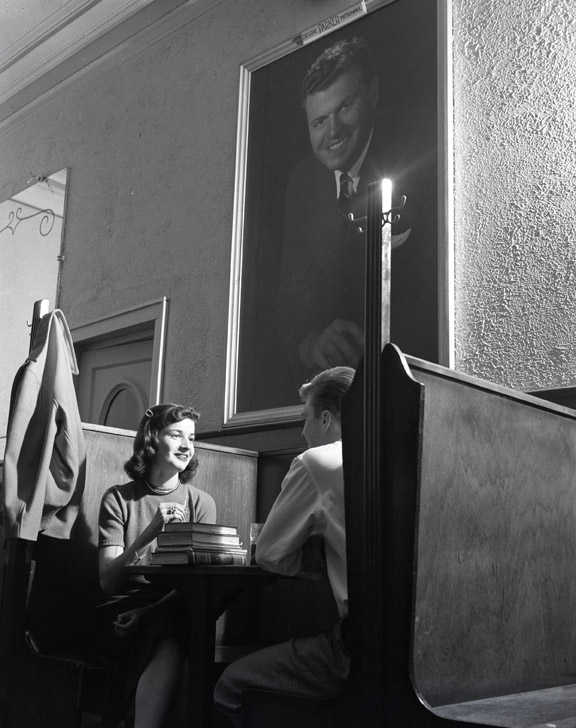
In honor of Valentine’s Day this year, we thought we would tell you about a reader survey on top places to meet a future significant other; post some real-life “Happily Ever Afters” from OSU’s past, and show old photos of romantically linked – but sadly, unidentified – couples on campus.

Throughout the blog, we’ve placed photos of couples, some of whom look desperately in love, and all of whom desperately need identification. As you read the blog, see if you can place names to faces, and if you can, please e-mail us at: archives@osu.edu   Don’t forget to include the number of the photo!

Now, the survey: In June 1991, The Ohio State University Alumni Magazine published the findings of a reader survey on the top places to meet your future significant other (based on the number of resulting marriages). They were:

  1. in class;
  2. at a Greek house or event;
  3. at a dorm or dorm event.

    #2 Couple in front of fraternity house, c1970s

The top five all-time places to take your date (1910s-1990s) were:

  1. Mirror Lake and Libraries;
  2. Ohio Union (of any era);
  3. Greek house or event
  4. Football game
  5. Hennick’s Drug Store. Hennick’s, which was located at 15th and High, was the campus soda fountain of the 1930s and ’40s.

It seems odd that the library would top a football game as the best place to take a date, but there you have it. Meanwhile, here are a few stories from the June 1991 issue of alumni magazine of some real-life Buckeye couples:

#3 Couple at Hennick's, n.d.

David L. Sherck, ’57, was so sure that K. Carol Dixon, ’56, would marry him that he asked his fraternity brothers to gather at Mirror Lake to sing the sweetheart song while he proposed. They were married in June 1957.

When it began raining during the June 1941 commencement ceremony at Ohio Stadium, many fled for cover underneath the stands. It was there that Irving R. Lackritz, ’39, proposed to Dorothy S. Krakoff, ’41, in front of both sets of parents. They were married in November 1941.

Richard and Elizabeth Goertemiller, both Class of ’50, were at the 1950 OSU-Michigan game – now known as the “Snow Bowl” – when he proposed. She was so cold, she could barely say “yes,” but she did, and they were married in April 1951.

#4 Couple on campus, c1970s

#5 Freshmen dance at Ohio Union, 1967


Filed by C.N.

Bleeds Scarlet and Gray: Herbert A. Toops

Herbert Toops, 1941

We are celebrating Prof. Herbert A. Toops because it was this week in 1975 that the Board of Trustees named a prize after him for creativity in psychology. And creative Toops was. The expert in standardized testing became involved in data processing, and the psychology department ended up with a free computer because of it, courtesy of IBM.

Toops started his career at OSU as an undergrad, graduating in 1916 with both a B.A. and a B.S. in education. He earned a master’s degree in education the next year, then taught at OSU for a year. After receiving a scholarship to Columbia University, he earned his Ph.D at that university in 1921. After several years working for the U.S. Army and the U.S. Department of Labor, he returned to OSU in 1923 as an assistant professor of psychology. In 1927 he was promoted to professor.

During his 42 years as an educator at Ohio State, Toops became well-known for his work with standardized testing; in fact, he was the creator of the Ohio State Psychological Examination (OSPE), which at one time was given to all incoming freshmen to test their aptitude for college. In his work on standardized testing, he became involved in data processing. According to an obituary published in the Board of Trustees minutes after Toops’ death in 1972, his early involvement in data processing led to IBM giving the Department of Psychology a computer – it was the University’s first.

During his long career at OSU, he supervised 16 doctoral and 20 master’s degree candidates, and published more than 150 articles. He retired in summer 1965 and passed away on August 14, 1972.

Older posts Newer posts