From Woody's Couch

Our Playbook on OSU History

Author: drobik.5@osu.edu (page 5 of 62)

Orton Hall Chimes have struck the right chord with Buckeyes for 100 years

Orton Hall Bell Tower, 1995For 100 years, students making their way across the Oval have been serenaded by the Orton Hall Chimes – 12 bells that have become an integral part of the OSU experience for many in the University community. They were delivered to OSU on Feb. 11, 1915, after the classes of 1906, ’07, ’08, ’09, ’10, ’11, ’13, and ’14 banded together to purchase the bells for roughly $8,000. (The class of 1912, apparently a group of nonconformists, decided to donate a mantel piece to the Main Library).

The dozen bells, together weighing roughly 7 ½ tons and all tuned in D flat, were installed over the following weeks. According to a “Contract for Chimes” signed by the Board of Trustees with the manufacturer, the McShane Co., the bells were to be made out of Lake Superior copper (about three-quarters) and imported East India block tin, and they were guaranteed not to crack. At Commencement that year, the Chimes were officially dedicated, and also that year, a new organization called “The Chimes Club” formed to take charge of playing melodies at 11:50 a.m. and 4:50 p.m. daily. Chemistry Professor W.L. Evans noted at the time that it was “expected that the advent of the chimes will create a new interest in college music at OSU.”

Orton Chimes before installation, 1915

Orton Chimes before installation, 1915

A few years later, the classes of 1919 and 1920 purchased an automatic striker for the bells to mark the time of day, and by 1949, the bells were renovated and an electric clock device was installed so the Chimes would ring on the quarter hour and the full Westminster Quarters melody would play at the full hour.
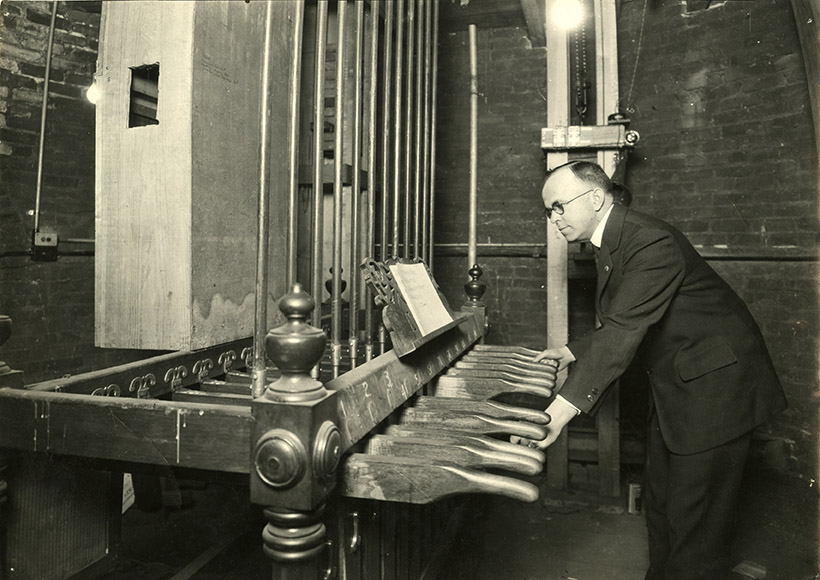
Allen McManigal, 1920s

Allen McManigal, 1920s

Meanwhile, the twice-daily serenades were still done by hand. Four faculty members – including Evans – traded the duty of climbing the 80-some steps twice a day to play the serenades in the Chimes’ early history. Later, an engineering drawing professor, Allen McManigal, took charge of the Chimes, playing them himself or supervising music students to do so. His direction continued for more than 25 years until his death in 1950; later, Music Professor Wilbur Held, an organ music specialist, supervised students. In the 1960s, these students, called Chimes Masters, were paid $25 a week for the responsibility of making it to the top of the tower in time to play such songs as “June is Busting Out All Over” on especially dreary or snowy days. In addition, “Carmen Ohio” was played during the football season, as well as carols during the holidays.

After roughly 60 years of ringing, the chimes needed a little tune-up, so the Class of 1978, in conjunction with OSU, made a $28,000 repair to the bells in 1985. A year later, a more modern electrical system was installed to automate the serenades as well, although an electric keyboard also was installed, making it much easier and less laborious to play by hand.
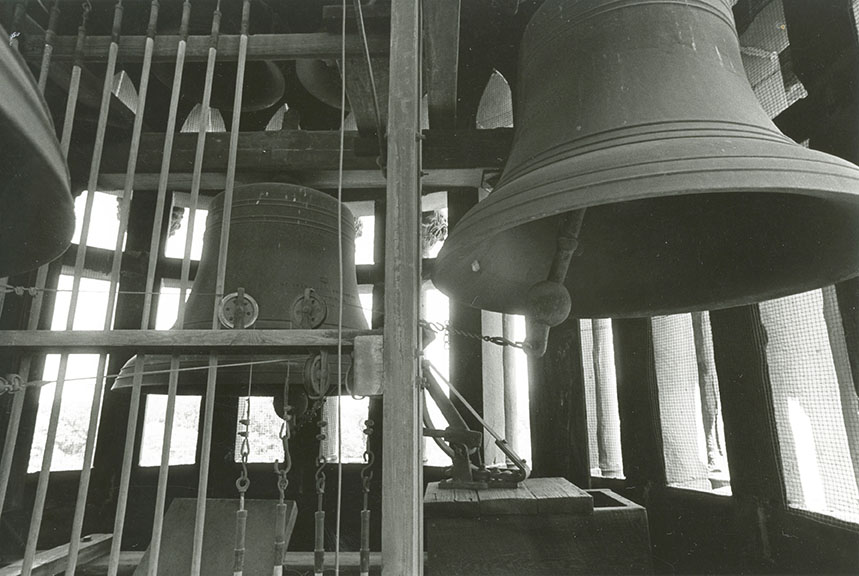
Orton Hall bells, 1985By 2003, two new bells were installed, this time chiming at G sharp and A sharp. This $12,000 addition enabled the Chimes Masters to have much more a variety in songs to play, which was often a complaint made by students over the years. These new notes could now play songs like “America the Beautiful” and “The Buckeye Battle Cry.”

On Wednesday, Feb. 11, 2015, the Ohio Staters, Inc., will host a 100th-anniversary celebration event at Orton Hall from 5:30 p.m. to 8 p.m. The event will feature remarks by President Drake, refreshments, a display of related artifacts and tours of the tower. For more information go to the Staters’ Facebook page.

Archivist Tamar Chute: Celebration, changes in store for Archives during 50th anniversary

Tamar Chute

Tamar Chute, University Archivist

It is an honor for me to serve as University Archivist at The Ohio State University, particularly this year as we celebrate the University Archives’ 50th anniversary. Students often ask me, “What does the Archives do?” My short, elevator speech is “The University Archives serves as the official memory of The Ohio State University.” How we do that is the complicated part.

First, we collect material. In 2014 the Archives accepted more than 240 items or collections from units on campus and generous donors. These ranged from a small diary written by an unknown student in 1931 to more than 50 boxes from the Advanced Computing Center for the Arts and Design. To make highly used items widely available, we have worked with partners throughout the Libraries and University to digitize material, such as the Board of Trustees meeting minutes, Course Bulletins, and the Makio.

Diary_inside

Student diary from 1931

Adding material online has increased the number of donations we receive and the number of questions we answer. In 2014, the University Archives answered nearly 3,000 reference questions from individuals ages 8 to 80! We’ve helped people with National History Day projects, term papers, books, and their search to find information about their relatives. In each case, the Archives staff searched our holdings to help in any way possible.

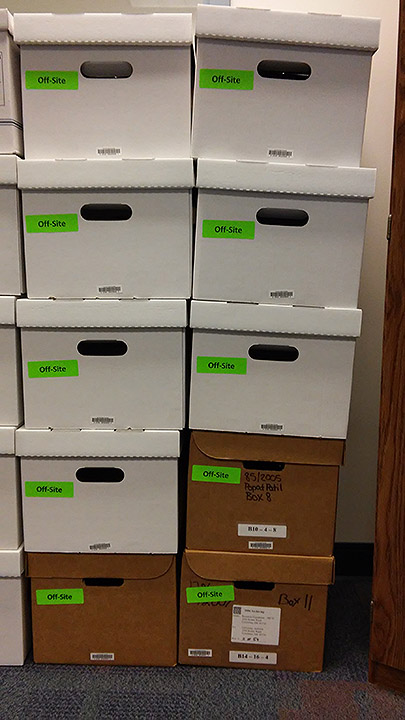
BoxesThe year 2015 will transform the Archives in many ways. Due to a lack of space in our stack area, nearly 14,000 boxes will be transferred to an off-site storage facility in February. These boxes will remain available to patrons but will require a little more advance notice to review (24 hours). At the same time, all of the Libraries’ Special Collections are migrating to a new online archives management tool, and the Archives will be working with a vendor to digitize our collection inventories. This means our inventories will be available to researchers any time and any place.

The year 2015 also will be the time to celebrate our past and look to our future. Be sure to keep reading our blog posts for updates and watch for a special feature about the University Archives in the March/April issue of the alumni magazine.

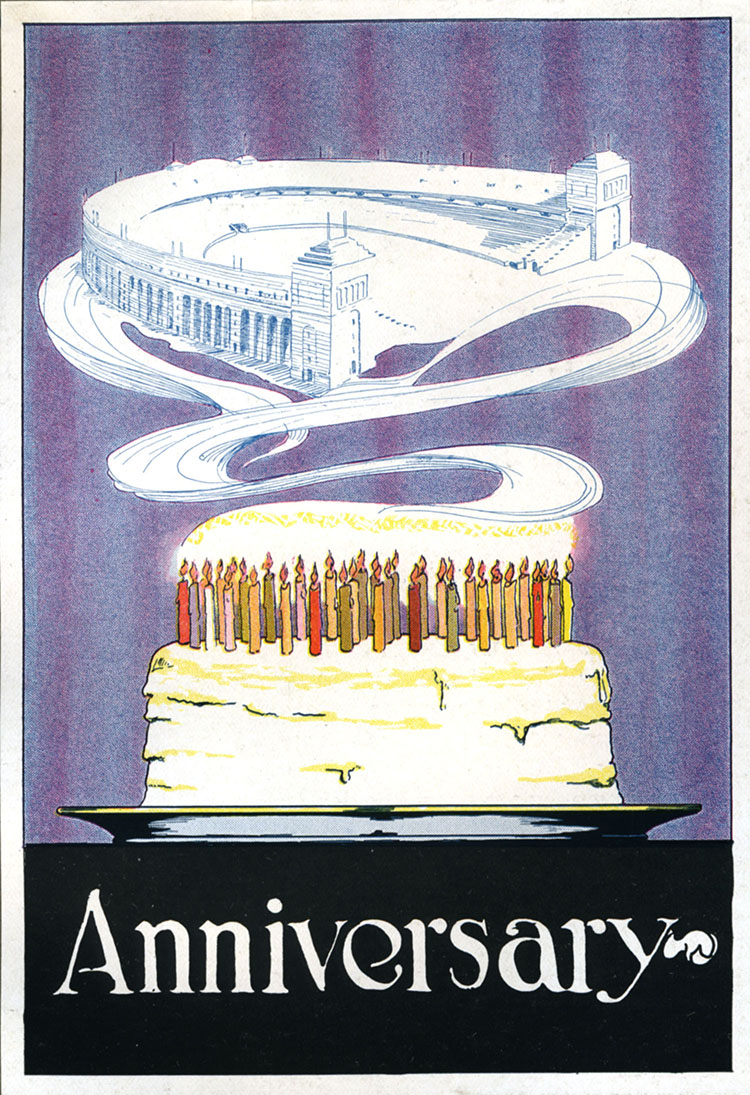
Sketch from the University's 50th anniversary celebration

In addition, I hope you can join us for our big anniversary event on May 14 from 4-7 p.m. Come toast the University Archives, take a tour of our facility, participate in a hands-on experience with interesting and unique artifacts, and watch rarely seen historical film footage.

All of us at the Archives are grateful for the support of so many people during the first 50 years of the University Archives. We look forward to celebrating our golden anniversary with you!

(Image at left is a sketch from the University’s 50th Anniversary Celebration in 1920.)

Twelve Days: For Woody Hayes and others, the Archives aims to ‘pay it forward’

(In celebration of the University Archives’ upcoming 50th Anniversary in 2015, we bring you “The Twelve Days of Buckeyes.” This is the last of a series of 12 blog posts highlighting the people who were instrumental in the creation and growth of the Archives. Stay tuned for more posts and other announcements related to our anniversary celebration next year.)

Woody Hayes, 1963

Woody Hayes, 1963

It’s been nearly 30 years since Woody Hayes’ death, yet his legacy is still very much alive for many people. Even OSU students who hadn’t yet been born when he died in 1987 know about Hayes. And although many these days can’t name many details – such as the fact that he still has the most national championships of any OSU football coach – they almost invariably can recall that he was some kind of an important figure at the University.

We would like to think that the Archives contributes a little to this continuing legacy.

The Archives has housed the Woody Hayes Papers since 1990, when his widow, Anne, donated them to the University. The collection includes papers, books, awards, memorabilia, photos and other effects.

Anne Hayes, n.d.

Anne Hayes, n.d.

Though it is larger than most, the collection of roughly 75 boxes is very similar to the dozens of faculty and staff collections housed here. Each collection’s materials document the careers of the people who have worked at OSU. Like many of these collections, though, Hayes’ goes beyond mere documentation of a career. His materials reflect a person whose job title was coach, but whose contributions to the University and community went far beyond that. Consider:

– Photos from his own U.S. Navy service during World War II. In these, Hayes is incredibly young but already shows leadership skills that would he would use for 27 years as OSU football coach. (He achieved the rank of Lt. Commander and was in charge of both a patrol boat in the Palau Islands and a destroyer escort.)

Hayes, (center), with two unidentified men, n.d.

Hayes, (center), with two unidentified men during WWII

– A wooden clock with a plate inscribed “Bryant-Foust Crippled Children’s Day Award presented to Woody Hayes…,” given to him in 1986. Hayes was a big supporter of charities that involved children and regularly visited patients at Columbus’ Children’s Hospital.

Letter from Richard Nixon, 1979

Letter from Richard Nixon, 1979

Correspondence with VIPs that include the likes of Bob Hope and Richard Nixon, both of whom Hayes considered friends. Nixon even gave the eulogy at Hayes’ funeral.

Hayes at 1986 commencement

Hayes at 1986 commencement

– A videotape of Hayes’ speech at the 1986 Winter Commencement ceremony, just a year before he died. It shows a frail, elderly but grateful man who was still spurring people to “pay it forward.”

As Hayes’ encouraged, we at the Archives hope we can “pay it forward” to the community by not only preserving such materials but making them available to researchers, classes and the community for years to come.

To learn more about Woody Hayes, please see our web exhibit commemorating the anniversary of his 100th birthday

You can also read a transcript of his Commencement speech.


Older posts Newer posts