From Woody's Couch

Our Playbook on OSU History

Author: drobik.5@osu.edu (page 48 of 62)

Spring is in the air: When Chadwick Arboretum comes alive

Chadwick Arboretum lake, 1994

What makes a college campus attractive? One of the key elements is its gardens, and OSU is no exception. The campus has had gardens dating back to the early 1880s, but they’ve never been just for show. The 1883 annual report to the Board of Trustees from the Department of Horticulture reported that:

“Owing to our long continued summer drouth (sic) the plants did not look as well as usual. [However,] By the completion of the Green-house … we will not only add to the attractiveness of the University, but also furnish a valuable means of illustration for the students of this department.”

For many years, the Horticultural Gardens were located behind Townshend Hall, just a stone’s throw from the Ohio Stadium. In April 1980, the Department proposed to establish the Chadwick Arboretum north of the Agriculture Administration building.  The Board of Trustees approved the proposal in July of that year, and a dedication ceremony was held in May 1981. At the time, the Arboretum included several acres of gardens along Lane Avenue, near the Agriculture Administration Building. In 1989 a lake was added, and in 1990, its first director was hired. The arboretum was then expanded to 36 acres, surrounding the OSU sports parks on the west side of the river. In 1995, The Richard and Annette Bloch Cancer Survivors Plaza was added to the Arboretum grounds on the northeast side of Olentangy River Road.

Lewis Chadwick, 1987

The Arboretum was named after Dr. Lewis C. Chadwick, an internationally acclaimed horticulturist, who worked extensively with OSU campus planners in selecting appropriate plants for various campus areas. He was employed for 38 years in Department of Horticulture, retiring in 1967. He kept up his University ties, continuing to work on projects—including the arboretum that now carries his name. Throughout his career at the University, Chadwick attempted to collect or produce landscape plants from around the world, as well as planting many trees across campus. He died in 1993 at the age of 91.


Filed by C.N.

SEL built as one-stop-shop for science majors

Science and Engineering Library, 1992

The Science and Engineering Library, the place to be over the years for many students who have needed a spot to work into the wee hours, will soon have a new name, to reflect its evolution from serving only science majors to serving as a bridge between the sciences and humanities.

When it opened in 1993, however, its collections were made up strictly of the sciences: Engineering, Physics, Chemistry, Mathematics, Astronomy, Materials Engineering, and Computer Science. Ten years earlier, a plan had been laid to consolidate these departments’ libraries into one building, in order to eliminate redundancies and improve the size and quality of study spaces.

Construction on the library began in August 1991, after the demolition of the Brown Hall Annex. The library was part of a three-building project, along with the Math Tower and a two-story classroom building, both behind the library on 19thAvenue. All three buildings were designed by Philip Johnson, an Ohio native and award-winning architect who also designed the AT&T Building in New York City and the Crystal Cathedral in California. Johnson received an honorary degree from OSU in 1988. SEL’s design employs the dominant motif of the late 19th and early 20th centuries—the Roman Arch. Art by Dale Chihuly, who specializes in hand-blown glass, was installed in the main lobby.

1992

The Science and Engineering Library opened on January 3, 1993, the campus’ only library to be open 24 hours a day, seven days a week. In autumn 2011, the Music and Dance Library collections were moved from Sullivant Hall to SEL, cementing the link between sciences and humanities.


Filed by C.N.


Kennedy Commons named for first dining halls director

Kennedy, 1940s

For nearly 40 years, June F. Kennedy dedicated her career to food science, particularly the feeding of OSU students. So, it’s only natural that the Board of Trustees named a dining facility after her.

Kennedy, who received a bachelor’s and master’s degree in Food Science and Nutrition from Missouri State University, was hired in 1920 as an assistant professor in the Department of Home Economics. She also was appointed head of the Institution Management and Dietetics program at that time. When Pomerene Hall was built in 1922, it included the Refectory, a campus restaurant also dedicated as a laboratory for institution management students. She took charge of the lab in 1934. She is credited with opening food service facilities to students in Campbell, Brown, Page and Arps Halls.

During World War II she took charge of the South Campus dorms and also coordinated food services for veterans housed in University housing at Port Columbus Airport, helping transport cooks and equipment to the site in the wee hours of early morning.

1959

In 1946, Kennedy was appointed as the University’s first food-services director, not an easy role with the huge enrollment growth after the end of the war. At the same time, until her retirement in 1959, she also taught upper-level courses in institutional management. She died in 1991 at the age of 100.

On April 1, 1983, in recognition of her long years of service, the Board of Trustees renamed the Women’s Commons to the June F. Kennedy Commons. The commons was built in various stages between 1939 and 1940 to serve the women’s dorms of Bradley and Canfield halls. A final addition connected it to Mack Hall.

Kennedy Commons, 1963


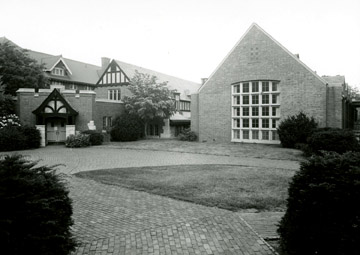
Recently, the Commons received a Silver rating in the LEED (Leadership in Energy and Kennedy Commons, 1963 Environmental Design) program administered by the U.S. Green Building Council. The 30,000-square-foot dining facility had been closed for a year for renovations, re-opening in the fall of 2011. It is the third building on campus to receive LEED certification; the first was the Ohio 4-H Building and the second was the Ohio Union. Read more about the Kennedy Commons’ LEED certification at http://urds.osu.edu/articles/urds/16.

Older posts Newer posts