From Woody's Couch

Our Playbook on OSU History

Author: drobik.5@osu.edu (page 46 of 62)

OSU’s Dad’s Day: a fall-weather festivity for fathers

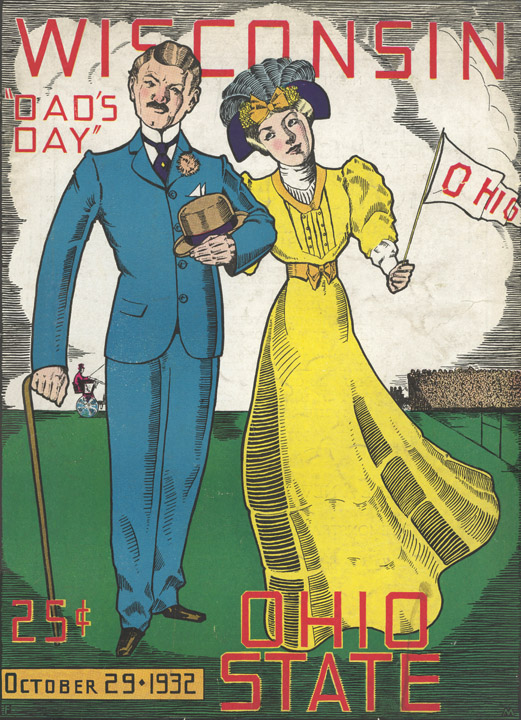
October 29th, 1932 football program cover for "Dad's Day"

In honor of Father’s Day this weekend, we decided to research a bygone OSU tradition: Dad’s Day. Dad’s Day was usually celebrated in late October or early November during a home football game to which students would invite their fathers. The football program for the game would include something about Dad’s Day, and the band would perform a special selection at half time. In 1921, which is the first mention of the celebration, many fathers were seated on the sidelines behind the home team. (We hope they had a better view than they would have today.)

In 1932 OSU parents created a Dad’s Day Association. (There was a Mother’s Association as well, but some mothers helped with the committee.)  In 1932 the association claimed that it would celebrate the ninth annual Dad’s Day that year, although that may or may not be correct. The celebrations continued to be an annual tradition through the 1950s; then it seems that the name changed to Parents’ Weekend. Parent’s Weekend seems to have been popular through the 1960s; after a long hiatus, it was reestablished in the 1990s and is now called Parent and Family Weekend.


Commencements past: Quarterly tradition ends

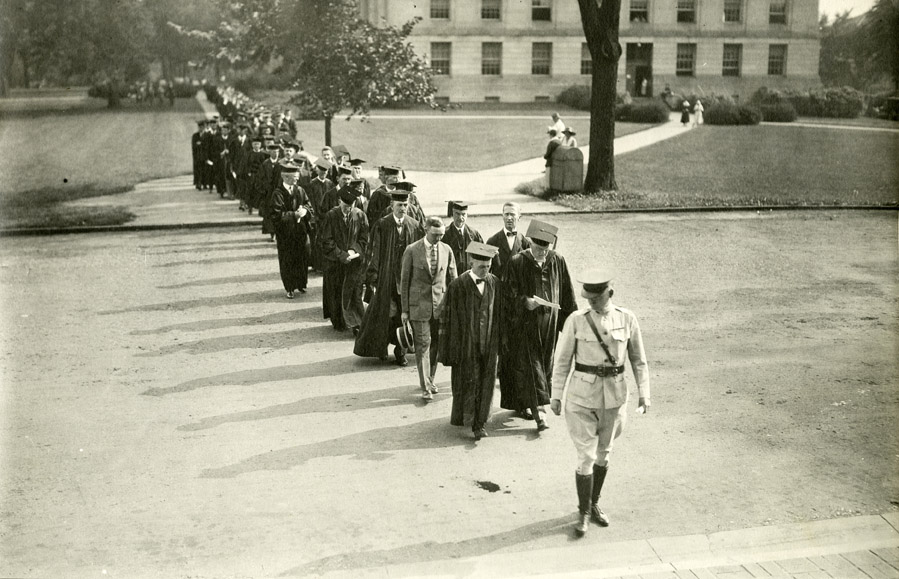
Commencement group marching from the Library to University Hall Chapel, August 31, 1923

When OSU’s first commencement ceremony was held in 1878, the University was on a semester system; the now-familiar four-quarter plan was not established until 1923. Talk of switching started during World War I when, in May 1918, the faculty voted at their regular meeting to urge the Board of Trustees to switch to quarters, saying such a move would improve the education for students. After an investigation into the matter, the Board made plans to switch the calendar to quarters in 1921. The plan was ultimately pushed back another year, and the first graduation on the quarter schedule was held on August 31, 1923.

Some facts about that first graduation:

Date of first academic-quarter commencement: August 31, 1923

Location: University Hall chapel

Number of degrees conferred: 151

President: William Oxley Thompson

Commencement speaker: Max Carl Otto, Professor of Philosophy, University of Wisconsin

Tuition paid that spring: $20

Examples of classes taken that spring: Hygiene; Pathogenic Protozoa; The Library and the School; Household Mechanics; Railroad Surveying; American Diplomacy since the Civil War (all 58 years of it) and oddly enough, Swedish Gymnastics

To all of the graduates of this year’s 400th and final academic-quarter Commencement, congratulations!

End of an era: Classroom bells go silent for semesters

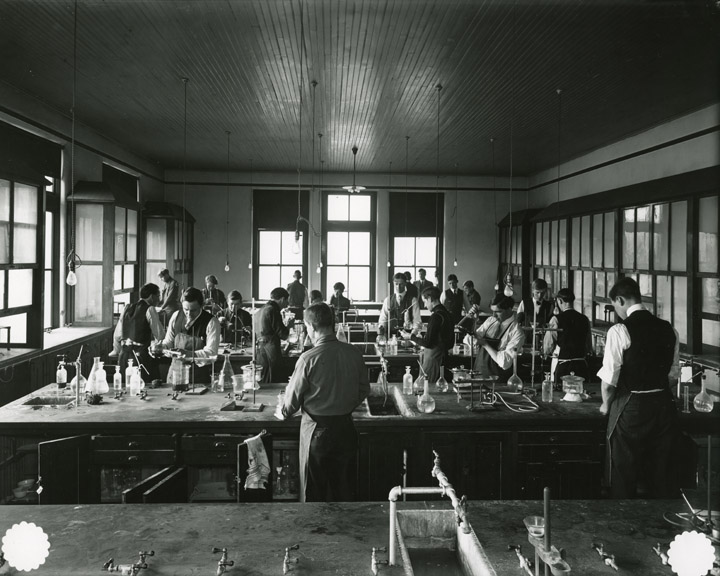
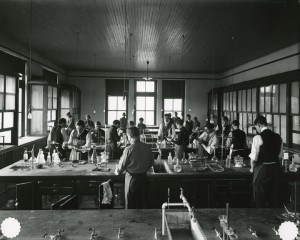
Metallurgy lab in Lord Hall, 1910

Someday, we’ll be noting in our blog, as we do with other historical campus events, the anniversary of this date – June 1, 2012 – the day the classroom bells stopped ringing permanently. With the conversion to semesters, and the subsequent wide variations in class times, the University decided to shut down the bell system with the end of this quarter. Today’s 4:18 p.m. bell will be the last.

It’s an end to what appears to be more than 100 years of bells signaling the start and end of classes in various buildings around campus.

The first reference to bells can be found in the minutes of the Board of Trustees’ Building Committee for the meeting of June 14, 1906. An appropriation of $45 was listed for bells to be installed in what later became Lord Hall, the home of the School of Mines and Engineering. Other expenses listed were electrical fixtures, electric lamps, motors, shades and chairs. At a similar meeting two years later, the minutes state that the committee approached the E. Howard Clock Company on the matter of obtaining a “Watchman’s Clock System for the various buildings of the University…for ringing the class bells…for the sum on $520.”

In 1920 John Coven, a master mechanic at the University Power House, explained to a Lantern reporter how the clock system worked. The bells are regulated from a clock in the chief engineer’s office. A wiring system linked that clock with all of the classroom bells. A spring, attached to the clapper, was wound every two weeks in every bell so that it would spring – and ring – when called to do so.  This system also tracked the night watchman and the campus policeman before the age of telephones. Stations were set up around campus with a button that would record the time and the station location so that, in the event of an emergency, an official could be located.

There’s been talk before of disabling the bells for good – most recently in 1993. The Classroom Coordinating Council and the Scheduling Office went so far as to conduct an experiment: Bells were disconnected in five buildings for a quarter. Surveys were then sent to 400 faculty and 300 students to see what they thought about the change. More than half responded, and in the end, the bells kept ringing.

To learn more about the disabling process, read this Columbus Dispatch story:

http://www.dispatch.com/content/stories/local/2012/06/01/at-ohio-state-its-o-h-bye-o-to-classroom-bells.html

Older posts Newer posts