

 This week marks the 20th anniversary of the Buck-ID, the ubiquitous ID for students and staff alike that started out as essentially a computerized meal ticket for dining-hall residents. It wasn’t the first ID on campus, though.
Until 1969, students used fee cards to prove they were, in fact, supposed to be on campus. These cards listed the amount of tuition and other fees charged for that quarter, then were stamped to show they had been paid. Any student caught with another student’s fee card could face serious disciplinary action.
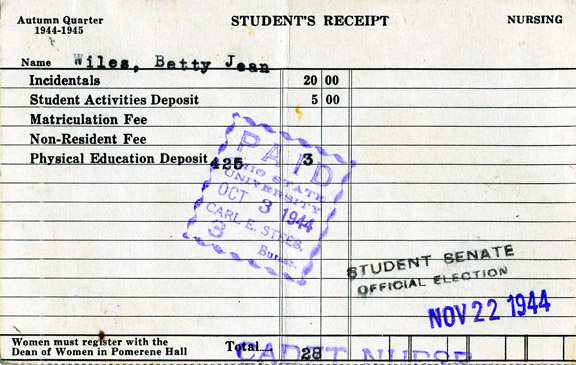
Student fee card, 1944
In 1969, the University introduced a new, plastic-coated card for students that was small enough to fit in a wallet, unlike the fee cards. On the front was each student’s photo, which was taken by the Department of Photography. The cards included the student’s name and Social Security number as well.
These cards evolved over time, until the first Buck-ID was introduced in 1994. These new cards were sturdier than the old identification cards, and had two magnetic strips on the back, as well as a barcode. They did not have Social Security numbers on them, which made the new Buck IDs more popular than the old IDs. And they gave students buying power.

A student uses a BuckID at Taco Bell, 1996
At that time, the Buck-ID was mostly a convenient alternative to meal tickets, though. Students could set up an account for $10, and parents or students could load more money for food at any time. This simple system took off: That year, 7,000 students signed up for accounts; two years later, 22,000 had Buck IDs. Meanwhile, the few businesses that were allowed to accept the card at the time reported a minimum of a 20 percent increase in sales the first year.
In 1997, the COTA bus system got on board: For an extra $9 fee, students could use their Buck ID to ride buses on any Columbus route for free. Eventually, new COTA routes, including those to the retail corridor along Sawmill Road and the Lennox Town Center, were added to better accommodate students.
By 2000, the Buck ID was transforming into what we know of it today, as not only a specialized credit card to be used at chain stores like CVS and even The Columbus Dispatch, but also as an ID, allowing students and staff access to buildings, library materials, and more.




Recent Comments