From Woody's Couch

Our Playbook on OSU History

Year: 2012 (page 20 of 25)

Spring is in the air: OSU Football is still king in the spring

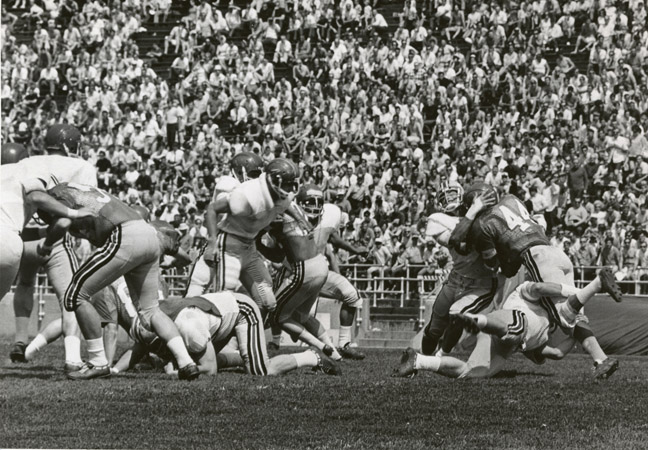
Spring Game, 1969

It’s springtime in Columbus: The birds are singing, flowers are blooming, and the Oval is full of students. It is the perfect time to think …football! Of course, at Ohio State every season is the perfect time to think football. Since the Spring Game is tomorrow, however, we decided to share a little history on this annual tradition.

The Spring Game (originally called “Reds vs. Whites”) is the conclusion of the spring practice season for the football team, and it’s also a way for the coaches to decide how the team will take shape the following season. Many times the game helps determine starters at important positions, such as quarterback, kicker, and running back. It is also a time for freshmen to impress the coaches. The Spring Game has been played since 1931 with few exceptions: During World War II, when many players were off fighting, and in 1990, mostly because of injuries, the game was cancelled because not enough players were able to participate.

Attendance at the Spring Game has continued to grow since the first game. According to The Lantern, attendance in 1946 was around 6,000 fans, plus 500 high school coaches. The following year attendance rose to about 14,000 fans. Ohio State holds the National Spring Game Attendance Record at 95,722 in 2009. Since the 1930s the athletic department has scheduled several events, such as baseball games, track meets and now lacrosse matches, to make the weekend more inviting for families. Until the 1990s the tickets were free to anyone but now cost around $7, with a portion of the proceeds given to a chosen charity. Charities have included the Ronald McDonald House, the Stefanie Spielman Fund for Breast Cancer Research, and this year, LiFE Sports, or Learning in Fitness Education, which uses sports to teach youngsters important life skills.
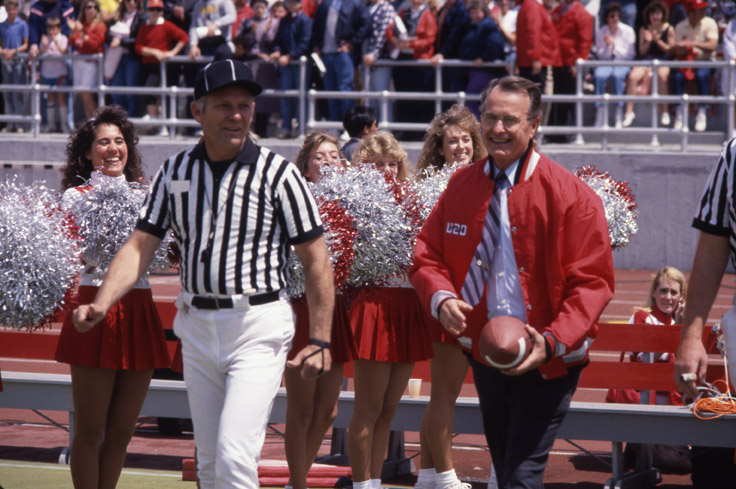
Vice President Bush, 1989

Over the past 81 years, the Spring Game has included some of its own traditions and had a few quirky moments. The Spring Game has been played in various places across campus, including the Ohio Stadium, various practice fields, and in 1999 the Woody Hayes practice facility, an invitation-only game. In 2000 and 2001 the Spring Game was played at Crew Stadium while Ohio Stadium was under renovations, limiting the crowd to 22,500 fans. Most years there are a familiar face or two on the sidelines: In 2003 when Eddie George, Chris Spielman and Luke Fickell served as head coaches, and in 1989 then-Vice President George H.W. Bush delivered the game ball to Brutus.


This Week in OSU History: ‘Dynamo’ takes over presidency

James Canfield, 1897

It turns out E. Gordon Gee is not the University’s first president who could be mistaken for a human sparkplug. Back in 1895, OSU’s fourth president was elected – James Canfield – and he was considered quite the “human dynamo,” too.

Canfield was born in Delaware, Ohio, in 1847, but his family soon moved to New York City, where he grew up and attended school. He graduated from Williams College, and briefly practiced law in that “state up north” before taking a teaching position at the University of Kansas in 1877, which he held for 14 years. His teaching focus was English, History, Civics and Political Science, and he became a sought-after orator.

In 1891 Canfield accepted the Chancellorship at the University of Nebraska, and four years later – on April 11, 1895 – he was elected President of Ohio State. The Board of Trustees knew his reputation as a “human dynamo,” so it should have come as no surprise to them that Canfield immediately went to work once in office.

One of Canfield’s first acts as president was to establish a lab in 1895 near Lake Erie (the precursor to Stone Lab. Under his leadership, enrollment surpassed 1,000 (1897), and the Power Plant and Armory were built. The University also added Domestic Science, Commerce and Administration courses to the curriculum.

Canfield Hall, 1940s

Canfield was by all accounts a very “take charge” person. According to the University’s 75-year history, he once stopped to ask the janitors and scrub-women why they were not on their hands and knees, scrubbing the floor. So it is no wonder that his administration was also marked with conflict – particularly over Canfield’s attempt to form a partnership between OSU and a Columbus medical college. It turns out the University did end up partnering with the Starling Loving Hospital—shortly after Canfield left office. The move ultimately led to the formation of OSU’s Medical Center.

Canfield resigned his post in 1899 to become the Librarian at Columbia University. He died in 1909.

In 1940, Canfield Hall was named as a tribute to him and his daughter, the novelist Dorothy Canfield Fisher.


Filed by C.N.


Spring is in the air: Evolution of the Oval

University Hall, 1897

It may come as a surprise to many, but the Oval was not in the original campus design. It was, as Shakespeare would have put it, a happy accident.  The original campus design was that of an English country manor: University Hall was set on the highest point, and a long curving drive ran diagonally across what is now the Oval towards present-day Page Hall, where the drive met High Street.  It was not until the 1890s – some two decades after the University opened – that the Oval began to take shape.

In 1890 the second chemistry building (the first had burned down, and yes, the second one also would  fall victim to fire) was built on the site of Derby Hall. In 1891 construction began on both Hayes Hall and Orton Hall. The Botany Building already stood on the site of the Faculty Club. So the North and South sides of the Oval were beginning to take shape. It should also be mentioned that several of the faculty members had homes on the grounds, including one that would have stood on the Oval today.

In 1893 the master plan proposed by Captain Herman Haerlin was the first to propose an open space on campus with no roads running through it. However, this space was described as a “quadrangle.” This plan was further aided by the completion of several new buildings: Townshend Hall, Biological Hall (on the site of Hagerty Hall), and the Armory. The roads on the North and South sides of the space were changed to connect all of the buildings, so now there were two roads linking High Street and Neil Avenue in a roughly circular shape.

In 1901 the end of the Oval closest to High Street was reshaped, giving it a more curved appearance, and making the Oval an oval. The diagonal drive that cut across the space was removed in 1912, the same year the Thompson Library was completed.

So, the Oval has changed little since 1901, which largely explains how it got its name. The first reference to “the oval” came in 1910. From 1912-1913 it was usually referred to as “the campus oval.” From 1913 to 1920 it was back to “the oval.” Note that it was not capitalized until 1920.

Oval, 1916

The Oval, prior to the Long Walk, 1913


In 1914 many of the walks on the Oval were repaved, and it was at that time that the Long Walk was constructed (the “long walk” was first mentioned in 1919 and capitalized, also beginning in 1920). Another major transformation occurred in the 1970s: the roads around the Oval were made pedestrian-only walkways. This explains how you can now walk out the front doors of University, Bricker, Orton, and Hagerty Halls without getting hit by a car.

Filed by C.N.

Older posts Newer posts