From Woody's Couch

Our Playbook on OSU History

Year: 2012 (page 19 of 25)

Kennedy Commons named for first dining halls director

Kennedy, 1940s

For nearly 40 years, June F. Kennedy dedicated her career to food science, particularly the feeding of OSU students. So, it’s only natural that the Board of Trustees named a dining facility after her.

Kennedy, who received a bachelor’s and master’s degree in Food Science and Nutrition from Missouri State University, was hired in 1920 as an assistant professor in the Department of Home Economics. She also was appointed head of the Institution Management and Dietetics program at that time. When Pomerene Hall was built in 1922, it included the Refectory, a campus restaurant also dedicated as a laboratory for institution management students. She took charge of the lab in 1934. She is credited with opening food service facilities to students in Campbell, Brown, Page and Arps Halls.

During World War II she took charge of the South Campus dorms and also coordinated food services for veterans housed in University housing at Port Columbus Airport, helping transport cooks and equipment to the site in the wee hours of early morning.

1959

In 1946, Kennedy was appointed as the University’s first food-services director, not an easy role with the huge enrollment growth after the end of the war. At the same time, until her retirement in 1959, she also taught upper-level courses in institutional management. She died in 1991 at the age of 100.

On April 1, 1983, in recognition of her long years of service, the Board of Trustees renamed the Women’s Commons to the June F. Kennedy Commons. The commons was built in various stages between 1939 and 1940 to serve the women’s dorms of Bradley and Canfield halls. A final addition connected it to Mack Hall.
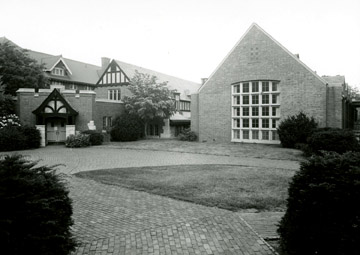
Kennedy Commons, 1963


Recently, the Commons received a Silver rating in the LEED (Leadership in Energy and Kennedy Commons, 1963 Environmental Design) program administered by the U.S. Green Building Council. The 30,000-square-foot dining facility had been closed for a year for renovations, re-opening in the fall of 2011. It is the third building on campus to receive LEED certification; the first was the Ohio 4-H Building and the second was the Ohio Union. Read more about the Kennedy Commons’ LEED certification at http://urds.osu.edu/articles/urds/16.
An ode to OSU’s First President and No. 1 Geology Fan

In the early days,  OSU’s yearbook, the Makio, did not include photos, only illustrations to go along with annual updates on the classes and student organizations. It was seen more as a literary publication, which meant there also was plenty of fiction inside, including poetry.

Today, to celebrate “Poetry in Your Pocket Day 2012” (April is National Poetry Month), we decided to find a short OSU-related poem we could share with you from an early Makio, in case you’re desperately looking for something you can stick in your back pocket as a way to honor the day.

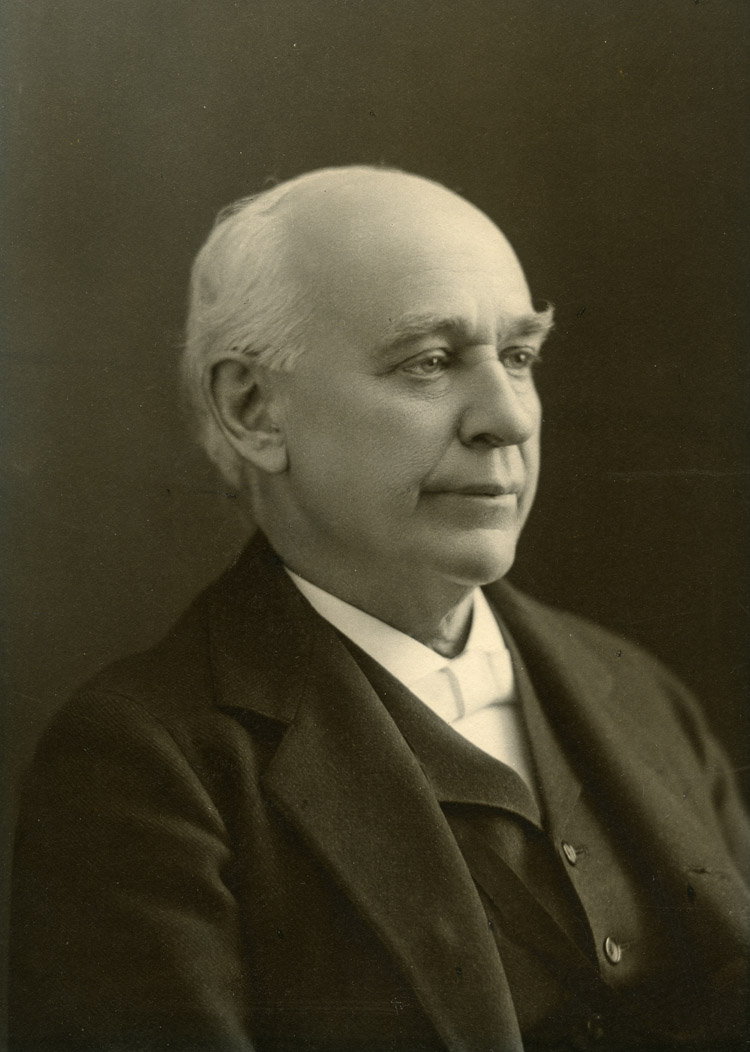
Portrait of Edward Orton Sr., 1890

Our selection comes from the second issue of the Makio – 1882 – which also happened to be the year after OSU’s first president, Edward Orton Sr., ended his tenure in this role.

While president, he also served as chairman of the Department of Geology, and after his presidency, he served as state geologist until his death in 1899. After his presidency, he witnessed the construction of a building to house the geology department, which resulted in the aptly named Orton Hall in 1893. The building not only housed the geology department, but also a geology museum, which was started with a gift from Orton of his own collection of 10,000 geological specimens.

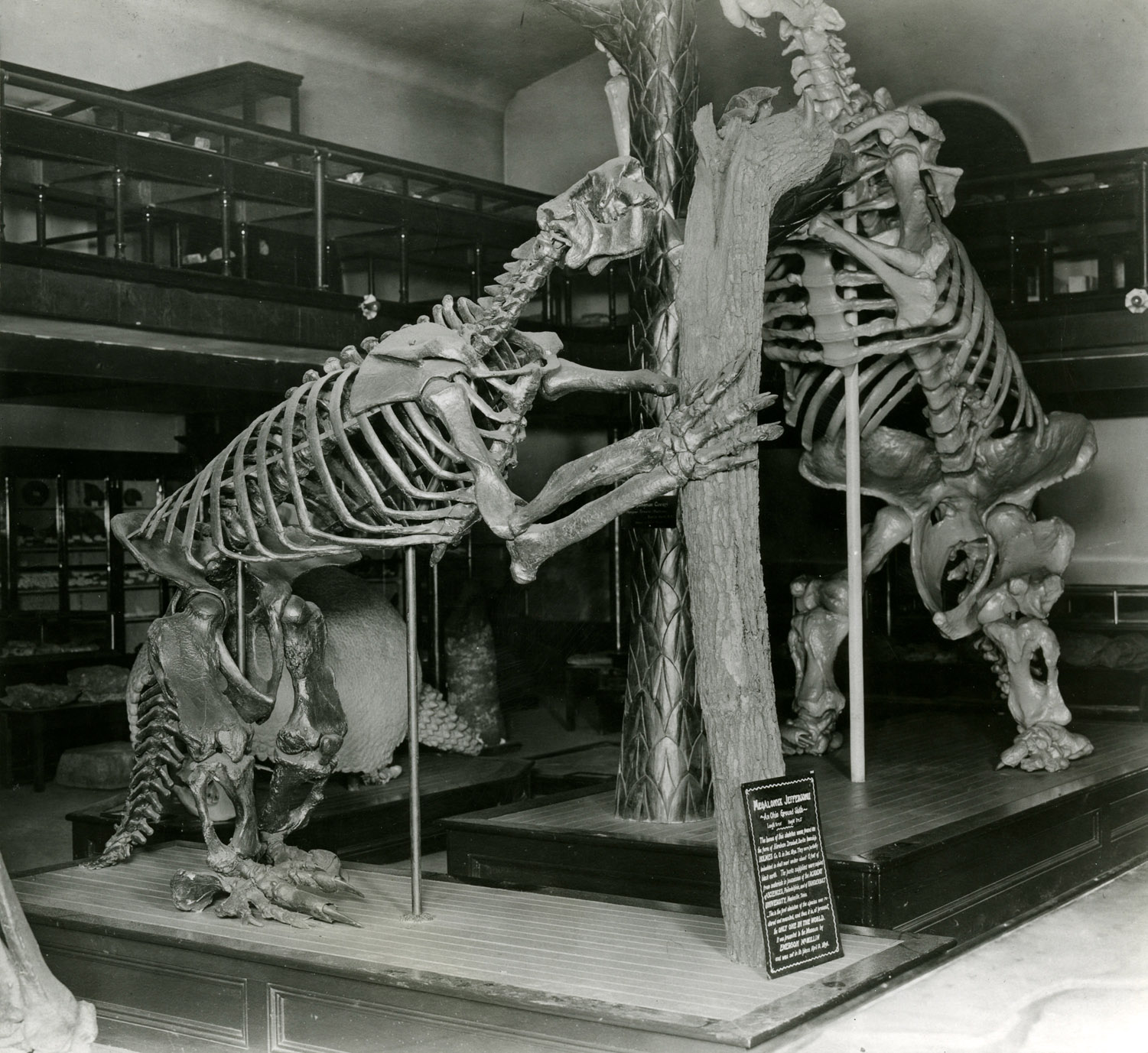
Skeleton of ground sloth, no date

For the geology building, Orton encouraged the use of stone native to Ohio, and in fact, the exterior stone is composed of 40 varieties of Ohio stone, placed in the order in which they appear in the bedrock. Instead of mythic gargoyles surrounding the top of the tower, there are carvings that represent various prehistoric animals,  and inside above the pillars in the vestibule, there are carvings of fossils dating from the time when Ohio was under a vast warm, shallow sea.

Are you beginning to see a theme here?

So, among the poetic “Faculty Pokes” on page 89 of the 1882 edition of the Makio, the editors have some fun with their beloved ex-president’s passion for geology:

“I conned the rocks with anxious eye,

A student meek and docile;

When a distant whisper floated by,

Oh, come and be a fossil!”

Orton Hall Tower, featuring carvings of prehistoric animals, 1982

This Day in OSU History: WOSU’s first broadcast

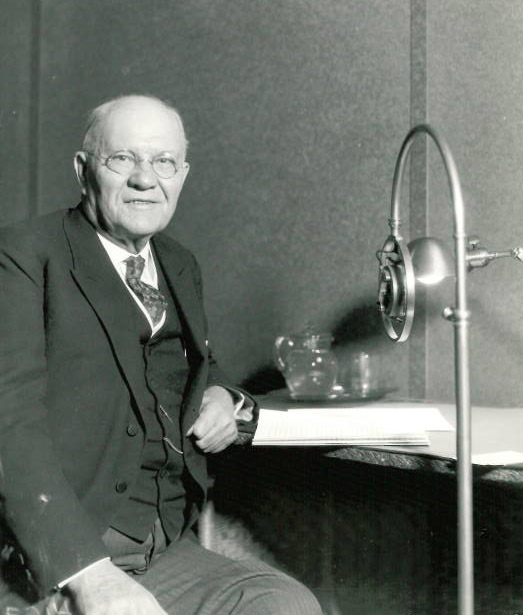
W.O. Thompson in the WEAO studio, 1920s

Ninety years ago today, OSU’s first radio station, WEAO aired its first broadcast. At the beginning of that broadcast on April 24, 1922, then-OSU President William Oxley Thompson gave some remarks – the first words aired on the station – and they were heard by people up to 120 miles away, which far exceeded the university’s expectations since the station broadcast at about 100 watts.

It was a major leap from the turn of the century when OSU’s department of electrical engineering began experimenting with wireless telegraphy. By 1913 the university had an experiment station, capable of local broadcasts, which was particularly useful during the flood that struck central Ohio that year.

WEAO radio towers (at Woodruff and Neil), 1926

In June 1922, OSU’s station received its permanent license and the call letters WEAO, making it the first full-fledged radio station in central Ohio. (The call letters stood for “Willing, Energetic, Athletic Ohio.”) In 1924 the station began covering OSU football games, play by play. In 1925 the station became an independent entity, separate from the electrical engineering department. Its letters were changed to WOSU in 1933, and it received a 1000-watt transmitter in 1948.

Some things have stayed the same: Students have been employed since the station’s beginnings. It has also never sold advertising: to this day it is funded from public donations and University, and state and local funds. For more information about WOSU’s history, or its current programming, see: http://wosu.org/about-wosu/history/.


Older posts Newer posts