
Michigan game action (from left to right), 1928, 1932, 1952
For more than 100 years OSU has been playing the University of Michigan in football, and from that long rivalry, the Archives has accumulated a lot of stories, from the mundane to the unexpected to the downright dangerous.

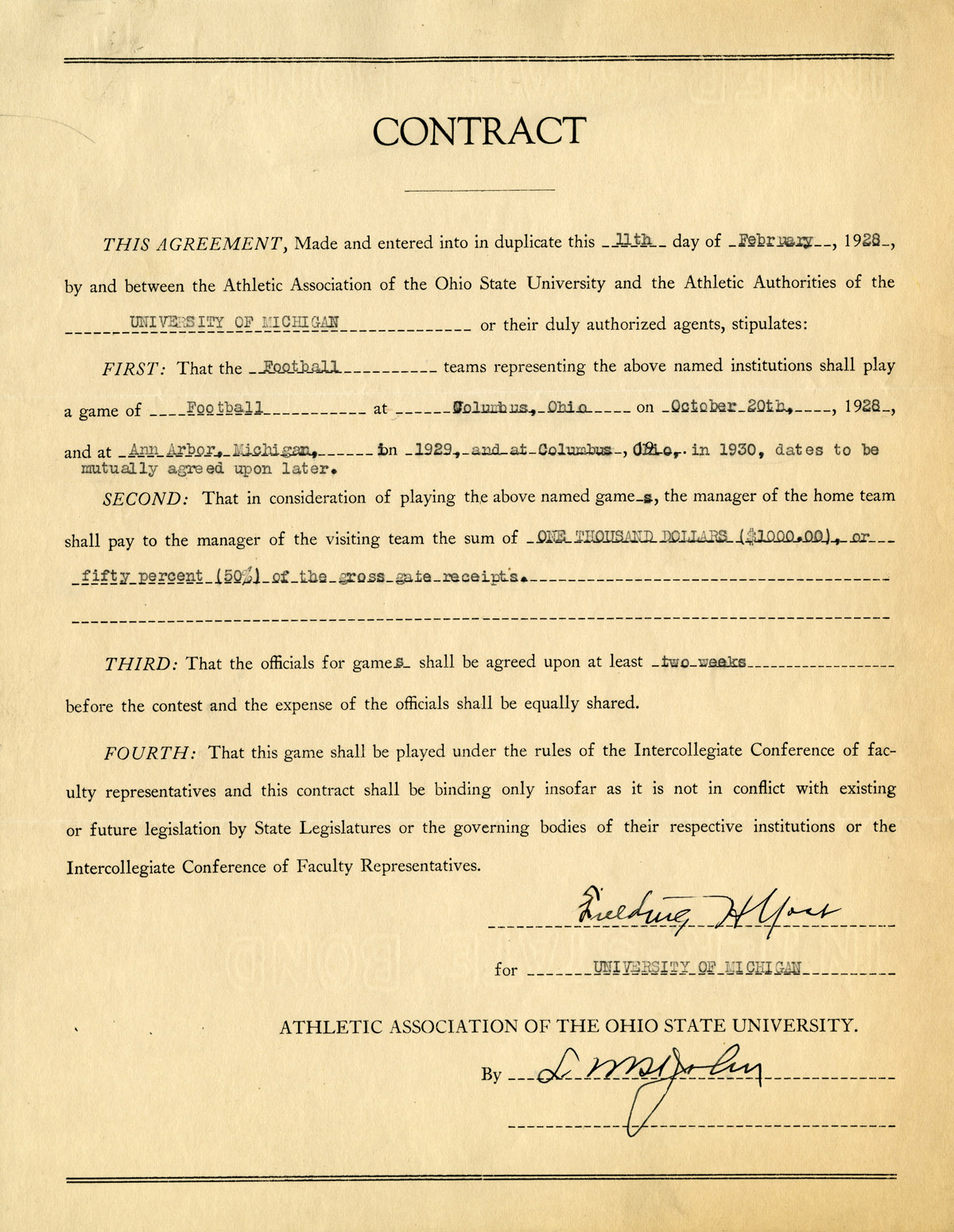
#1 – Contract, 1928
First the mundane: Click on the first image and you’ll see how the contracts outlining how gate receipts would be distributed looked in the old days. We particularly love the clause that starts: “THAT the Football teams representing the above named institutions shall play a game of football…” Well, what else were they going to play – water polo? But these things must be specific in order to be legally enforceable, we suppose. Can you imagine how such a contract might read today?
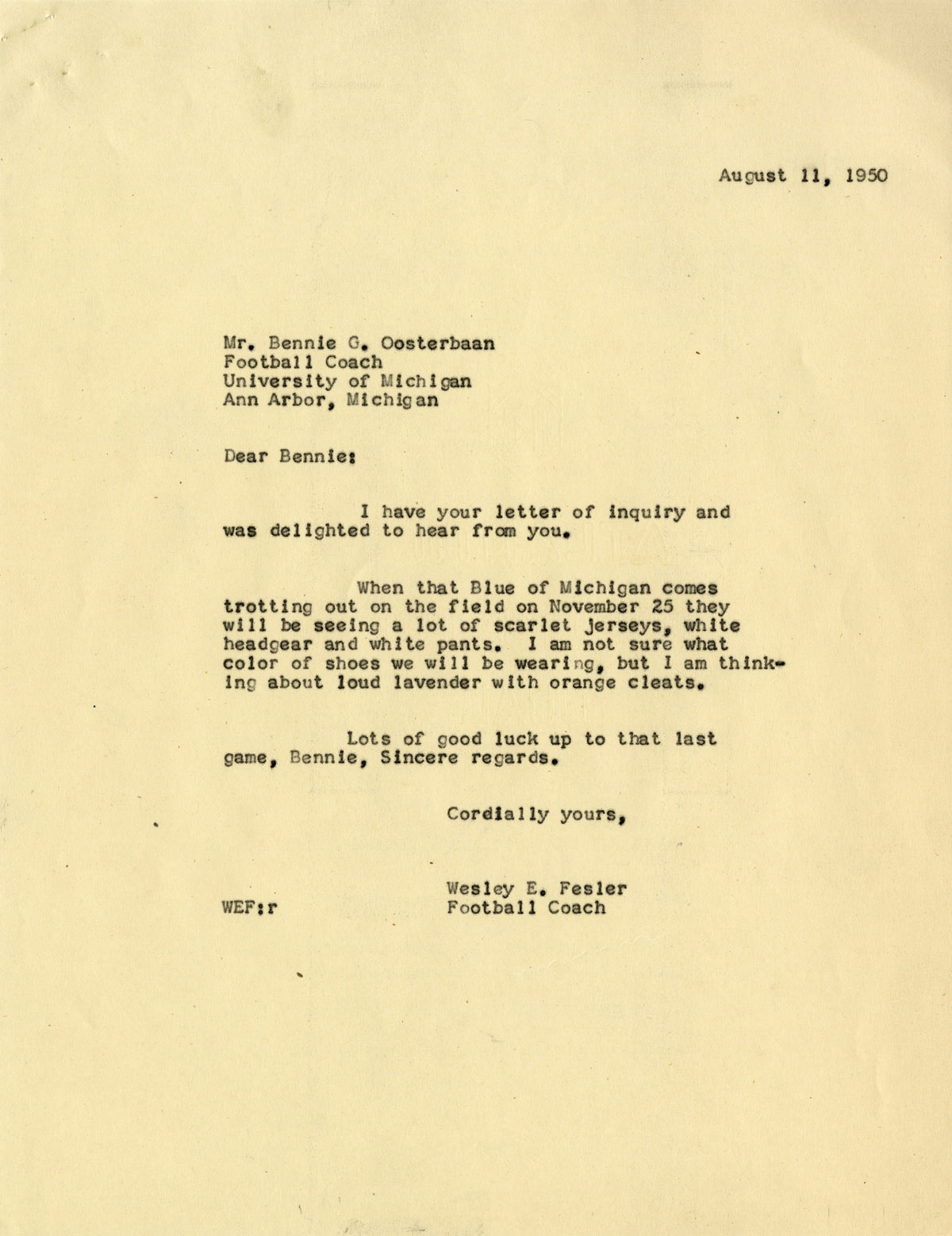
Now for the unexpected: Some of the game preparations by the coaches that were very ordinary for the time, would seem downright bizarre now. Today’s example is in a 1950 letter, (#2 on right), from then-OSU Coach Wes Fesler to then-University of Michigan Coach Bennie Oosterbaan, a letter that seemed quite lighthearted, considering it concerned the biggest game of what would be Fesler’s last season with the Buckeyes.

#2 – Letter, 1950
In any case, in the letter, Fesler describes the color of each article of clothing the OSU players will be wearing at the game. You might ask, why in the world would he do that? Remember that in 1950, television was relatively new, and programs were still broadcast exclusively in black and white. So each team’s uniform combinations had to contrast sufficiently enough with the other team’s for the home audience to be able to tell which team was doing what on the field.
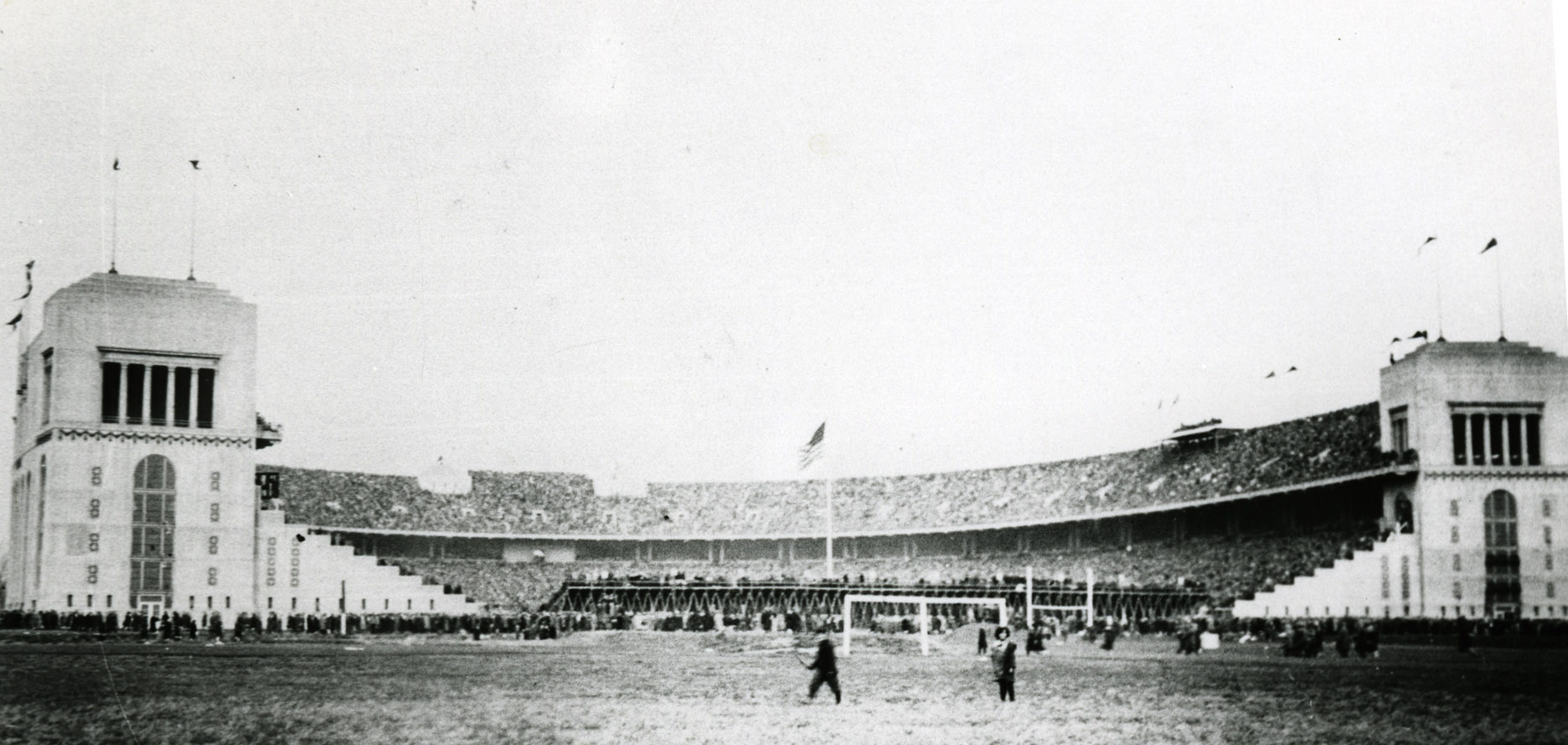
And now, for the dangerous: We all know the rivalry between The Ohio State University and “That State Up North” can become heated, but in 1926 the rivalry took a backseat to a dangerous incident in the stands. During the November 13 game, a defective pyrotechnic bomb was shot off by the military department. The shot was supposed to explode in the air and reveal a flag with Ohio State’s emblem; instead, it fell into temporary bleachers. Three people were seriously injured and remained in the hospital for an extended period of time, while several others experienced minor burns to their skin and clothing. The University reimbursed each spectator for his or her clothing and medical expenses, totaling more than $12,000.

The Stadium is shown here during the 1926 Michigan game. The temporary bleachers are in the foreground of the photo.
And the last item really has nothing to do with the OSU-Michigan game, but it does have to do with Thanksgiving weekend, and both teams were involved:
In 1931 President Hoover thought he would help tackle the unemployment issues of the day by asking colleges and universities to donate their profits to local charities from a football game played on Thanksgiving. According to athletic director Lynn St. John’s papers, the Western Conference schools were not in favor of scheduling charity games. Pressure was placed on the schools, however, and the decision was made to add extra games at the end of the 1931 season. A round-robin game between Chicago, Iowa, Indiana, and Illinois was scheduled for Thanksgiving Day at Staff Field in Chicago. The remaining teams played head-to-head on the Saturday after Thanksgiving: Northwestern versus Purdue, Wisconsin versus Michigan, and Ohio State versus Minnesota.
The Buckeyes, unfortunately, lost the game to the Golden Gophers and in doing so, lost a chance at a piece of the Western Conference title. The games did raise more than $137,000 for the unemployed, though, with more than $30,000 donated to the Ohio State Relief Commission.
Read more about the OSU-Michigan rivalry in our web exhibit:
http://library.osu.edu/projects/OSUvsMichigan/index.htm








Recent Comments