
Jon Woods
You might have heard last weekend that Jon Woods, director of the OSU Marching Band for the past 25 years, is retiring after this season. We are sorry to see him go, and we thought we’d take the opportunity to tell you a little bit more about the directors who came before him. (Our thanks to the editorial staff of Script Ohio, a must-have for any OSU Marching Band aficionado who wants to have the full score on the band’s history.)

Gustav Bruder
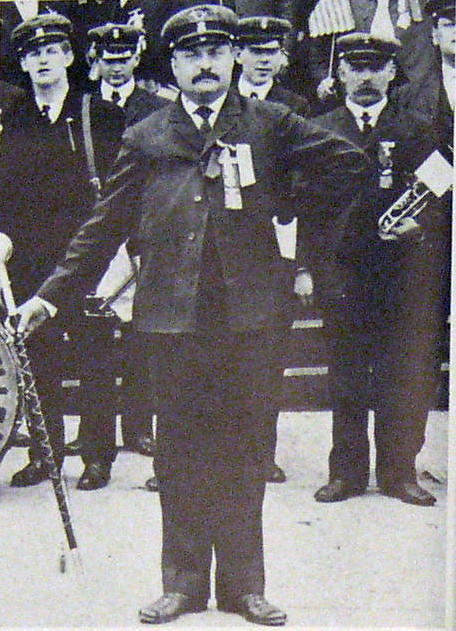
The band started in 1878 as an all-student affair – a drum corps to play accompanying music as ROTC cadets marched. It wasn’t until 1896 when Gustav Bruder was hired as the first full-time director. Bruder had quite a military background: He was accepted into the U.S. Army at age 12 and played for the Columbus Barracks Band. He was offered a position in the U.S. Marines Band by none other than John Philip Sousa. When he started the job as OSUMB director (1896-1928), there were only about a dozen students; by 1914 he had increased the number to 64, and by 1921 there were 100. Under his leadership, the band began playing at football games, they performed the first O-H-I-O, and started wearing spats and pompons.

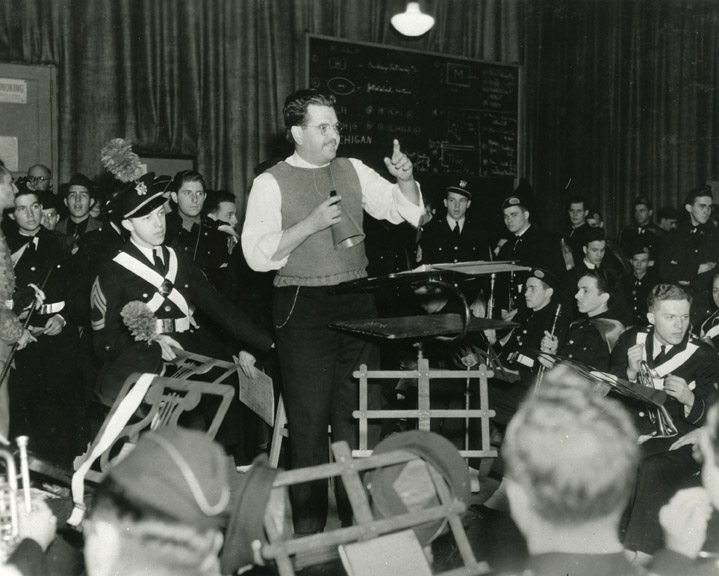
Eugene Weigel Conducting a Band Rehearsal, 1938
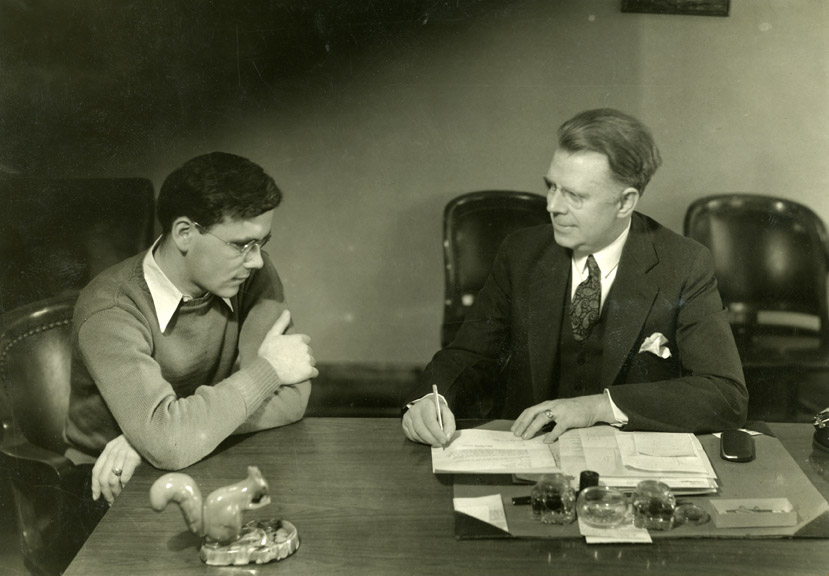
Eugene Weigel was the next director, serving from 1929-1938. He had served as supervisor of instrumental music for the Cleveland Public Schools for five years before leading the OSUMB. While serving as OSU Marching Band director, he was a professor of music at OSU, and was the head of the School of Music for five years afterward. Under his leadership, the supervision of the band transferred from the Dept. of Military Science to the School of Music, the entrance to the Stadium ramp incorporated the herald trumpet fanfare and the band playing the Buckeye Battle Cry, the band transformed from the traditional woodwind, brass and percussion to all-brass and percussion – the first all-bass college band in the U.S. – and “Script Ohio” was introduced.

Manley Whitcomb
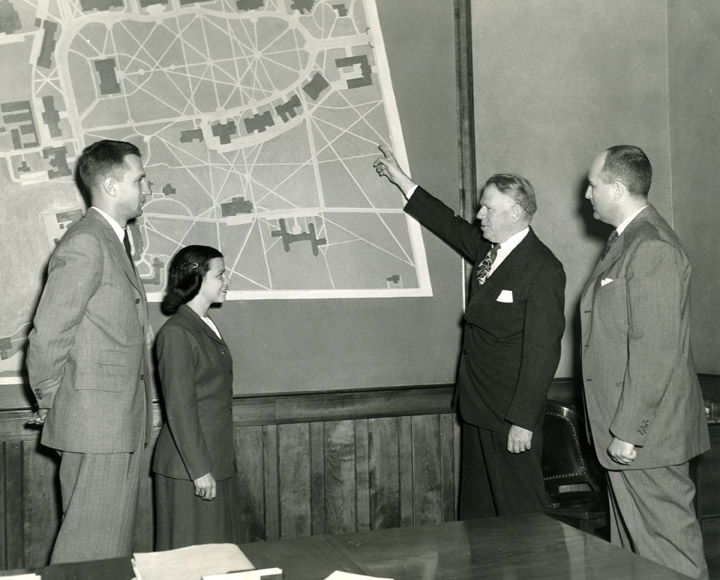
The next director, Manley R. Whitcomb (1940-1942 and 1946-1951), was the first with a Ph.D – in education, from Columbia University – and had been assistant to Eugene Weigel. Before “Whit,” as he was called by band members, came aboard, only the director had a chart of formations. Whitcomb gave every member of the band a copy, which enabled more complicated formations. He also introduced the “8-to-5’ style of marching in which members would make eight steps for every five yards, and the accompanying high knee and leg lift. This allowed the band to match the phrasing of music, which meant even more complicated routines.
William McBride
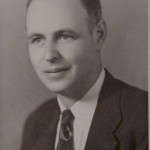
From 1943 to 1945, while Whitcomb served in the Army, William B. McBride served as director. He had served as supervisor of music for several townships, then as instructor of music at both Ohio Northern and Miami universities, before coming to OSU. After Whitcomb returned, McBride continued to serve as associate, then full professor of music at OSU until his retirement in 1970.

Jack Evans
Jack O. Evans, former director of instrumental music for the Shaker Heights school system, began his tenure in 1952, after serving as Whitcomb’s assistant for four years. One of his biggest accomplishments was to move the band rehearsal room from a stock judging pavilion to the Stadium recreation room, which also meant there were two nearby practice areas – the Stadium parking lot and the fields behind the south end of the Stadium. He’s also credited with introducing the Orton Hall chimes arrangement to introduce “Carmen Ohio” at the end of each game. Also during his tenure, the first sound motion pictures were made of the band, by the OSU Dept. of Photography and Cinema.

Charles Spohn
Charles O. Spohn started his OSU career long before he served as OSUMB director (1964-1969). He first served as associate conductor of the OSU Concert Band in 1951, shortly after receiving a bachelor of music degree from Butler University. While he was OSUMB director, two important band traditions were introduced: the band’s arrangement of “Hang On, Sloopy,” and the TBDBITL alumni band, which annually combines with the OSUMB to perform multiple “Script Ohio”s. He also introduced indoor concerts and marching practice before the Saturday skull sessions.

Paul Droste
Paul E. Droste (1970-1983) began his long association with OSU as an OSUMB member in the 1950s, the only director to do so. After serving stints as music director for several Ohio school districts, he returned to OSU to interview for the top band job, just before the campus was closed because of student demonstrations. Even so, Droste took the job, and spent his first year as director leading centennial-themed shows to celebrate the University’s 100th year. During Droste’s tenure, the and was expanded not only in number – by 50 mnusicians – but also in gender. For the first time ever, women were allowed to try out to be members during the 1973 season.

Jon Woods
Then, of course, there is Jon Woods, who has served as director for the past 25 years. Woods served as associate director for 10 years before that. One of his first innovations as director was charting the formations by computer; he also initiated an invitational for high school bands in order to recruit members. Also during his tenure, the uniforms were updated, and the band had its first female assistant director. It also moved into its current location, the Joan Zieg Steinbrenner Band Center. Read more about Woods in the Dispatch story here. (http://www.dispatch.com/content/stories/local/2011/09/03/jon-woods-retires.html)













Recent Comments