From Woody's Couch

Our Playbook on OSU History

Category: Traditions (page 6 of 7)

Twelve Days of Buckeyes: In OSU history, this alum is a bona fide “10”

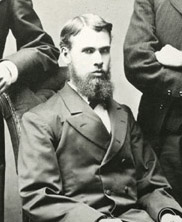
Curtis Howard, 1878

Born not far from Columbus, Curtis Clark Howard was among the first group of students to apply for admission to the then-Ohio Agricultural and Mechanical College. In fact, he was No. 10 on the list of names entered in the official Registrar’s Book.

While he was a senior, Howard and fellow students, Alice Townshend and Harwood R. Pool, formed the committee responsible for selecting the college’s colors. Howard in particular was motivated by the upcoming commencement, and wished to have college colors to display at graduation.  The committee originally settled on orange and black before discovering that those were the Princeton colors.  Subsequently, scarlet and gray were chosen, a decision that still affects Buckeyes today.

Howard graduated with the first class in 1878 and received a master’s degree in 1881 from Johns Hopkins University.  He then returned to Columbus and became the professor of chemistry and toxicology at Starling-Loving Medical College, which would become the OSU College of Medicine in 1914.  He also was involved in founding the University alumni association and was elected its first president.  In 1896, Howard traveled to the University of Berlin and studied there until 1899, when he returned to the College of Medicine, where he remained until 1916.  He died on October 23, 1932, in Columbus.

At the time of his death, he was the president of the Century Chemical Company of Columbus, a Fellow of the American Association for the Advancement of Science, and according to the OSU alumni magazine, he was an expert on “minerals and mineral waters”, “sanitary analyses of waters”, “natural and artificial gases”, “organic compounds, pharmaceutical compounds and poisons.”  He was also the author of several books in both English and German.
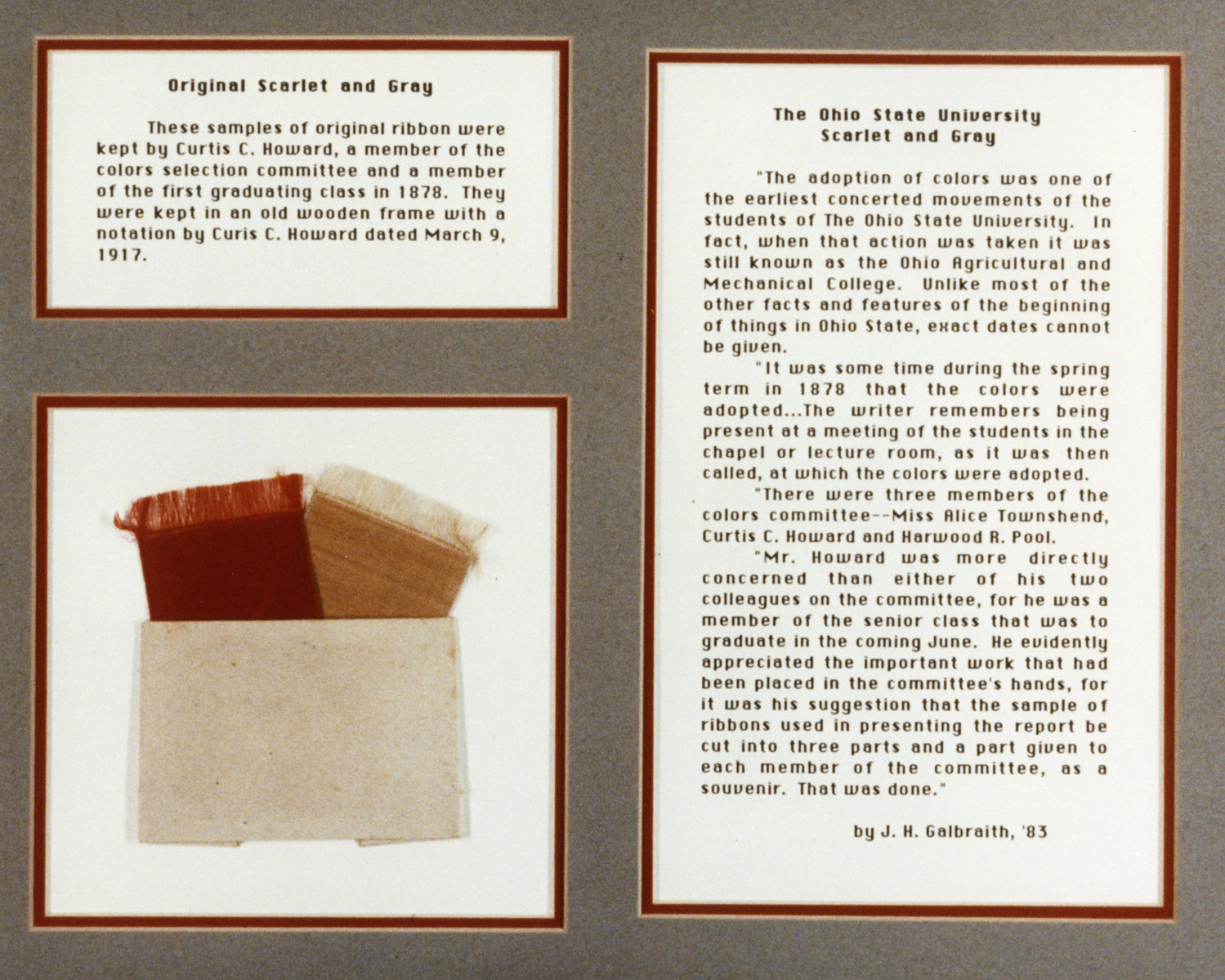
The original, framed, scarlet and gray ribbons
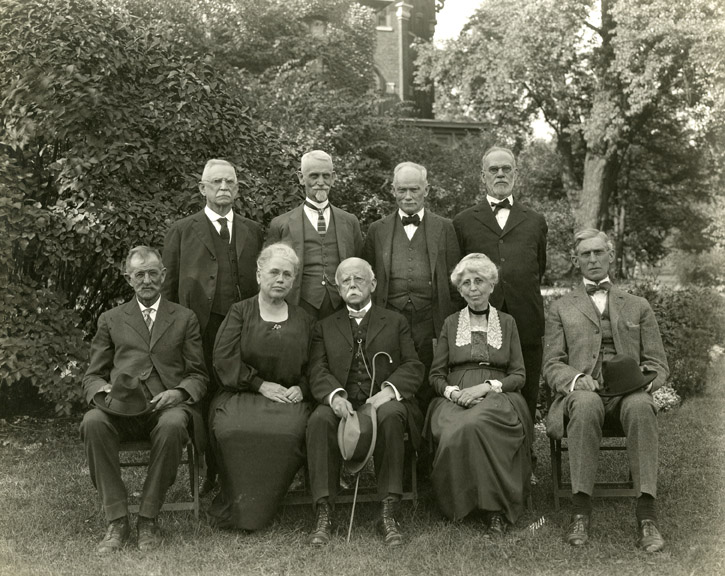
 

Reunion of Ohio State’s first graduating class, 1923. (Howard is on the far right in the second row.)

Filed by C.I.


The Illibuck Stops Here

Bucket and Dipper members pose with the Illibuck, 1955

Long before the OSU-Michigan game ended play for the regular season, it was a tradition for the Illini-Buckeye rivalry to bring things to a close. From 1921-1933, Ohio State and Illinois met to play their final games.

In 1925, OSU’s junior honorary, Bucket and Dipper, decided to spice up the series with the introduction of Illibuck, a turtle who was awarded to the winner of the past year’s meeting between the two teams. Illinois’ junior honorary, Sachem, got in on the fun, and the Illibuck is passed back and forth between the teams to this day. Bucket and Dipper and Sachem regularly travel back and forth to games to meet with their corresponding organization and escort Illibuck. The name was chosen because it combines parts of both schools’ nicknames.

In addition to the Illibuck, the rivalry’s traditions include a ceremonial peace pipe, which is shared by the two honoraries at halftime. According to a 1966 article in The Daily Illini, the ceremony occurred as follows: “Two groups of students one from each school, will meet in the center of the gridiron, shake hands, smoke a peace pipe and drink from a wooden bucket. Then the Illini will give the OSU group a turtle named ‘Illibuck.’”

Illibucks, 1988

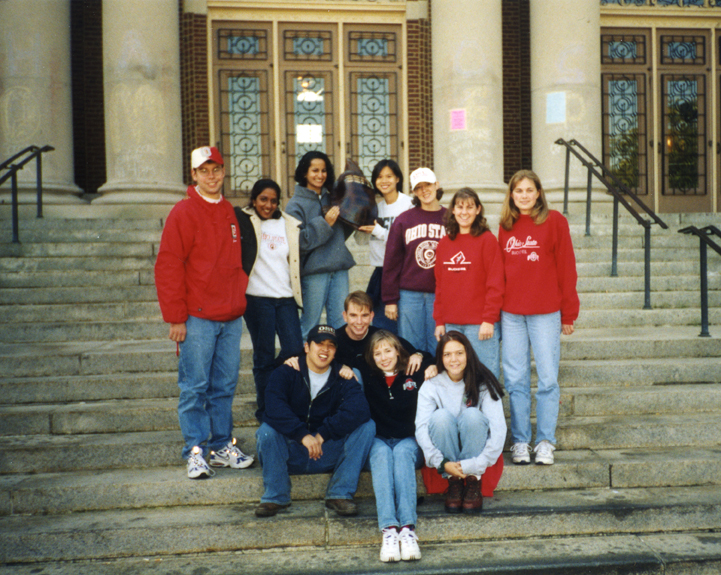
Bucket and Dipper members pose on the steps of Foellinger Auditorium, University of Illinois, 1998

The turtle was chosen because of its longevity but, in an ironic twist, the first Illibuck, a snapping turtle purchased in a Columbus pet store, suffered from the stress of being passed back and forth between Columbus and Champaign and passed away after only two years. Before his death, he spent his two years living in various fraternity houses and campus buildings at the University of Illinois, even briefly sharing space with an alligator in the Natural History building. He was much celebrated and beloved around campus.

The modern Illibuck is made of wood and is replaced as his shell fills up with scores from games featuring the two teams. This year’s game will be the 99th time the two have played since they first met on the field in 1902. Ohio State currently leads the series, 63-30-4, but Illinois has been known to pull off surprising upsets against the Buckeyes, and the Illini have won 7 of the past 11 games held at the Shoe.

If you happen to be on OSU’s campus, you can stop by the University Museum on the first floor of University Hall to see an Illibuck on display.

To read more about the history and adventures of Illibuck, look in the digital archives of The Daily Illini (UIUC’s campus paper) and The Lantern (OSU’s campus paper).

OSU’s Dad’s Day: a fall-weather festivity for fathers

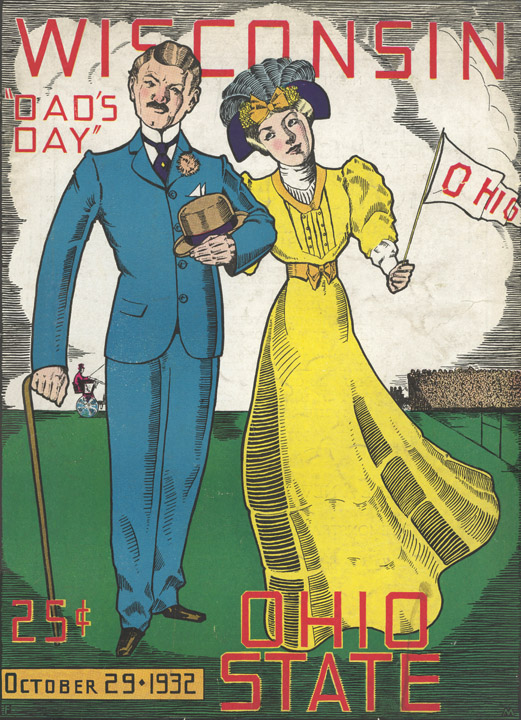
October 29th, 1932 football program cover for "Dad's Day"

In honor of Father’s Day this weekend, we decided to research a bygone OSU tradition: Dad’s Day. Dad’s Day was usually celebrated in late October or early November during a home football game to which students would invite their fathers. The football program for the game would include something about Dad’s Day, and the band would perform a special selection at half time. In 1921, which is the first mention of the celebration, many fathers were seated on the sidelines behind the home team. (We hope they had a better view than they would have today.)

In 1932 OSU parents created a Dad’s Day Association. (There was a Mother’s Association as well, but some mothers helped with the committee.)  In 1932 the association claimed that it would celebrate the ninth annual Dad’s Day that year, although that may or may not be correct. The celebrations continued to be an annual tradition through the 1950s; then it seems that the name changed to Parents’ Weekend. Parent’s Weekend seems to have been popular through the 1960s; after a long hiatus, it was reestablished in the 1990s and is now called Parent and Family Weekend.


Older posts Newer posts