From Woody's Couch

Our Playbook on OSU History

Category: Students (page 16 of 32)

Donor reveals the rest of the story for early OSU grads

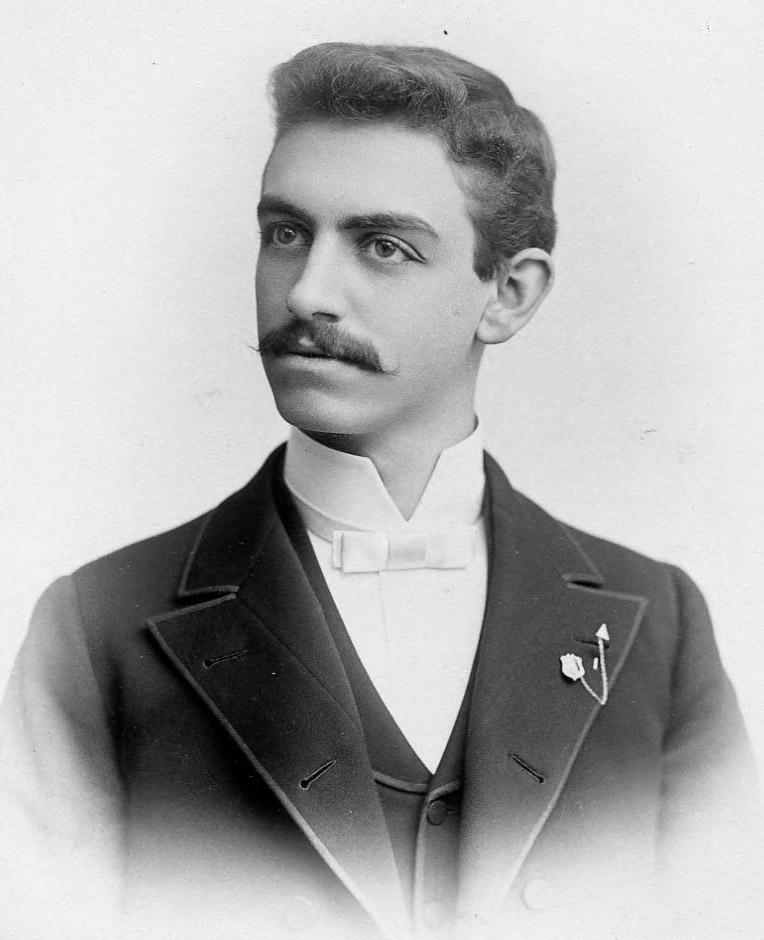
James Wilgus, 1888

James Wilgus, 1888

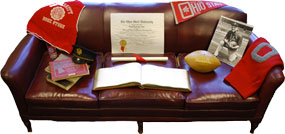
We recently had the chance to peek at the University’s early student life, thanks to Peggy Wymore, granddaughter of James Alva Wilgus, an early OSU graduate who also taught here briefly before leaving to study at Harvard. Wymore graciously donated a number of items from Wilgus’ time here as a student, including a class tie, some of his class essays, some memorabilia from student groups to which he belonged, and some of the exams he gave undergrads when he was teaching history here.

Our resources on individuals who attended OSU before 1900 are unfortunately slim – student directories, early Makios (which were more like literary magazines back then), and if the person became very famous or successful in his or her field, an obituary. So we never really know what happened to students from this era – what did they do after graduating? Where did they go? What were their lives like?

A tie that belonged to Wilgus

Wilgus’ tie, c1887-1888

Thanks to Peggy Wymore, we not only have mementoes of Wilgus’ time here, but she also was kind enough to fill in a lot of the details of his life after OSU – and that of his wife, Flavia, also an alum.

Wilgus was born on a farm near Conover, Ohio, in 1866. He attended a rural school and worked on his father’s farm until age 16 when he entered Ohio State in 1882 as a preparatory student, which meant, like many students coming to OSU at the time, he had to complete a number of prerequisites before becoming an official freshman. Such prerequisites included Latin, Algebra and Physics. He entered as a freshman in 1884, taking a wide range of classes like Latin, Botany, History and Physical Labor.
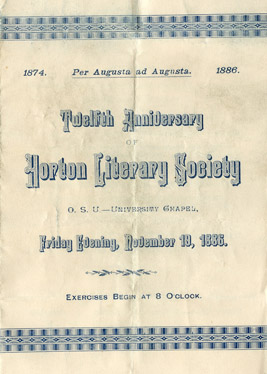
1886_horton_literary_society_front

Brochure for Horton Literary Society event, 1886

 Meanwhile, Flavia McGurer – the future Mrs. Wilgus – entered Ohio State as a Preparatory student in 1887. Her courseload included German, Trigonometry and Physical Geography. According to the 1889 Makio, the Columbus resident had entered OSU as a freshman and was listed as class historian of the Class of ’92. But she never graduated. That’s because she married Wilgus on Christmas Day in 1889, then traveled with him after he earned his master’s degree, to Harvard University where he was a Thayer Scholar from 1891-1892.  He was reappointed at Harvard for a second year, but his failing health prevented him from taking the appointment.

The traveling continued, however: The couple moved to Minnesota in 1894 where Wilgus was hired at the State Normal School in St. Cloud to finish out the term starting in January of that year. In September, OSU President William H. Scott asked Wilgus to do a small amount of teaching in history, and Wilgus returned to Columbus to serve as assistant of History from 1894-95. On January 3, 1895, Wilgus received a telegram from James Chalmers, professor of the Platteville (Wisconsin) Normal School, asking him to “accept the history professorship” there. (The name later changed to the Wisconsin State Teachers’ College – Platteville.)

Wilgus accepted, and the couple moved to Wisconsin, where he spent the rest of his career at the State Teachers’ College as a professor of History and Social Sciences. He taught there until his retirement June 6, 1939. He died in Platteville shortly after that – July 24, 1939.

Flavia McGurer Wilgus, 1888

Flavia McGurer Wilgus, 1888

Upon moving to Platteville in 1895, “Mrs. Wilgus at once identified herself with the Platteville Normal. The Wilgus home became a place where students as well as faculty members spent many happy hours. As the years passed, the family circle became larger. Curtis came, then Dorothea, and finally Wallace . . .  Mrs. Wilgus continued to live in her beautiful, helpful way.” (from the June 23, 1926, issue of The Exponent,” the Platteville State Teachers’ College newspaper).

Flavia also was involved in many activities and societies at her church; she was a member of the Eastern Star as well as other women’s clubs and civic societies. In 1903 she even had a small mail-order business. During World War I she contributed monthly to “The Fatherless Children of France.”

According to Wymore, Flavia was a loving mother, devoted to her children and active in their lives – their studies, play, training, and even in making  many of their clothes: In Dorothea’s letters to home from the University of Wisconsin, she would draw a picture of what she wanted in an outfit, and Flavia would sew it up for her.

On June 21, 1926, 31 years after she and her husband moved to Platteville, Flavia died suddenly and unexpectedly after complications set in from an emergency operation.  In her obituary it stated, “Mrs. Wilgus was a beautiful life. Forgetful of self, . . . writing upon every page of the book of her life . . . All who approached her were received with that simple grace that bespoke the true woman. . .”


We’d like to thank Peggy Wymore most sincerely for not only preserving such important tokens of her grandparents’ lives, but for sharing some of them with us, as well as her grandparents’ stories. Thank you, Peggy!


Horton Literary Society, back of brochure, 1886
Horton Literary Society, back of brochure, 1886

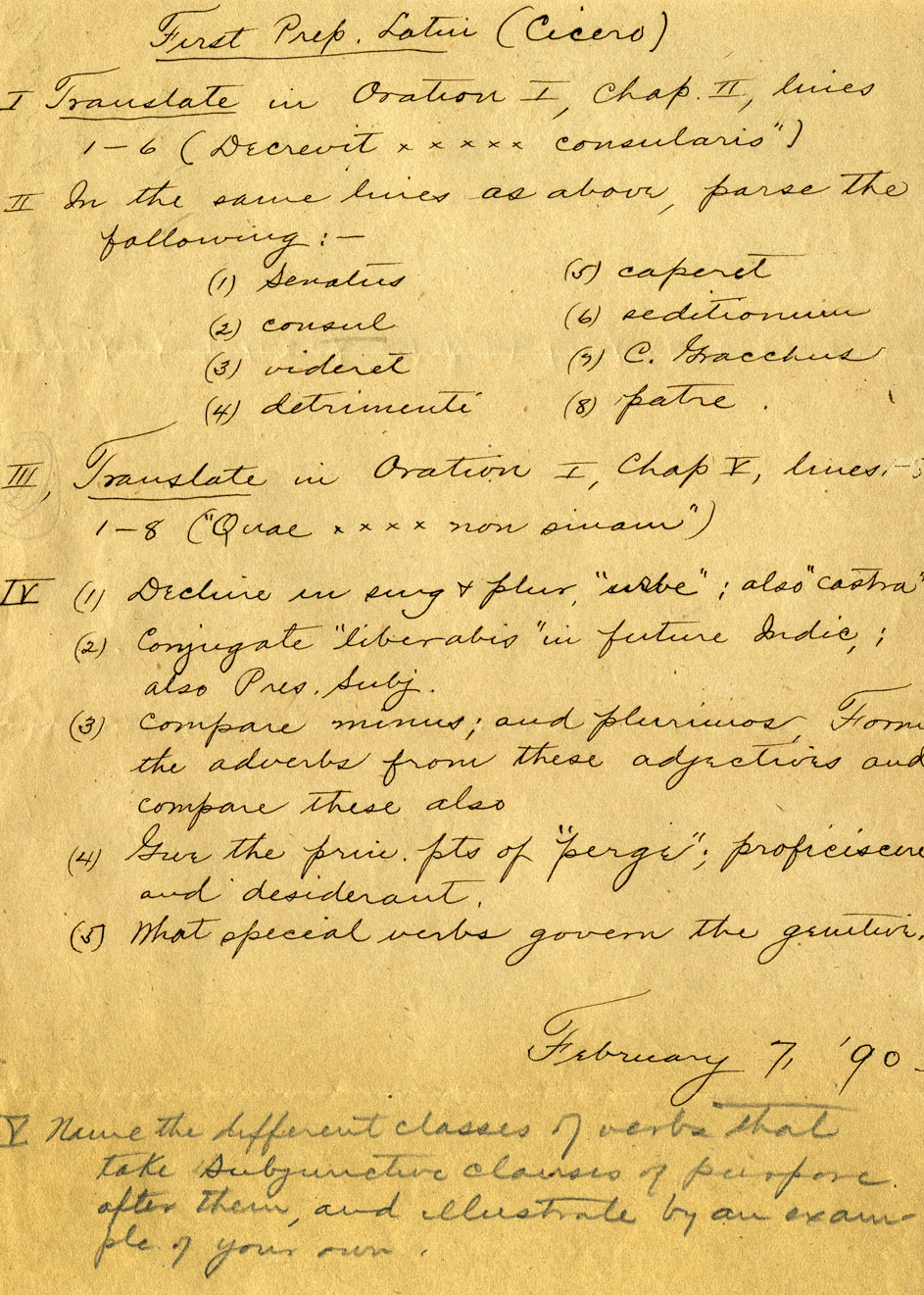
Exam questions from Wilgus' Roman History Class at OSU, 1888

Exam questions from Wilgus’ Roman History Class at OSU, 1888


Long Gone Campus Traditions: Cut-throat competition for the cane

1919 Cane Rush

1919 Cane Rush

(“Long Gone Campus Traditions” is a continuing series of posts where we explore some of the more unusual, sensational and even violent student traditions that have been obsolete from OSU’s campus for quite some time.)

The Cane Rush was undoubtedly one of the most brutal student traditions to ever taken place on OSU’s campus.  In fact, some have described the event as a mixture of rugby, football and WWF wrestling.

The Cane Rush, which originated in the 1880s, was a contest between classes of undergraduate men.  The object of the game was to find and obtain the rival’s walking cane and move it across the opponent’s goal line.  The teams, which often numbered in the hundreds, could be quite brutal.  Students tackled each other, wrestled one another on the ground, and tore each others clothes, all in an effort to obtain the cane.

The Cane Rush in 1894 was so violent that one Lantern reporter wrote:

“If our young men are to do that for which in the ordinary walks of life they would have to answer to the law of the land, it is high time that the iron hand of discipline be imposed. University history should not be blotted by the record of many such affairs as occurred last Thursday.”

The first presidents of the university and many of the faculty agreed that the Cane Rush disrupted classroom activities.  The competition was normally an unplanned event and the early rushes had few rules or authority figures involved.  One Cane Rush in 1889 reportedly lasted for an hour and a half.

President Thompson holds the cane, 1920

President Thompson holds the cane, 1920

However, when William Oxley Thompson became president in 1899, he confronted the controversy of the Cane Rush head-on.  Rather than waiting for the event to begin spontaneously, Thompson organized the event himself.  The President said that as long as the students conducted the event in an orderly manner, he would allow it to continue. Under his direction, the competition had official rules, a specific date and location, and a set time of 20 minutes.    

The Cane Rush became a beloved student tradition under Thompson’s administration and in 1908 it reportedly drew some 10,000 spectators.  Because of its reputation, students even began charging admission to the event.

The popularity of the Cane Rush began to decline in the late 1920s and by 1932 the event was no long held. Lack of interest, the shift away from class as the focus of student life, and the fact that Thompson retired, were some of the reasons that caused the demise of the Cane Rush.  There were efforts to revive it in the 1930s and 40s, but those efforts never took off.

Cane Rush on the Oval, 1891

Cane Rush on the Oval, 1891


Students pose with cane in front of University Hall, 1894

Students pose with cane in front of University Hall, 1894


1919 Cane Rush

1919 Cane Rush

Long Gone CampusTraditions: Classes tug for dominance in war across Mirror Lake

Tug of War across Mirror Lake, 1910s

Tug of War across Mirror Lake, 1910s

(Today we begin a summer blog series titled “Long Gone Campus Traditions”.  In these posts we’ll explore some of the more unusual, sensational and even violent student traditions that have been obsolete from OSU’s campus for quite some time.)

Perhaps one of the best discontinued traditions is the class Tug-of-War which was held annually between the freshman and sophomore classes, mostly from around 1909 until the late 1920s. In the beginning, the spectacle was usually held on “Tradition Day”, which marked the end of the school year. A bonfire was held, when the freshman burned their beanies, and class honoraries held their initiations.  A field day and review of cadets also took place, all leading up to Commencement.

 The Tug-of-War portion of the festivities was held across Mirror Lake. Freshmen would reportedly stand on one side of the lake and the Sophomores stood on the opposite bank. The University’s President kept time, and eventually one side would end up getting dragged through the water.

 The event became sporadic starting in the mid-1930, but was still held as part of what had become Traditions Week after World War II. In one event in 1949, for instance, the lake was tinted with a bright green dye, so that whichever team was dragged through the water, members would “literally turn green with envy,” according to that year’s May Week chairman, Stanley Zucker.

 It is unclear why the tradition eventually ended. There are no Lantern stories about it after 1949, and as early as the 1920s, University officials were not exactly pleased with the spectacle. Then-President Rightmire came down very hard in 1926 on all aspects of hazing, both between classes and within the Greek organizations, after multiple incidents ended with police intervention.

1916

1916

 Filed by C.N.

Older posts Newer posts