From Woody's Couch

Our Playbook on OSU History

Category: Students (page 10 of 32)

“Wedded Husband” married Chinese culture with English language at OSU

Hong Shen, 1919

Hong Shen, 1919

Nearly 100 years ago, a young man from China studying ceramic engineering at OSU wrote a play in English that was performed in University Hall. It was likely the first-ever English-language play written by a Chinese national to be performed in the U.S.

The young man’s name was Hong Shen, the play was called “The Wedded Husband” and it was performed in University Hall Chapel on April 11 and 12 in 1919 before a capacity audience of 1,300.


Shen was studying at OSU on a scholarship paid by the Chinese government. It was his first play written in English; previous works – “Fruit Vendor” and “Which Is It?” had been performed at his alma mater, Tsing Hua College in Beijing.
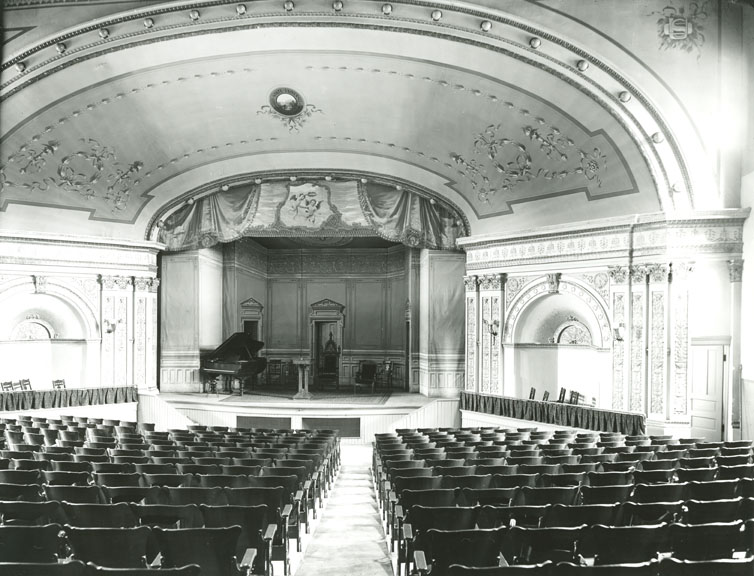
 

University Hall Chapel, c1900

University Hall Chapel, c1900

The play was co-sponsored by OSU’s Cosmopolitan Club and the Chinese Students’ Clubs of OSU and Oberlin College, and all of the men’s parts were performed by Chinese students who, like Shen, had been sent to the U.S. by the Chinese government under the provisions of the Boxer indemnity fund.


According to a Lantern article, Shen received a telegram from professors at Goucher College and the Columbia School of Fine Arts to reserve tickets for them. (They were going to be in Columbus for a meeting of the Methodist Centenary Movement.)


The play is about a young woman, Miss Wang, who is arranged to be married to a gentleman named Master Chen. She agrees to the marriage out of filial devotion to her father but during the ceremony, she falls ill. The doctor suspects she is a victim of the plague that is ravaging the city and orders her to be quarantined. Master Chen, however, defies the order to care for his wife. He ends up dying of the plague, while Miss Wang recovers. She is then arranged to be married to Master Yang, but when she hears of how Master Chen risked his life for her, she changes her mind and remains a loyal widow.


Last November, OSU’s Institute for Chinese Studies put on a revival of the play in the Roy Bowen Theatre, in the Drake Union. It was part of a series of events honoring Shen, who left OSU in 1919 to study dramatic arts at Harvard before returning to China where he eventually became an important figure in modern Chinese theater, film and drama. His daughter recently donated a collection of his works to the University.
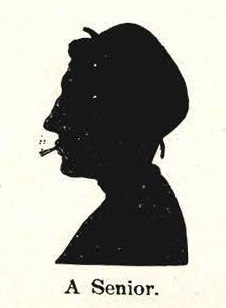
OSU snuffed out smoking on campus as early as 1900

Sketch of a smoking student from the 1895 Makio.

1895 Makio.

Earlier this month, the University’s new tobacco-free policy took effect. It prohibits the use of all types of tobacco products on University-owned property, both inside and outside of buildings. This is the most widespread prohibition on tobacco products on the books yet at OSU. However, the University has banned tobacco on campus, at least to some extent, since 1900.

That year, in an update to the campus by-laws, Section 46 was amended to read: “The use of tobacco in any form in the lecture rooms, halls, corridors, door-ways, stair-ways, laboratories and libraries of the university is prohibited.” Until this time smoking was allowed in hallways, but not classrooms or labs.

There was a push in 1930 to have this rule revoked on the grounds that many campus buildings were fireproof, with an understanding that the ban would still hold for non-fireproof buildings, but it was unsuccessful.

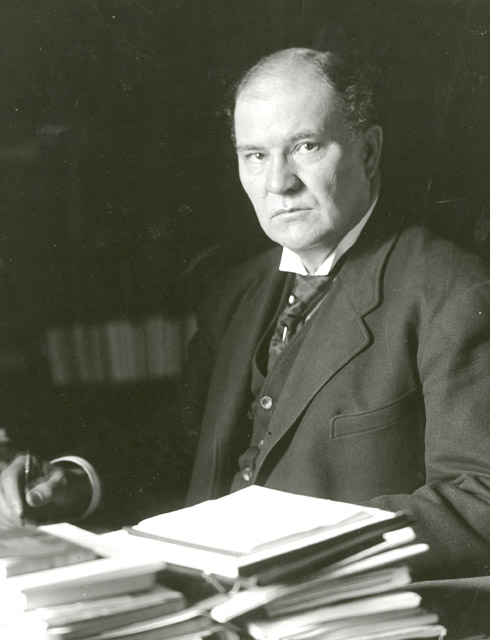
William Oxley Thompson, 1907

President Thompson, 1907

At a Wednesday morning convocation in March 1901, then President William Oxley Thompson spoke out not only against the use of tobacco products but the “use of narcotics or stimulants in any form,” particularly for those men under the age of twenty-five. He argued that stimulants produced “a derangement of the nervous system and such a result cannot but affect any man’s abilities in later life.” Keep in mind that this predates the Surgeon General’s report by 63 years!

Campus interest in controlling tobacco use waned until the 1970s. In 1975 Associate Provost George Crepeau sent a memo to all faculty regarding a lack of enforcement of the 1900 ban. The memo mentions “students (and professors) …smoking in rooms with large red NO SMOKING signs posted.” It also discusses the “damage to floors in some buildings where cigaretts [sic] have been dropped and tiles have been burned.” There were many complaints to the Office of Academic Affairs and the President (then Harold Enarson). In 1977, Enarson announced a new focus on enforcing the no-smoking rules in compliance with a new state law regarding smoking in public places.

Student smoking in classroom, 1976

Student smoking in classroom, 1976

A University committee was formed to review the existing non-smoking policy and issued recommendations in 1986 that included banning the sale of tobacco products on University grounds and offering a smoke-cessation program for OSU employees who smoked.

After much public discussion among the University community regarding the proposed policy, the Board of Trustees approved it effective July 1, 1987. Some small changes were made, specifically that the smoking or non-smoking designation for single-occupant offices that could be enclosed were left up to the inhabitants. The Ohio Public Health Association awarded OSU a silver commendation in 1987 for this policy.

In 1991 OSU put together a new Committee to Review University Non-Smoking Policy. As a result of this committee, a new stricter policy was approved by the Board effective July 1, 1993. The updated policy extended the ban to all indoor areas, including St. John Arena and Ohio Stadium, with the exception of “specifically designated private residential space.” The ban

on the sale of cigarettes on campus was continued, as were smoking cessation services. A policy regarding alcohol and tobaccos advertising was issued in 1999, banning both from public campus spaces.

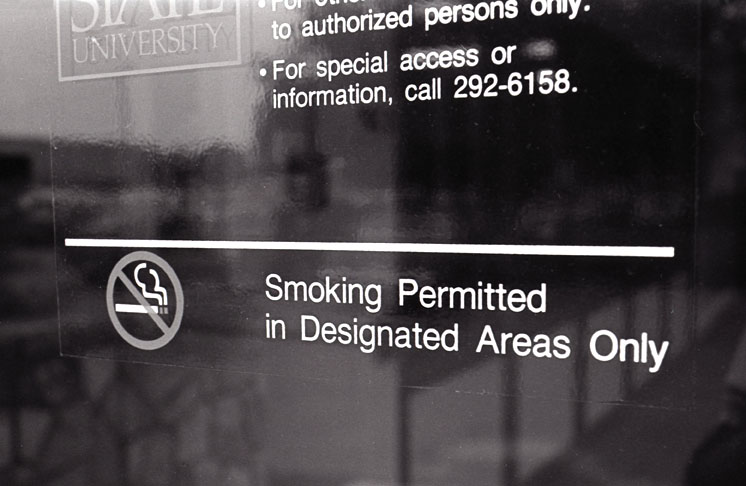
"Smoking permitted in designated areas only" door sticker, 1988

“Smoking permitted in designated areas only” door sticker, 1988

Prior to the current tobacco-free policy, the last major change was in response to the 2006 Smoke Free Workplace Law passed by the state of Ohio. This law prohibited smoking inside buildings or under outside overhands and within 25 feet of doors, windows, and air intakes. This same year, the entire Wexner Medical Center became tobacco free, even in outside spaces. The current policy took effect on January 1, 2014.


School’s Out

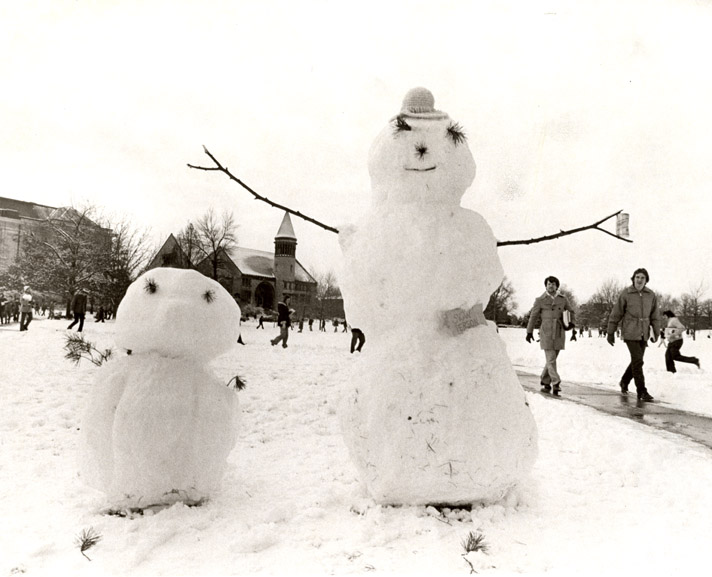
Oval, 1976

Oval, 1976

The recent polar vortex that shut the campus for two days serves as a reminder that even the Ohio State University isn’t impervious to the forces of nature. The campus has been closed a number of times for weather-related hazards, but classes also have been cancelled for a variety of other reasons over the years.

1918: October 11-November 12. Were you to travel through time to November 11, 1918, on the OSU campus, you might think classes were cancelled in celebration of the signing of the armistice between the Allied Forces and Germany that marked the end of World War I, but that wasn’t the case. The campus was instead shut down in an attempt to stop the spread of the influenza epidemic.

1968: April 9. Classes scheduled to be held between 8am and 4pm were cancelled out of respect for the funeral of Rev. Dr. Martin Luther King Jr., who was assassinated on April 4 in Memphis, TN.

Students hold a memorial for Martin Luther King, 1968

Students hold a memorial for Martin Luther King, 1968

1970: May 7-19. The University closed for nearly two weeks after four students were killed by the National Guard on May 4 at nearby Kent State University. The closure was an attempt to calm protestors on OSU’s campus and was largely successful. Learn more at our web exhibit on the 1970 Student Demonstrations.

1971: February 8. President Fawcett cancelled classes at 3 p.m. due to the 10 inches of snow that had fallen by then. He was quoted in The Lantern as doing so to “allow streets and sidewalks to be cleared so classes and offices can operate normally Tuesday.”

1977: January 18. Classes were cancelled due to cold weather in an attempt to conserve gas and electric resources at the request of Columbia Gas and Southern Ohio Electric. But students didn’t get too much of a break: Cancelled classes were rescheduled for President’s Day.

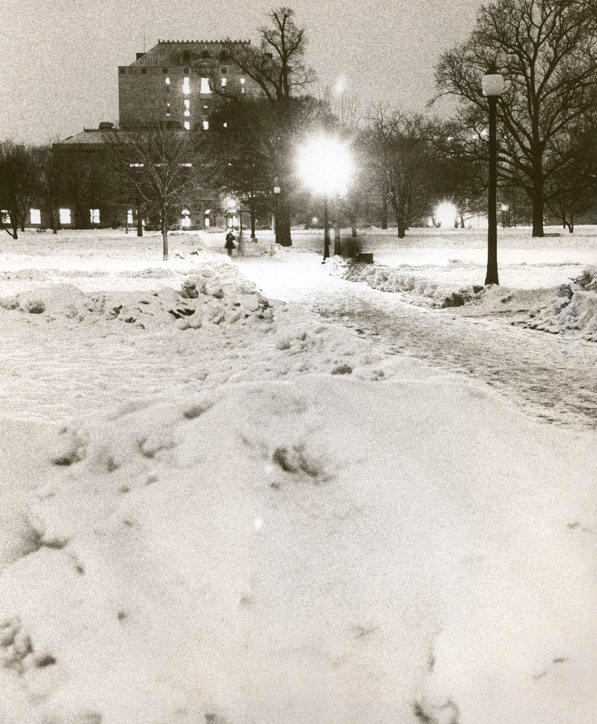
Photo of the Oval, 1978

The Oval after the Blizzard of ’78

1977: April 8. All classes scheduled on West Campus were cancelled after an explosion in Scott Hall. The blast was caused by an electrical malfunction and injured a graduate student and a firefighter.

1978: January 26-27. The famed Blizzard of ’78 stopped all but essential services on campus with 65 mph wind gusts and almost five inches of snow. Payroll operations, Medical Center personnel, telephone center operators, physical facilities workers, and student-life employees all braved the elements to keep necessary functions going.

1984: February 28. It wasn’t quite the Blizzard of ’78, but the snowstorm that hit town in late February of ’84 did manage to bring most of Columbus screeching to a halt. In addition to the county offices, courts, highways, and garbage pickups that were shut down for the day, some campus parking garages were closed and classes were cancelled starting at 4 p.m.

Older posts Newer posts