From Woody's Couch

Our Playbook on OSU History

Category: Presidents (page 7 of 8)

This Week in OSU History: ‘Dynamo’ takes over presidency

James Canfield, 1897

It turns out E. Gordon Gee is not the University’s first president who could be mistaken for a human sparkplug. Back in 1895, OSU’s fourth president was elected – James Canfield – and he was considered quite the “human dynamo,” too.

Canfield was born in Delaware, Ohio, in 1847, but his family soon moved to New York City, where he grew up and attended school. He graduated from Williams College, and briefly practiced law in that “state up north” before taking a teaching position at the University of Kansas in 1877, which he held for 14 years. His teaching focus was English, History, Civics and Political Science, and he became a sought-after orator.

In 1891 Canfield accepted the Chancellorship at the University of Nebraska, and four years later – on April 11, 1895 – he was elected President of Ohio State. The Board of Trustees knew his reputation as a “human dynamo,” so it should have come as no surprise to them that Canfield immediately went to work once in office.

One of Canfield’s first acts as president was to establish a lab in 1895 near Lake Erie (the precursor to Stone Lab. Under his leadership, enrollment surpassed 1,000 (1897), and the Power Plant and Armory were built. The University also added Domestic Science, Commerce and Administration courses to the curriculum.

Canfield Hall, 1940s

Canfield was by all accounts a very “take charge” person. According to the University’s 75-year history, he once stopped to ask the janitors and scrub-women why they were not on their hands and knees, scrubbing the floor. So it is no wonder that his administration was also marked with conflict – particularly over Canfield’s attempt to form a partnership between OSU and a Columbus medical college. It turns out the University did end up partnering with the Starling Loving Hospital—shortly after Canfield left office. The move ultimately led to the formation of OSU’s Medical Center.

Canfield resigned his post in 1899 to become the Librarian at Columbia University. He died in 1909.

In 1940, Canfield Hall was named as a tribute to him and his daughter, the novelist Dorothy Canfield Fisher.


Filed by C.N.
 

Twelve Days of Buckeyes: OSU and the 19th U.S. President

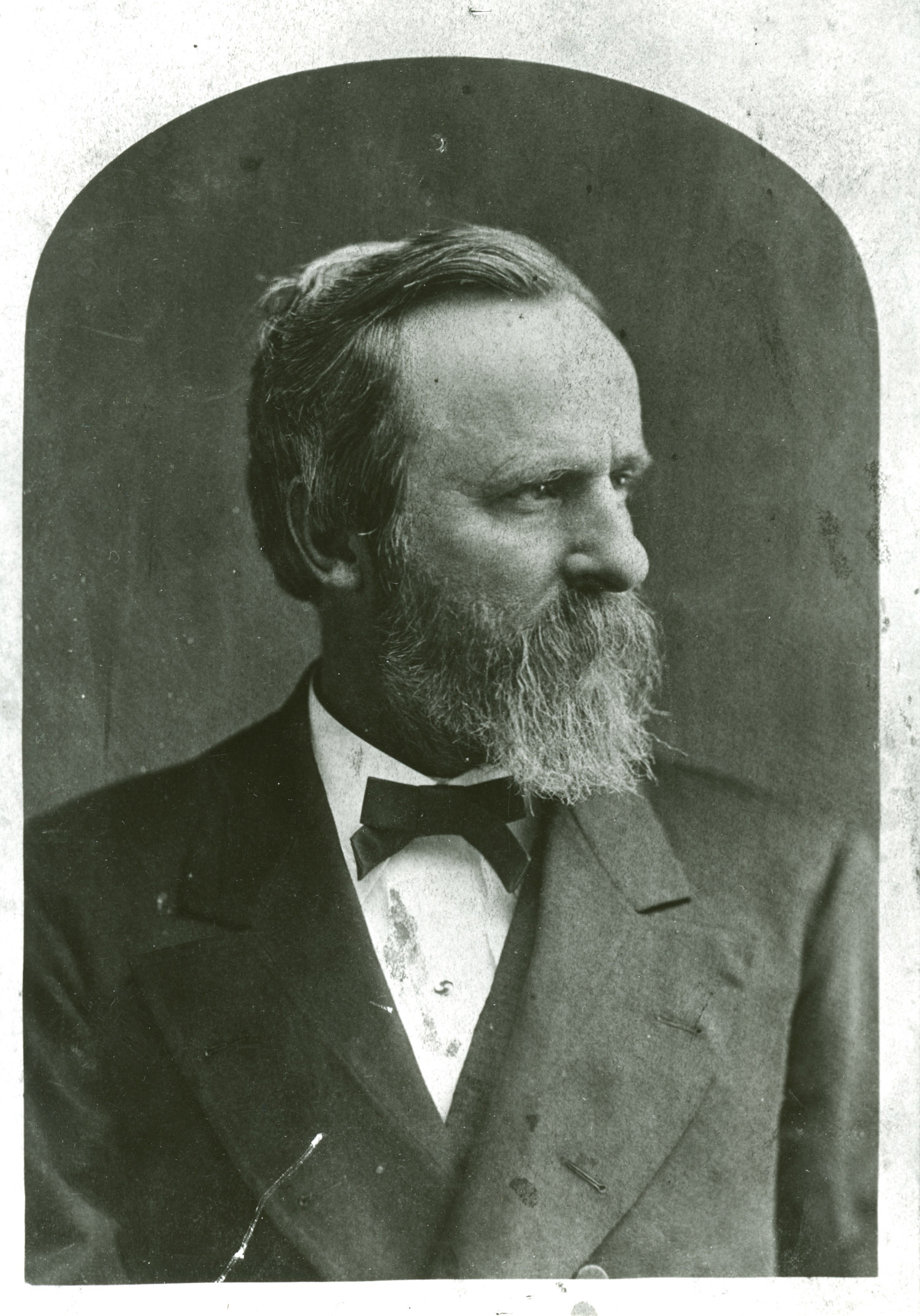
Hayes, 1887

It’s common knowledge that Rutherford B. Hayes served as President of the United States (1877-1881), but it’s not nearly as well-known about his impact on OSU’s history.

In 1862, Congress passed the Morrill Act, which created a system of land-grand colleges focusing on engineering and agriculture. Ohio lawmakers were not keen at first in supporting the law. Some feared, for instance, that it would become a big burden for states, which had to manage the sale of federal lands in order to create endowment funds for these universities. Finally, in 1870, the state legislature passed the Cannon Act, one of a series of bills to resolve the many issues of the original Morrill Act.

Cannon Act

One of the major sticking points was whether the money should be divided among the pre-existing schools, or whether a new college devoted to engineering and agriculture should receive the funds. Rutherford B. Hayes, a Republican elected Governor of Ohio in 1868, did not like the idea of awarding the federal funds to any existing school: he saw this was an opportunity to start something new. When he signed the Cannon Act into law, he got his wish: there would be a new school: the Ohio Agricultural and Mechanical College.

Within two months of the law’s passage, Hayes had selected the required nineteen-member Board of Trustees (one for each Congressional district in Ohio), choosing as many Democrats as Republicans as he could, to make the group as bi-partisan as possible. The next hurdle was the new college’s location. Four counties from around the state vied for the new campus, and it was likely Hayes who influenced the board to choose Neil Farm, just north of Columbus.

University Hall engraving, c1873

Hayes was a tireless supporter of OSU, right up until his death in January 1893. Just a few years before, using his political influence, he urged members of the U.S. House and Senate to support a second Morrill Act that would add to land grants awarded in the original law a maximum of another $25,000 per year. In 1891, the Ohio General Assembly granted the support from the second Morrill Act to the Ohio State University.

Ironically, despite his own achievements – Civil War hero, Governor of Ohio, President of the United States – Hayes felt the office of University president was beyond most men, presumably including himself. During a discussion concerning a presidential search for the University, Hayes told other members of the Board of Trustees: “We are looking for a man of fine appearance, of commanding presence, one who will impress the public…he must get along with and govern the faculty, he must be popular with the students … a man of affairs; he must be a great administrator. Gentlemen, there is no such man.”

When news reached the campus that Hayes had died, then-OSU President William Henry Scott ordered classes be adjourned and that the faculty attend a special meeting. University Chapel in University Hall was draped in black. In a memorial resolution, the Board called it an “irreparable loss” to the University.

(We owe much – again – to retired University Archivist Raimund Goerler’s “The Ohio State University: An Illustrated History” (2011) for this post. Another good source for early OSU history, also used for this post, is James Pollard’s “History of The Ohio State University: 1873-1948” (1952).)

Twelve Days of Buckeyes: Late to class? Give yourself a demerit!

A chemistry class in 1885

With its current focus on selective admissions, OSU can boast of a student body dedicated to scholarly pursuits; when Ohio State was first opened in 1873, the University relied on demerits to keep students academically focused. It was a pretty simple system:

The penalty for an unexcused absence from class or from drill was four demerits; an unexcused failure in recitation got you two demerits; and for each unexcused tardiness, one demerit was assigned. If a student received ten demerits in a single term, twenty-five demerits in the first two terms or thirty in the first year, the parents were notified. Expulsion was the price to pay for twenty demerits received in the first term, thirty-five in the first two terms, or forty during the year.

There’s no record of how many demerits were issued; the system was abolished fifteen years later, except for preparatory classes. OSU’s third president, William H. Scott, wrote at the time: “This action by no means exempts students from accountability; but instead of having a definite penalty measured out by law for each delinquency, they must answer for any abuse of their liberty to the teacher in whose class the delinquency occurs.”

Orton, 1875

That’s according to James Pollard’s 1959 history of OSU, where he also recounts how little misbehavior there was in general. According to Pollard, OSU President Edward Orton apparently was impressed by the dearth of mayhem on campus: “We have been happily free during our short history from the relics of barbarism that still survive in so many colleges in the shape of hazing and the reckless destruction of property.”

North Dorm students, 1889

Not counting the North Dorm, of course. Several OSU Alumni Monthly articles have recounted stories of OSU’s first residence hall, where male students lived, and its collegiate atmosphere: Stolen pigs appearing in dorm rooms, firecrackers set off in the house, coal scuttles tossed down the stairs at night. Apparently, it also was common in the dorm to shoot out of the window. Aiming seems to have been optional – in one incident, a horse was hit, so then-University President Edward Orton ordered all of the boys to produce their weapons in order to match bullet to the gun. It was, to his chagrin, and the detriment of justice, that every boy in residence produced a .32 caliber revolver.


Older posts Newer posts