From Woody's Couch

Our Playbook on OSU History

Category: People (page 26 of 52)

‘Across the Field,’ and into the record books: Drum-major firsts

"Tubby" Essington, 1923

“Tubby” Essington, 1923

The Ohio State University Marching Band began as a drum corps in the 1878-79 academic year, so from the very beginning the band has had a drum major. At that time, the drum major led the musical unit that accompanied the weekly parade of cadets and kept tempo for the units to follow, according to Script Ohio, the definitive OSUMB history.

It wasn’t until the early 1920s, though, that the band had its first drum major who exhibited the showmanship and personality to be a standout figure on the field. That figure was G. Edwin Essington, whose nickname was “Tubby.” It’s unclear why it began, but Essington was the one who started the tradition that continues today.

Dwight Hudson, 1970s

Dwight Hudson, 1970s

He served as drum major for three seasons, from 1920 to 1922. He is best remembered for leading the parade through the streets of Chicago after the Buckeyes defeated the University of Chicago on its home turf in 1921. His characteristic showmanship gained him national recognition that day: At that time, marching bands were in the process of transitioning from traditional military bands to the large, complex entertainment units we know today. The following year, he performed at the first game played in Ohio Stadium. (The Buckeyes were defeated by Michigan, but the band no doubt put on a good show.) He graduated from Ohio State in 1925.

Fifty years later, the Marching Band introduced its first African-American drum major to Ohio Stadium crowds: Dwight Hudson. He started twirling in elementary school and wrote a letter to Paul Droste, then the Marching Band’s director, that he wanted to become the band’s drum major someday. To achieve that goal, he practiced – so much that in 1975 he placed 7th in the world twirling competition. When he came to Ohio State, Dwight Hudson fulfilled his wish: In 1977 he became the drum major. Hudson served as drum major for three years, longer than any other drum major since Essington. His final performance was at the 1980 Rose Bowl.

Shelley Graf, 1981

Shelley Graf, 1981

More than 100 years after the first band formed, the first woman earned the spot of drum major.

Michelle “Shelley” Graf was not only the first woman drum major at Ohio State, but also in the Big Ten. She also started twirling at a very young age, and she performed with her high school band, although as a majorette. Since Ohio State did not have majorettes, she decided to try for drum major. She was assistant drum major in 1980, then won the lead job in 1981. Graf still works for the University as a clinical instructor in the School of Health and Rehabilitation Sciences and as a physical therapist at the Wexner Medical Center. Every November, she leads her patients in performing Script Ohio.

 Filed by C.N.

Bleeds Scarlet and Gray: Long after death, Failer’s contributions continue

Josephine Failer, 1985

Josephine Failer, 1985

On the anniversary of her birth this week in 1910, we would like to remember Josephine Sitterle Failer, who graduated from Ohio State’s College of Pharmacy in 1939, the same year the OSU Development Fund began the first year she donated to the Fund. She contributed to the fund for the rest of her life, but that wasn’t the only way she showed her support for her alma mater.

From her graduation, Mrs. Failer stayed active with her College’s alumni association. Over the years, she served on numerous boards and committees, including: the Alumni Association’s Board of Directors and Executive Board, the Alumnae Scholarship Houses Advisory Board, the Ohio State Alumni Council, the Friends of OSU Libraries, and the University Hospitals board. For more than 25 years, Failer, who had a passion for antiques, co-sponsored the Greater Columbus Antique Show and Sale, raising more than $105,000 for OSU organizations, including Alumnae Scholarship Housing, the OSU Marching Band, Men’s Glee Club, Naval ROTC, OSU Libraries and student financial aid.

But Jo, as she was known, did more than raise money. She delivered groceries to the elderly, visited hospital rooms, spoke with parents at freshman orientation, and registered participants for Program 60. If there was a job that needed doing, Jo was the woman to do it.

For years, she oversaw that the living conditions at the Alumnae Scholarship Housing residences were up to par, even occasionally hemming curtains while her husband, Jay, replaced fuses or rewired lamps. She and her husband continued to live in the University District, on East 15th Avenue, befriending their student neighbors. She once said she knew she would not find a more interesting place to live anywhere in the city.

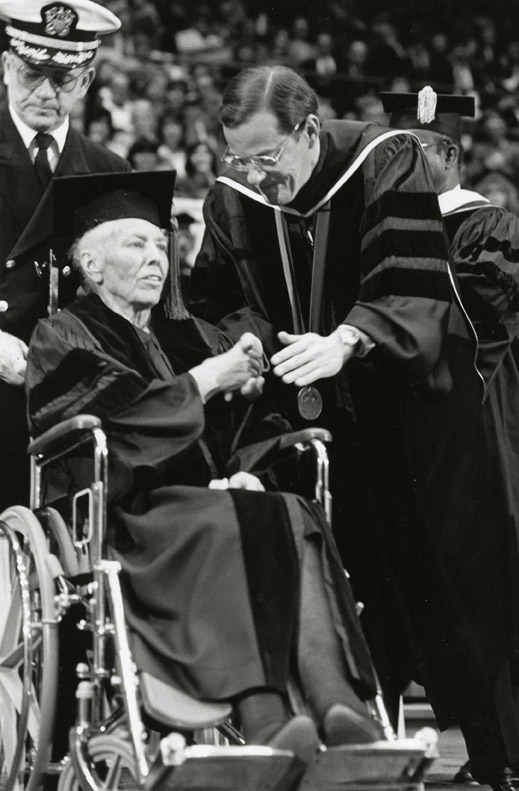
Failer receives her honorary degree, 1987

Failer receives her honorary degree, 1987

It was her love of the University, and her desire to give back to her alma mater that earned her an incredible amount of recognition. This recognition includes the University’s highest honors: the Distinguished Service Award (1964), the Alumni Centennial Recognition Award (1970), the Ralph D. Mershon Alumni Award (1984) and lastly, the honorary Doctorate of Humanities Award presented at the December 1987 Commencement a week before her death. She was 77 years old.

Failer’s dedication to OSU has continued long after her death, in the form of alumni awards and student financial awards in her name, such as the Josephine Sitterle Failer Alumni Award through the College of Pharmacy. The award honors a College alumnus or alumna who has made significant contributions to his or her community. A fund in her name also provides assistance to students in Alumnae Scholarship Housing who have been elected to membership in OSU honoraries. And the OSU Alumni Association established the Josephine Sitterle Failer Award for volunteer service to students. Its most recent recipient was James Miller, senior associate vice president for the Office of Technology Commercialization, whose many contributions include the renovation of a rundown fraternity house into a home for military veterans enrolled at Ohio State. Jo would be very proud.

Filed by C.N.

Long Gone Campus Traditions: Hats off to the era of freshman beanies!

1940

1940

Perhaps one of the few Ohio State traditions new students may wish to stay buried is the class cap, otherwise known as the ‘beanie.’ Freshmen (men only) used to be strong-armed into wearing caps in the name of creating school spirit and class unity. If by unity the administration meant commiseration, well then they got what they set out to achieve.

The caps and rules were in use from 1912 until the mid-century. Wearing the caps was just one of the rules enforced by “all men of the upper classes;” however, the junior men’s honorary Bucket and Dipper and its members were the only people ever authorized, by the Student Senate and the President of the University, to carry out the traditional punishment: namely, throwing offenders into Mirror Lake. Ironically, if some unauthorized person attempted to chuck a freshman in the lake, Bucket and Dipper members were honor-bound to protect the freshman.

A freshman is tossed into Mirror Lake, 1926

A freshman is tossed into Mirror Lake, 1926

Freshmen men were thus required to wear the caps from Freshman Week at the beginning of the term, until Cap Bonfire on Tradition Day, in June. Students caught without their beanies, or violating one of the freshmen rules, were punished. As one Alumni Monthly article put it, “Irregular meetings of Bucket and Dipper are held when freshmen are chased from the Long Walk and from the steps of University or Derby Hall.” These meetings convened on the edge of Mirror Lake and ended with the offending freshmen taking a swim. Other rules that could earn a dunking: skipping Chapel (which was mandatory until 1926), doing something to offend an upper classman (such as the freshman who posted signs saying “Bucket and Dipper go to Hell” near the Long Walk), or setting foot on the Long Walk.

As for Bucket and Dipper, the 14 members at that time were all junior men and had been chosen for their leadership, scholarship and service. Such greats as Chic Harley and Milt Caniff were members. During their initiation, members were thrown in Mirror Lake, so perhaps they had the prerequisite experience needed.

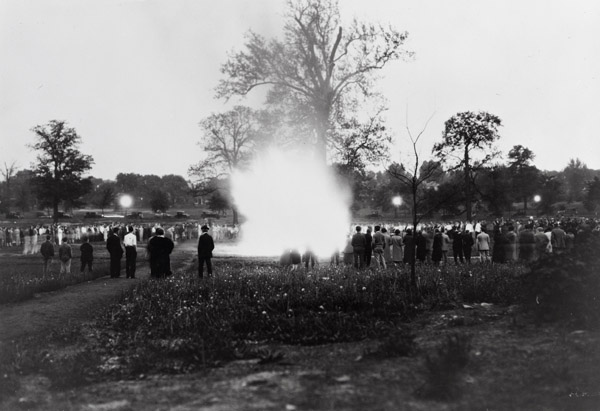
Freshman week cap burning, 1926

Freshman week cap burning, 1926

Thus, in June the freshman waged a two-day war on Bucket and Dipper. The “war” usually consisted on a tug-of-war across Mirror Lake—where the freshman consistently ended up in the lake. That night, students would gather for the Cap Bonfire, when some freshman opted to burn their beanies. (Many freshman did keep their beanies as a memento of their servitude.) Following the bonfire, many freshmen (again, ladies were excluded) went for a walk in their shirttails to cause a ruckus outside the home of then-OSU President William Oxley Thompson.

In 1926 Bucket and Dipper attempted to delay the burning; in the melee that followed, 103 freshman were thrown in the lake and the police were called. Ironically, it was a policeman that gave a freshman a concussion, not a trip into the lake. The following year, then-OSU President George Rightmire forbade Bucket and Dipper from dunking anyone, deserved or not. From then on, it seems the Bucket and Dipper initiates were the only ones to go swimming.

 As for the caps themselves, fashion in hats changed rather rapidly. Some prime examples from Ohio State include the “peanut-shaped skull cap,” “knitted toboggan” cap or “jockey-style” cap, or one with a “rolled brim topped with a scarlet button.”

Filed by C.N.

 To learn more about the tradition of freshmen beanies at OSU and other Big Ten universities, visit our web exhibit, “Beanies of the Big 10” at http://library.osu.edu/projects/beanies/.


Older posts Newer posts