From Woody's Couch

Our Playbook on OSU History

Category: People (page 14 of 52)

Lantern celebrates 100 years of daily coverage

Lantern front page, 1881

Lantern front page, 1881

This week marks the 100th year that The Lantern, OSU’s award-winning student newspaper became a classroom laboratory for journalism students to learn how to report and write the news on a daily basis. Its origins, though, were much more literary.

In January 1881, Volume 1, No. 1 of The Lantern appeared. Its editors picked the name after “La Lanterne,” a popular French magazine published in Paris at the time, and it started as a monthly appearing during the academic year only. In the initial issue, the editors promised to “represent the interests of our institution and student life as we find them.” And that’s been the goal ever since.

When it started, the newspaper was more like a literary magazine, publishing essays, and other writings that were submitted to the staff. In 1884, the newspaper began to appear every two weeks, and it was published by the Alcyone, Horton and Browning Literary societies. Seven years later, in 1891, the publication became a weekly.

Lantern students, 1914

Lantern students, 1914

The next year, members of the literary societies managing The Lantern decided to breathe new life into the publication and changed the name to “Wahoo.” Alumni were not so keen about the change apparently and demanded the return of the old name. The then-“Wahoo” editors seemed perplexed in a Nov. 29, 1892 editorial: “Since so few of the alumni formerly subscribed for the paper, it was surprising to see the sudden interest manifested when the name was changed. So “The Lantern” returned to the masthead – just 20 issues after “Wahoo” had appeared.

In 1914, journalism students took over the newspaper and it became a daily. Over the years, it has covered all kinds of historic moments on campus, from presidential inaugurations to student riots to NCAA championships.

To mark its historic 100th anniversary, we decided to give snippets of what appeared on the front page of the inaugural daily Lantern:

Lantern front page: September 15, 1914

Lantern front page: September 15, 1914

A now-forgotten OSU tradition called Cane Rush – where the freshman class and sophomore class battle to get a cane over the other’s goal line (sort of a combination of football and rugby) – would be held on Ohio Field that week. Strict new rules were in place to prevent winning by “strategy;” apparently, the year before, the sophomore class won when “Karl McComb dressed as a janitor walked down the cinder track with the cane concealed and climbed the goal posts on the freshman end of the field before the freshman discovered him.”

The Women’s Council was trying something new by providing each female freshman a “Big Sister” from the junior and senior classes. Each of these advisors had been given a name of three freshmen expected to enter OSU and had arranged to meet them at the train depot and help them secure lodging and finalize their class schedules. They would also introduce them to upper-class members and other freshmen. “By means of this every freshman girl will get started in school with little or no trouble or worry to herself.”

And finally, the staff reported that the honor of being the first to subscribe to the Daily Lantern went to Lowry F. Sater, president of the Ohio State University Association. In a letter to the newspaper that enclosed a check for his year’s subscription, Lowry wrote: “May your stock of oil never run low. I hope the Lantern will outshine any other luminary of its kind.”

Interested in seeing past articles of The Lantern? Go to the Lantern Archives and browse to your heart’s content. You’ll learn a LOT about OSU history along the way.


OSU student helped everyone know where to sit at home football games

Floyd Martin, 1923

Floyd Martin, 1923

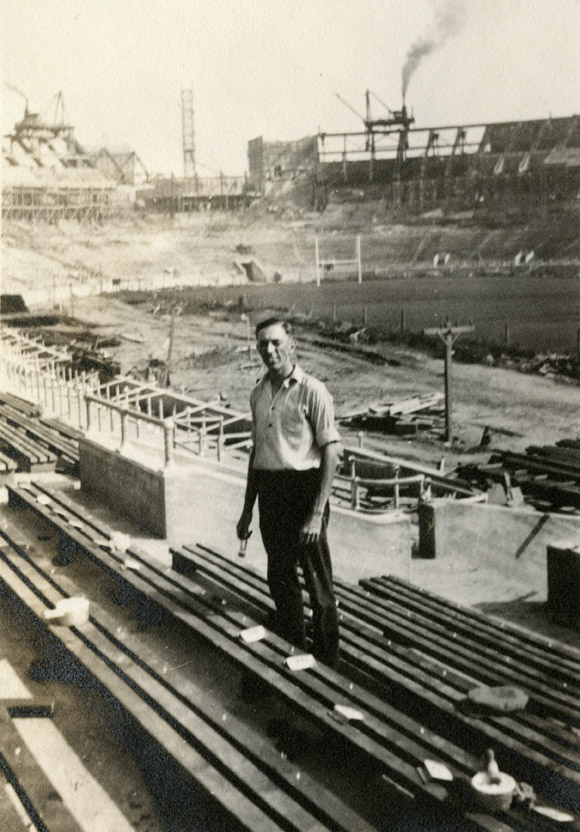
After receiving a scrapbook that belonged to OSU graduate Floyd Marion Martin, we’ve gained more insight on the work that took place during the construction of the Ohio Stadium. Martin graduated in 1923 with a Bachelor’s degree in Electrical Engineering and was involved in Theta Xi and the American Institute of Electrical Engineers, but he also took part in hand-stenciling the seat numbers in the Stadium.

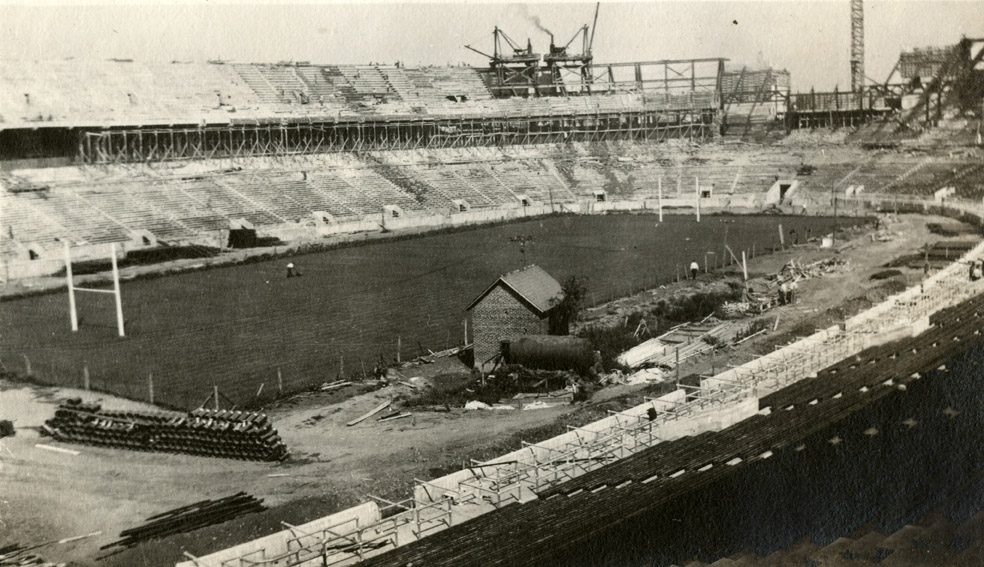
The construction for Ohio Stadium began on August 3, 1921, and by November, the concrete for the first nine rows of seats had been poured by contractors. In all, 75,000 barrels of cement, 22,000 tons of sand, and 45,000 tons of gravel would be used.

Martin's friends paint seat numbers on bleachers, 1922

Martin’s friends paint seat numbers in Ohio Stadium, 1922

Impressive numbers for an impressive edifice, the first of its kind for a college stadium. But fans needed a way to determine where they were going to sit on those concrete rows. By the next September, the football stadium was ready for seat numbers. Enter Martin and his friends, who were employed to put on the finishing touches.

The original seats that Martin and others worked on were three long strips of wood that ran thirty inches in width and seventeen inches in height. One photo, dated September 15, 1922, shows Martin at work with his friends, Pete, Baird, and Shug. They called themselves “The Royal Order of Stalling Stadium Stencilers”.

By October 7, 1922, the Buckeyes played their first game in the new Ohio Stadium against Ohio Wesleyan, winning the game 5-0.

(Below are a few more photographs from Martin’s album.)

1922

1922

1922

1922


1922

1922

– Filed by B.T.

‘Experiment’ for older students lasts 40 years

Program 60 students, 1981

Program 60 students, 1981

In December 1973, then-OSU President Harold Enarson approached the Board of Trustees with an idea: allow Ohio residents aged 65 or older to attend classes at OSU for free. It actually wasn’t his idea – he had seen a similar program the year before at the University of Colorado – but he still considered it an “experiment.”

Enarson told the Lantern after the meeting that he thought the program would get off to “a very slow start,” but hoped that “no one will get discouraged.”

His expectations, to put it mildly, were surpassed. The program is still going strong and has hundreds enrolled each semester.

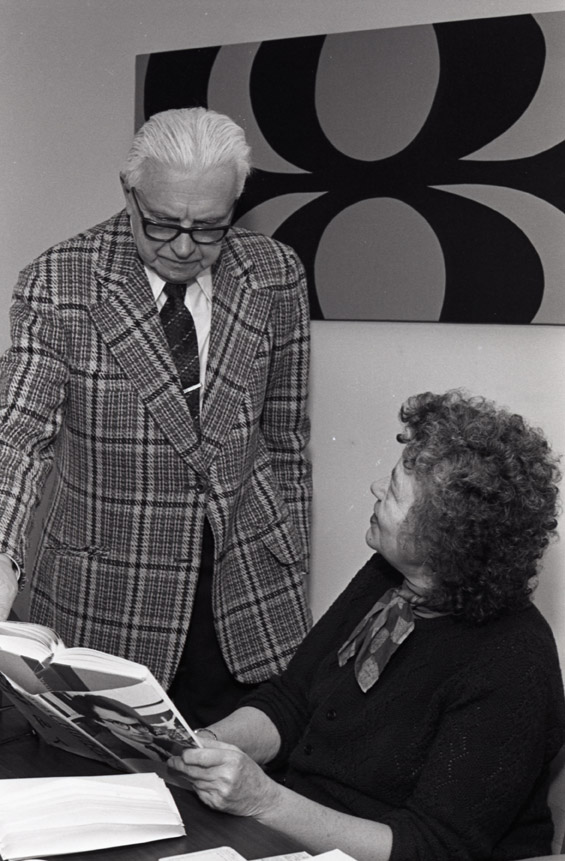
Then called Program 65, it began with winter quarter 1974 and was coordinated out of the Office of Continuing Education. It gave residents of Ohio 65 and older the ability to attend classes at the university free of charge. The first quarter brought in 67 men and women; by the next fall, 185 students had signed up for approximately 200 courses.

Program 60 students, 1996

Program 60 students, 1996

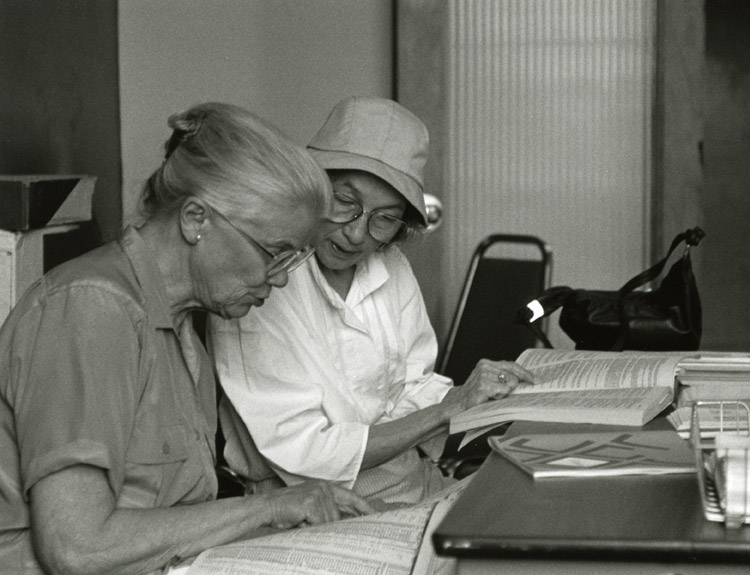
Ohio State’s Program 65 was such a success that the state legislature passed a bill in 1976 to require all state-supported colleges and universities to permit senior citizens aged 60 and older to attend classes on a non-tuition, space-available basis. OSU changed the name of the program to Program 60, and Enarson joked at the time that he was so proud of the program that on his next birthday – his 60th – he would quit his job, enroll in the program, and “haunt all of these faculty members.”

Filed by L.T.

Older posts Newer posts