From Woody's Couch

Our Playbook on OSU History

Category: Early University history (page 14 of 14)

A place of their own: Oxley Hall, the first women’s dorm

Oxley Hall, 1910

It may be hard to believe, but for many years in OSU’s early history, no female students lived on campus. Girls were expected to take rooms with local families or to live in boarding houses. Eventually, however, OSU women did get a dorm of their own: Oxley Hall.

The building was designed by a woman, who was an OSU alumna, to boot. Florence Kenyon Hayden was a former OSU student who had studied with then-University Architect Joseph Bradford. Her work was so good that Bradford suggested her to the Board of Trustees as the architect for the women’s dorm.

She got the job, although the trustees assigned her a male partner- Wilbur T. Mills – to complete the project. In a 1970 Columbus Dispatch interview, she said that she became fed up with Mills, locked him out of the office, and submitted her final plans for approval within the month. So apparently what we see today is Kenyon Hayden’s vision, although both she and Mills are listed as the official architectural team. After marrying a physician, she began designing medical facilities, for which she later gained some national attention.

Oxley Hall residents, 1931

Construction began on the building in 1907; it was built in the English Renaissance style with a Spanish tile roof, brick exterior and limestone trim. The cost of the original structure is listed as $66,490.85.

Residents moved into the building in September 1908 and took a vote on what to name their new home. The Board of Trustees accepted their recommendation, and on November 20, 1908, officially named the building for President William Oxley Thompson’s mother (her maiden name, which is where he got his middle name).

Some fun facts about living in Oxley Hall as a co-ed: A single room cost $1.75 per week in room and board; residing in a double room cost $1.50. The girls did have staff to cook and to clean the public areas of the house. There were mandatory quiet hours Monday-Thursday from

1950s

7:30 p.m. until 6:30 am. Girls could have callers on Sundays from noon-3 p.m., and from 5-10 p.m.; men were never allowed beyond the first-floor receiving rooms. Residents also had curfews, though those became less restrictive as the years progressed.

The building served as a dormitory until 1967, when it was decided that it was unsuitable as a residence hall and was leased to the University Research Foundation. The building was remodeled in 1989, and in 1991 the Department of International Affairs moved in, where it remains to this day.

Filed by C.N.
Twelve Days of Buckeyes: OSU and the 19th U.S. President

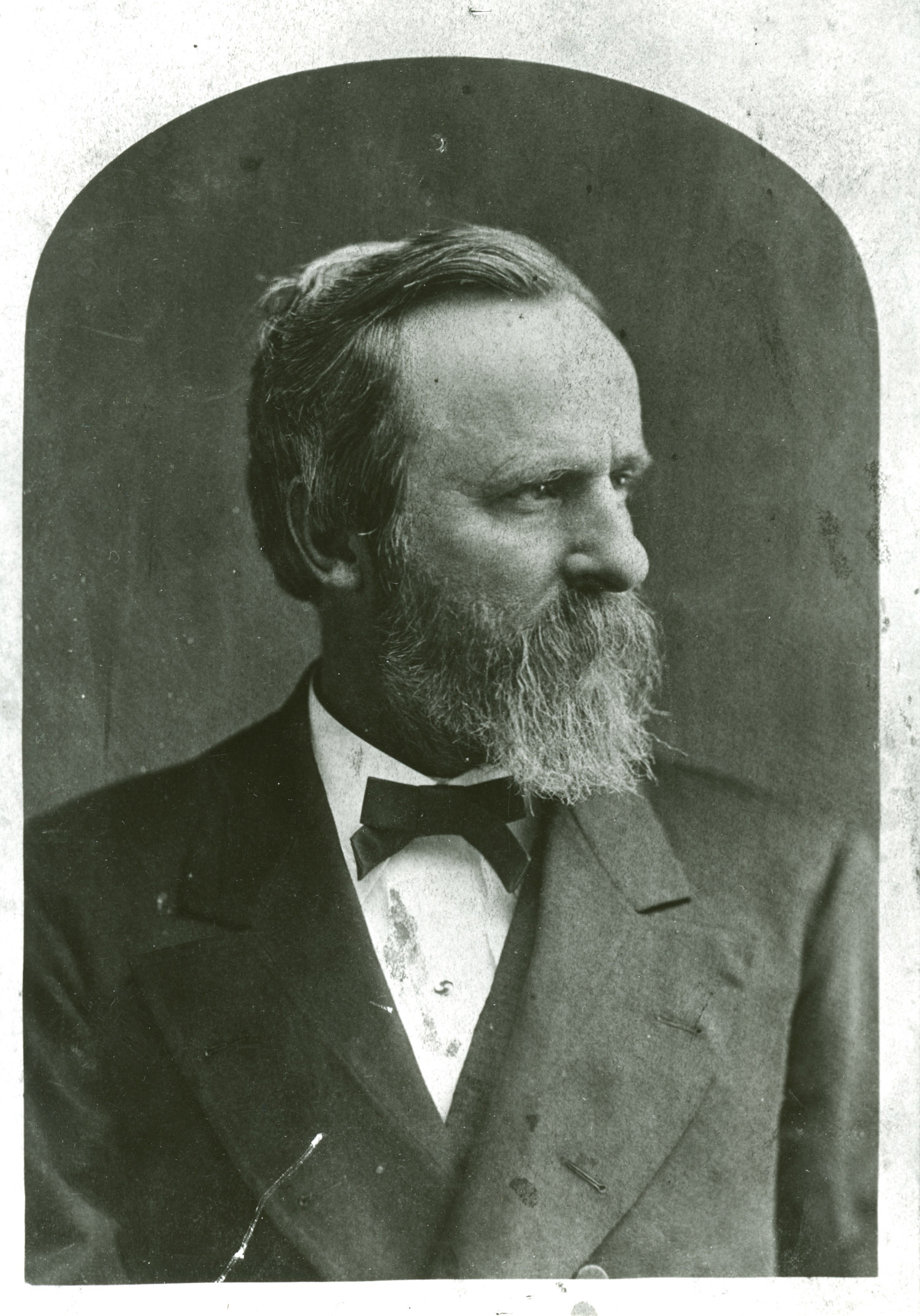
Hayes, 1887

It’s common knowledge that Rutherford B. Hayes served as President of the United States (1877-1881), but it’s not nearly as well-known about his impact on OSU’s history.

In 1862, Congress passed the Morrill Act, which created a system of land-grand colleges focusing on engineering and agriculture. Ohio lawmakers were not keen at first in supporting the law. Some feared, for instance, that it would become a big burden for states, which had to manage the sale of federal lands in order to create endowment funds for these universities. Finally, in 1870, the state legislature passed the Cannon Act, one of a series of bills to resolve the many issues of the original Morrill Act.

Cannon Act

One of the major sticking points was whether the money should be divided among the pre-existing schools, or whether a new college devoted to engineering and agriculture should receive the funds. Rutherford B. Hayes, a Republican elected Governor of Ohio in 1868, did not like the idea of awarding the federal funds to any existing school: he saw this was an opportunity to start something new. When he signed the Cannon Act into law, he got his wish: there would be a new school: the Ohio Agricultural and Mechanical College.

Within two months of the law’s passage, Hayes had selected the required nineteen-member Board of Trustees (one for each Congressional district in Ohio), choosing as many Democrats as Republicans as he could, to make the group as bi-partisan as possible. The next hurdle was the new college’s location. Four counties from around the state vied for the new campus, and it was likely Hayes who influenced the board to choose Neil Farm, just north of Columbus.

University Hall engraving, c1873

Hayes was a tireless supporter of OSU, right up until his death in January 1893. Just a few years before, using his political influence, he urged members of the U.S. House and Senate to support a second Morrill Act that would add to land grants awarded in the original law a maximum of another $25,000 per year. In 1891, the Ohio General Assembly granted the support from the second Morrill Act to the Ohio State University.

Ironically, despite his own achievements – Civil War hero, Governor of Ohio, President of the United States – Hayes felt the office of University president was beyond most men, presumably including himself. During a discussion concerning a presidential search for the University, Hayes told other members of the Board of Trustees: “We are looking for a man of fine appearance, of commanding presence, one who will impress the public…he must get along with and govern the faculty, he must be popular with the students … a man of affairs; he must be a great administrator. Gentlemen, there is no such man.”

When news reached the campus that Hayes had died, then-OSU President William Henry Scott ordered classes be adjourned and that the faculty attend a special meeting. University Chapel in University Hall was draped in black. In a memorial resolution, the Board called it an “irreparable loss” to the University.

(We owe much – again – to retired University Archivist Raimund Goerler’s “The Ohio State University: An Illustrated History” (2011) for this post. Another good source for early OSU history, also used for this post, is James Pollard’s “History of The Ohio State University: 1873-1948” (1952).)

Newer posts