From Woody's Couch

Our Playbook on OSU History

Category: Departments (page 11 of 16)

Twelve Days: 4-H founder helped form better farmers for the future

A.B. Graham, 1911

A.B. Graham, 1911

Before A.B. Graham no one thought to teach children in rural communities in any organized fashion on how to be better farmers when they grew up. Because of Graham, though, the agricultural club system known as “4-H” was born, and has grown to include roughly 7 million young people in more than 50 countries.

Albert Belmont Graham was born on March 13, 1868, near Lena, Ohio. He attended school in a one-room schoolhouse; upon his graduation at the age of 17 he took over the teaching job. His father had died when Graham was young, and his mother supported her family as a seamstress. Graham’s grandmother, a Quaker, lent him money to attend the National Normal School, and after graduation in 1888 he enrolled in OSU. He stayed only one year, though, and returned to teaching. In 1900 he was elected superintendent of schools in Springfield, Ohio.
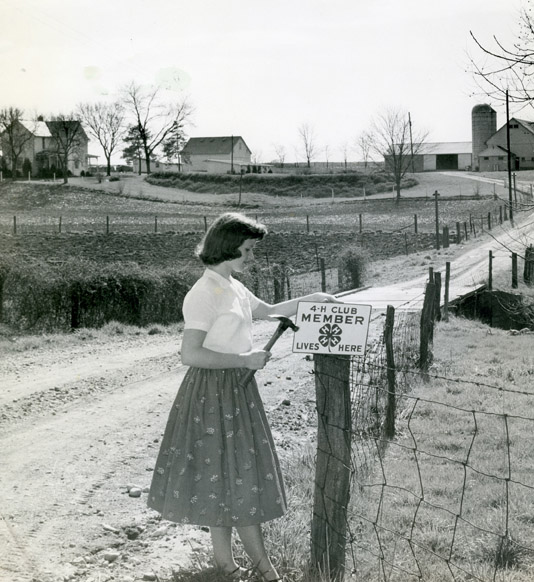
Girl posting 4H sign, no date

Girl posting 4H sign, no date

It was there, on January 15, 1902, that Graham founded the boys’ and girls’ agricultural club – the first of its kind in the United States and what would later become 4-H, which stands for Head, Heart, Hand and Health. The club was designed to supplement the education the children were receiving in school on the scientific study of agriculture.
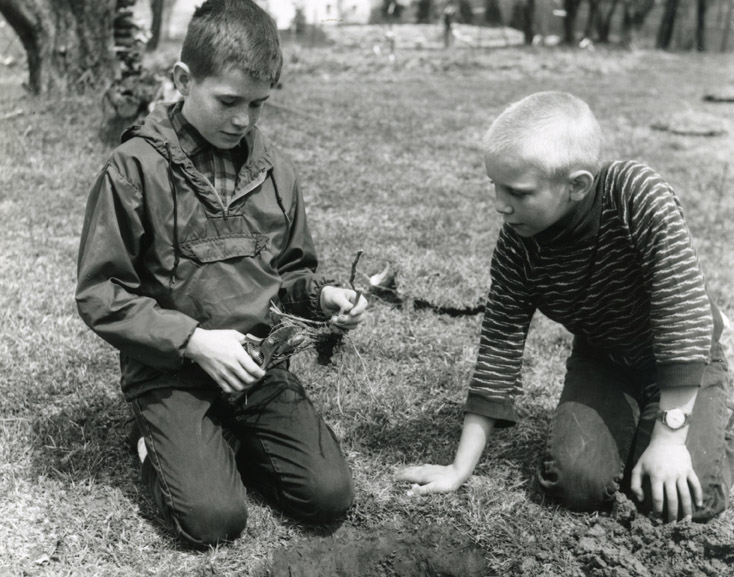
no date, A.B. Graham collection, two boys digging in dirtYoungsters were given seeds and taught how to test soil quality, how to plant and grow the seeds, to take notes and study scientific theory. They were asked to present their findings among their peers, and to conduct group projects. The club also worked with parents, helping to improve the quality of life in rural communities and to encourage good agricultural practices. The first club had 83 members who planted experimental plots of corn, vegetables and flowers, and kept meticulous records of their results.
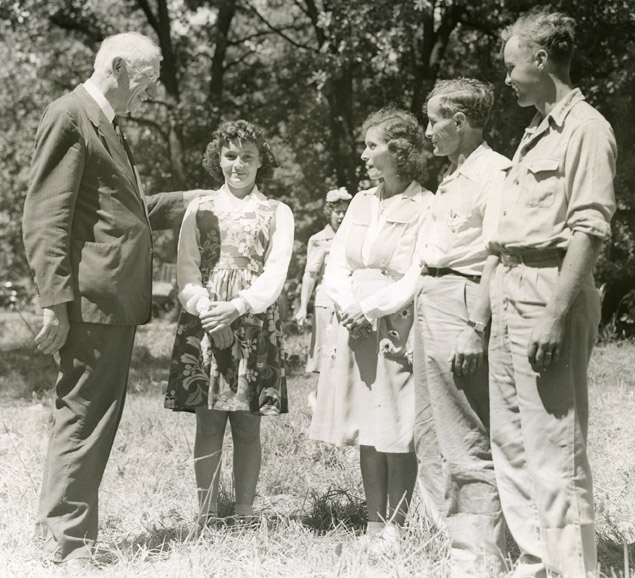
Graham talks with a young girl, 1945

Graham talks with a young girl, 1945

Meanwhile, Graham worked with OSU and the Ohio Agricultural Experiment Station at Wooster to test seed varieties and various agricultural methods. In 1905, OSU created the position of superintendent of agricultural extension for Graham, who by then was known statewide for his work with farming communities. The then-new service focused on what Graham had been doing all along: promoting healthy agricultural practices and encouraging schools to teach agriculture and home economics as part of their curriculum, as well as providing educational resources to students and the public.

Graham served as director at Ohio State until 1914, when he went to the New York State School of Agriculture to start a similar program there. Two years later, he moved to Washington, D.C., to work as chief of agricultural extension specialists for the U.S. Department of Agriculture. When he retired from that position in 1938, he returned to Columbus, staying active in the community and 4-H until his death on January 14, 1960, at the age of 91.

– Filed by C.N.
Twelve Days: James’ 35-year quest led to OSU’s top-rated cancer hospital

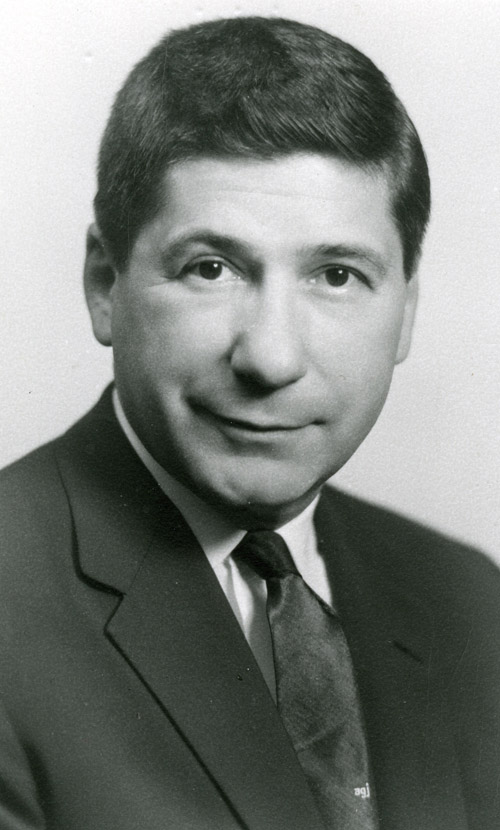
Arthur James, 1961

Arthur James, 1961

Dr. Arthur G. James believed all cancer would eventually be eradicated. That belief coupled with his dedication to the idea that cancer patients need separate, specialized care, led him to lobby, campaign, and fund-raise for 35 years to build a cancer hospital in Ohio.

The Arthur G. James Cancer Hospital and Research Institute opened at Ohio State on July 9, 1990. After a gift of $20 million from Richard J. Solove in 1999, the facility was renamed the Arthur G. James Cancer Hospital and Richard J. Solove Research Institute, but is commonly referred to as the James. The facility remains the only freestanding cancer hospital in Ohio to this day. 

James Cancer Hospital

James Cancer Hospital

James was born to Italian immigrant parents in the coal mining town of Rhodesdale, Ohio. The third of eight children, James worked to save enough money for college, graduated as co-valedictorian of his high school class and earned a scholarship to Ohio State.

Once at Ohio State, James continued to work part-time jobs to pay his room and board. He chose to study engineering, like his elder brother, but in his sophomore year decided he wanted to study medicine. He received his bachelor of arts degree in 1934 and his master’s degree in 1937. He met his wife, Milly, while in medical school and they were married in 1940.

Upon his graduation from Ohio State, he received a fellowship at Memorial Sloan-Kettering Hospital in New York, where he became interested in the field of surgical oncology. The outbreak of World War II disrupted these plans but eventually, he returned to complete his fellowship in New York.

Cancer Institute groundbreaking, 1984

Cancer Institute groundbreaking, 1984

He returned to his alma mater in 1948 as a member of the OSU faculty, a position he would hold for almost 40 years. In 1960 James began advocating for the establishment of a cancer hospital. At that time, the only hospitals dedicated to the study of cancer were in New York and Texas. Arthur James wanted to change that. It took him more than 30 years, but in the end, he convinced the community, the State and the University that a cancer hospital was needed.

In 1984, ground was broken on the hospital that now bears his name. It was completed in 1988, and, the James is now one of the premier cancer treatment hospitals in the nation.

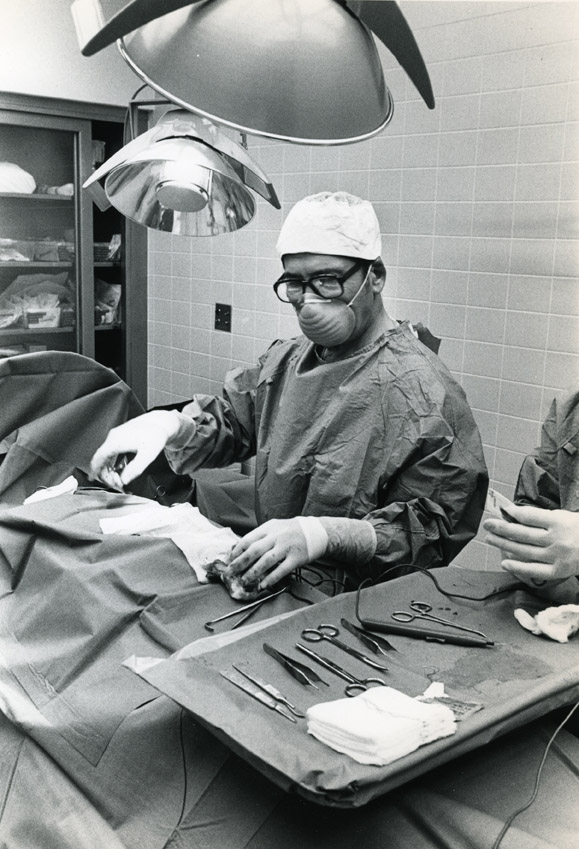
James performing surgery, 1979

James performing surgery, 1979

James was recognized for his work many times. He served as President of the American Cancer Society from 1972-73, and was awarded the organization’s Medal of Honor in 1990. He was also inducted into the Horatio Alger Association of Distinguished Americans, a non-profit service organization which recognized those people who have achieved great success despite humble or difficult circumstances. Despite the awards and the fanfare, James was always committed to the cause, and it was his passion to help people with cancer.

After a long battle with Parkinson’s disease, James died on October 22, 2001, at the age of 89 years. Dennis Smith, director of administration at The James at the time said of him, “Without Dr. James, this hospital simply would not exist. His memory and dedication will live on through this hospital and all we achieve.”

Twelve Days: With Stuckey, it was always safety first

Wilbur Edward Stuckey, 1965

Wilbur Edward Stuckey, 1965

Wilbur Edward Stuckey, better known as “Bill” to many Ohio farmers and students, was all about safety. He lectured on how to prevent Christmas tree fires, sent students out to campus buildings to look for potential accident hazards, and gave helpful tips on how to have fun safely on holidays like Memorial Day. (“Play Safe – Increase the Fun,” was the title of this talk.)

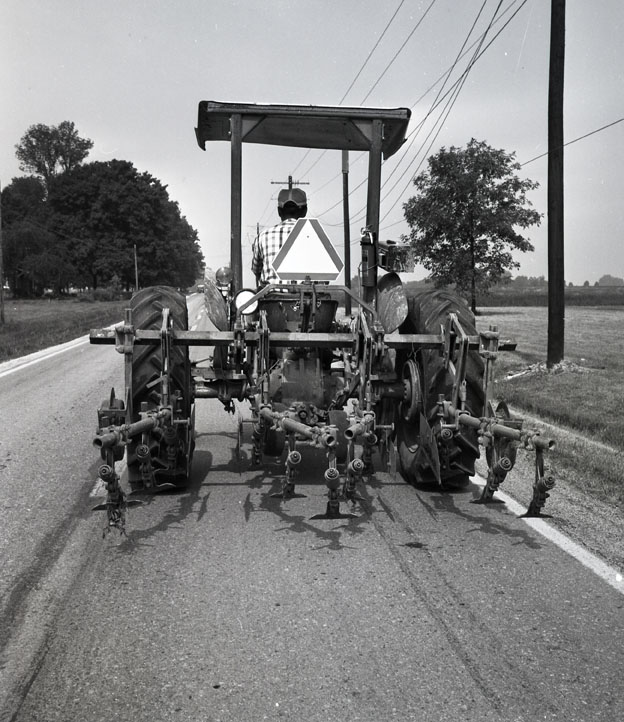
His most recognizable contribution was his steadfast promotion of the orange triangle ‘Slow Moving Vehicle’ sign now found on the backs of tractors, buggies and farm equipment across the nation. Here at the Archives, he’s also known as inventor of “The Convincer,” a wooden contraption that demonstrated the hazards of not wearing a seat belt. 

Stuckey was born February 8, 1911, in Bloomville, Ohio and enrolled in Ohio State in the fall of 1929. As a student, he was involved in Glee Club, the All Agriculture Council, and he was elected as President of the Townshend Agricultural Education Society for his senior year. He graduated from Ohio State with his B.S. in Agriculture in 1933.

"The Convincer"

“The Convincer”, Stuckey’s invention which used an egg on the seat to represent a person. Without the seat belt the egg would hit the box and break. With the seat belt, the egg would not break. The Convincer is held at the Archives.

After graduation, Stuckey accepted a position as a vocational agriculture teacher, but he returned to OSU in 1941 as a faculty member, teaching evening classes in Summit Station, Ohio. He received his Master’s degree Agriculture Education in December 1944, and he continued to serve on the faculty while working in the Division of Safety and Hygiene in the Industrial Commission of Ohio.

In 1955, he began working full-time in OSU’s Extension Service as a farm safety specialist, and he held that position until he retired in 1976.

Tractor with the slow moving vehicle sign on the back

Tractor with the slow moving vehicle sign on the back

Stuckey began tracking farm accidents in 1957, and this research led him to teach farmers and students across the state about the dangers of farm equipment and how to use such equipment more safely. He is credited with reducing the deaths on Ohio farms by half in the time he was safety director. In fact, he spearheaded the movement in the mid-1960s to adopt the “Slow Moving Vehicle” sign.

Stuckey died on January 12, 1981. In 1988, Stuckey was inducted posthumously into the Ohio Agricultural Hall of Fame. That same year, the Ohio Farm and Home Safety Committee established an endowment fund at OSU in his name, designated for research in farm and home safety.

 – Filed by C.N.

Older posts Newer posts