From Woody's Couch

Our Playbook on OSU History

Category: Campus locations (page 9 of 9)

Buckeye-D, from the heart

#1 Couples at dance, 1936

In honor of Valentine’s Day this year, we thought we would tell you about a reader survey on top places to meet a future significant other; post some real-life “Happily Ever Afters” from OSU’s past, and show old photos of romantically linked – but sadly, unidentified – couples on campus.

Throughout the blog, we’ve placed photos of couples, some of whom look desperately in love, and all of whom desperately need identification. As you read the blog, see if you can place names to faces, and if you can, please e-mail us at: archives@osu.edu   Don’t forget to include the number of the photo!

Now, the survey: In June 1991, The Ohio State University Alumni Magazine published the findings of a reader survey on the top places to meet your future significant other (based on the number of resulting marriages). They were:

  1. in class;
  2. at a Greek house or event;
  3. at a dorm or dorm event.

    #2 Couple in front of fraternity house, c1970s

The top five all-time places to take your date (1910s-1990s) were:

  1. Mirror Lake and Libraries;
  2. Ohio Union (of any era);
  3. Greek house or event
  4. Football game
  5. Hennick’s Drug Store. Hennick’s, which was located at 15th and High, was the campus soda fountain of the 1930s and ’40s.

It seems odd that the library would top a football game as the best place to take a date, but there you have it. Meanwhile, here are a few stories from the June 1991 issue of alumni magazine of some real-life Buckeye couples:
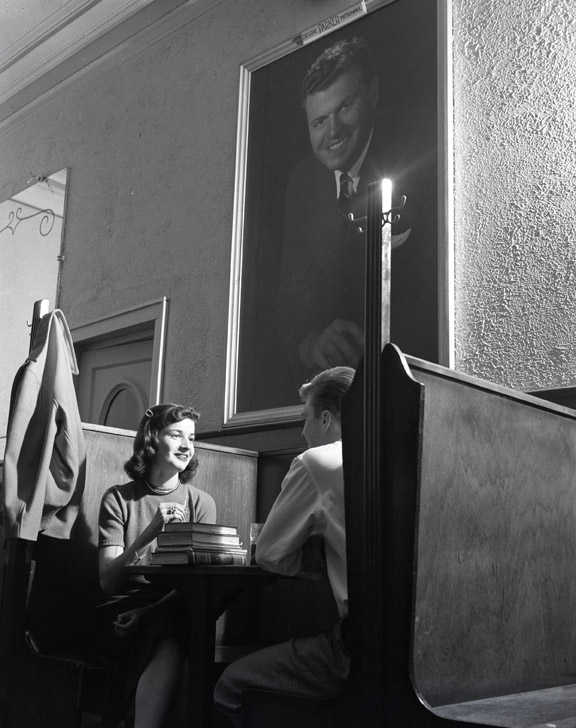
#3 Couple at Hennick's, n.d.

David L. Sherck, ’57, was so sure that K. Carol Dixon, ’56, would marry him that he asked his fraternity brothers to gather at Mirror Lake to sing the sweetheart song while he proposed. They were married in June 1957.

When it began raining during the June 1941 commencement ceremony at Ohio Stadium, many fled for cover underneath the stands. It was there that Irving R. Lackritz, ’39, proposed to Dorothy S. Krakoff, ’41, in front of both sets of parents. They were married in November 1941.

Richard and Elizabeth Goertemiller, both Class of ’50, were at the 1950 OSU-Michigan game – now known as the “Snow Bowl” – when he proposed. She was so cold, she could barely say “yes,” but she did, and they were married in April 1951.

#4 Couple on campus, c1970s

#5 Freshmen dance at Ohio Union, 1967


Filed by C.N.
“Buckeye Stroll” now in the Apple App Store

Want to learn OSU history? There’s an app for that.

Buckeye Stroll, OSU’s online historical campus tour, is now available in Apple’s mobile application store for the  iPhone, iPad and iPod Touch. Download the application, and with a GPS-enabled device, you can learn about OSU history as you walk around campus. Nearly 100 buildings are featured, with photographs and brief histories. The tour was created through a collaboration of the Libraries’ Web Implementation Team and the University Archives. Buckeye Stroll also is available on the Libraries’ web site at: http://library.osu.edu/buckeye-stroll

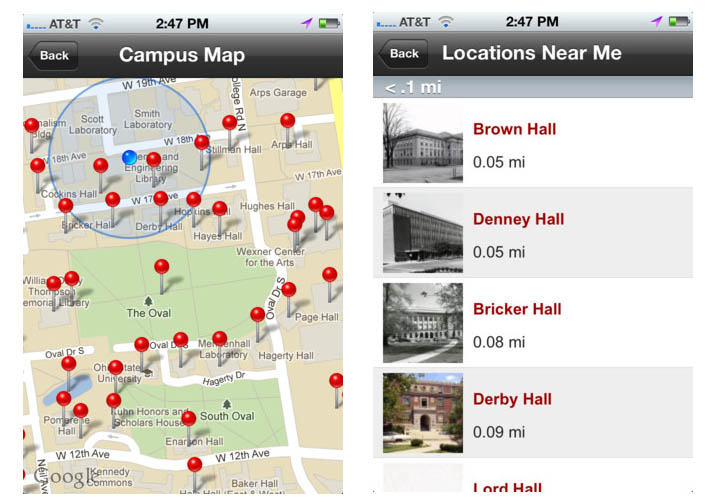
Here are a few screen shots from Buckeye Stroll:

The Buckeye Stroll application will locate you on the map and display your position as you walk across campus (left screen shot). It will also sort the buildings by proximity to your location (right).


Twelve Days of Buckeyes: Mirror Lake’s colorful past

(With this post, we begin our annual take-off on “The Twelve Days of Christmas,” but instead of riffing on the individual lyrics of this classic holiday song, we decided to offer up tasty treats about twelve events, people or places associated with OSU that – while they may not be well-known – make us thankful at this time to be Buckeyes. First up is one of our favorite spots on campus and one with a very interesting history: Mirror Lake.)

Mirror Lake Islands, 1909

The first reference to “Mirror Lake” comes from the 1912 OSU yearbook, the Makio. However, the lake had attracted attention long before then. University lore says that the site for the campus was chosen partly because of a spring at Mirror Lake’s location that supplied water to the Neil Farm. Yep, people could drink out of it.

The natural spring that fed the lake was first threatened in 1891, when Columbus put a storm sewer through campus. (The sewer became a popular site for photographs at one point.) The spring dried up, but University officials stepped in after a tremendous public outcry, and for the cost of $600, and some supervision by a professional in mines and engineering, the sewer was rerouted and the spring began flowing again. At this time the lake contained islands, which were accessible from bridges. Swans, turtles, and giant goldfish lived in the lake. An annual Tug-of-War was held during May Week that usually resulted in the dunking of all players.

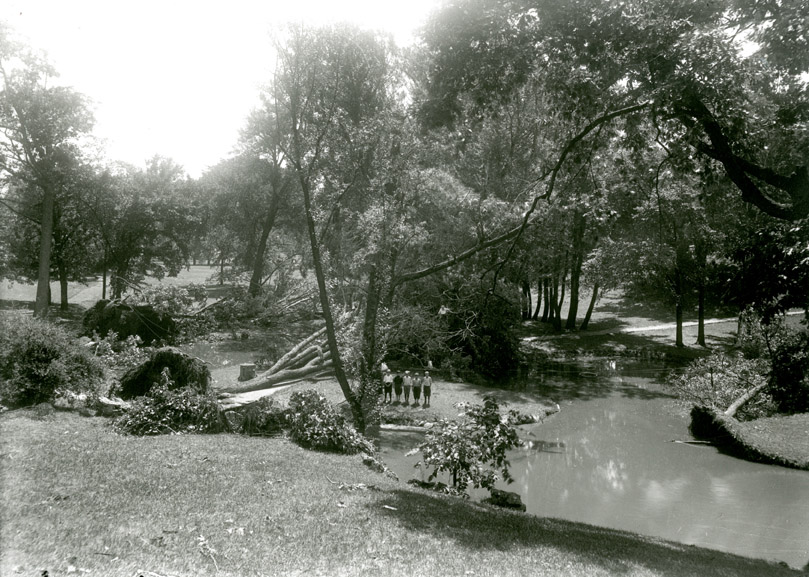
Windstorm damage, 1918

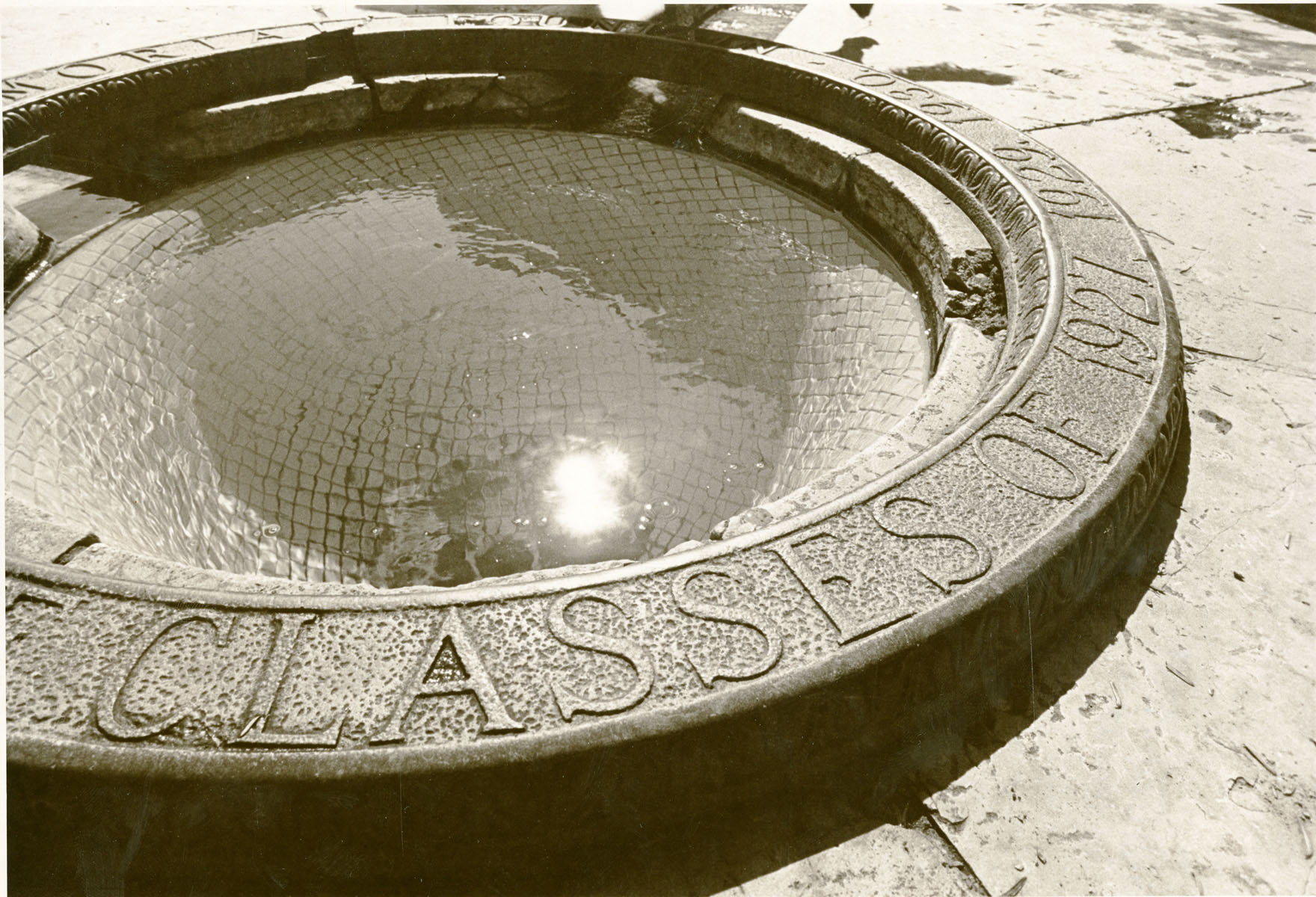
Memorial fountain

In 1918, a windstorm knocked down trees surrounding Mirror Lake and drastically altered its shape. Two years later, because of so much construction on campus, the spring dried up altogether, and again University officials sought to find a solution. The result was the memorial fountain (the class gift for 1927, 1928 and 1930) that stands today at the east end of the lake. The water was pumped from the Olentangy River to the fountain, but this created another problem: The water was sulfuric, and it stank, especially in the spring (no pun intended). No doubt romantic strollers avoided this area at that time. This also meant the end of wildlife in and around the lake. In the 1960s chlorine was piped in through the newly installed fountain to eliminate the smell. Eventually, the city of Columbus started supplying the water and does to this day. During the 1930s, the bottom of the lake was paved with bricks as part of a federal Works Progress Administration project, to better facilitate cleaning.

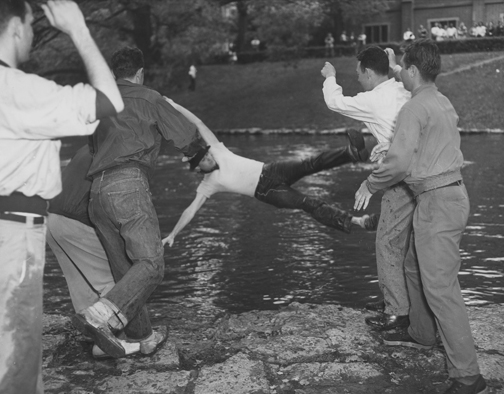
May Week dunking, 1952

Mirror Lake has always attracted bathing, as it were, whether it’s been voluntary or not. Dunking has been very prevalent over the years and has occurred for many reasons other than May Week: to celebrate fraternity elections, to “tap” new members of class honoraries, or to punish freshmen caught without wearing their beanies on their heads. It had gotten so out of hand by 1957 that the University banned it that year after serious injuries were reported the year before. Jumping into Mirror Lake has had no such restrictions, and the tradition of taking a dip in anticipation of the upcoming Michigan football game has continued roughly 20 years after its inception in the early 1990s.

Mirror Lake also has served as a magnet for young lovers, even those who are fighting. In 1964, there was the case of a spat between an engaged couple. The woman removed her engagement ring during the argument, and her fiancé took it from her and threw it into the lake. The following day the girl arrived on campus in a raincoat and a bikini, and went swimming, trying to find her ring (why her fiancé is still unclear). University policemen asked her to get out of the lake, but as only “swimming” was against the rules, she was allowed in to look for the piece of jewelry. After donning a scuba mask, she found the ring and eventually married the fiancé.


Newer posts