From Woody's Couch

Our Playbook on OSU History

Category: Buildings (page 8 of 25)

Buckeye Village has always had family atmosphere, international flair

Buckeye Village residents, 1940s

Buckeye Village residents, 1940s

The Buckeye Village’s first permanent housing was built in 1948 as World War II veterans returned to campus under the GI Bill to complete their education – often with a family in tow. (You can find one war veteran’s story of living there here.( http://kb.osu.edu/dspace/handle/1811/58840) 

Soon enough a club sprang up called the Buckeye Village Wives, which – among other activities – held fund-raising bazaars for a child-care center, organized lectures by University professors, and published a mimeographed newspaper called The Villager. (Apparently, a Mrs. Betty Gremillion won a basket of groceries for coming up with the name, according to a 1948 Lantern article.)

Also from the very beginning, Buckeye Village was international in nature: in 1948 the 152 wives living there represented four nations and three continents.

nd_buckeye_village_apartments

Buckeye Village, no date

As early as 1955 Village residents were banding together to make their opinions known to the University: According to a July 27 Lantern article, an “urgent cry’ by residents to paint both the inside and outside of the Village apartments led OSU officials to decide to skip the bidding process for outside vendors and have the University’s service department employees do the job.

Two years later residents were protesting a proposed 21-percent rent hike, even though the year before a Lantern editorial chastised the University for its lack of upkeep on the buildings, calling the Village OSU’s “biggest eyesore.” (It would not be the last time residents united to protest rent hikes.)

Buckeye Village residents, 1993

Buckeye Village residents, 1993

Less than five years later, though, the University had built forty new apartment units, which opened in 1961; the total number of units rose to 400. And in fact, a 1962 Lantern article said residents were content to live in apartments whose rents ranged from $79.50 to $89.50 per month ($4.00 extra for air conditioning), and who could take advantage of a community hall that housed a study library, a pool, ping-pong tables and a nursery school for children. There also was a community garden.

In the mid-1950s the University had dropped the rule that residents must be veterans, but students who lived there still had to be married. By 1986, the majority of residents (80 percent) were international students who were married; the rest were domestic students who were married or single parents. Today, any student can apply to live in Buckeye Village; however, priority still goes to married students and those with children.

First women students were a surprise show but made mark on OSU

The Townshend family, 1884

The Townshend family, 1884

In 1873, when two dozen young people showed up at University Hall to enroll in the then-new Ohio Agricultural and Mechanical College, two were women – in fact, they were the daughters of the first Professor of Agriculture.

Alice and Harriet Townshend were the youngest children of OSU Professor Norton Strange Townshend, who had stepped down from the College’s first Board of Trustees to teach agriculture classes at the new school. He was an advocate for women’s rights, and believed in higher education for all.

The former Townshend home, 1902

The former Townshend home in 1902. The family resided here from 1873 to 1895.

So, on the morning of September 17, 1873, Alice and Harriet, and their older brother, Arthur, walked from their home near 15th Avenue and High Street to sign up for classes, according to an interview with Harriet Townshend published in the October 1948 issue of The Alumni Monthly. In the interview, Harriet Townshend said that College President Edward Orton Sr. “almost fainted” when the two sisters showed up because he was not expecting women to enroll in the new school. He left it to the Trustees to decide, and upon reading the legislative bill passed to establish the College, they determined that women, as well as men, could attend.

While Arthur graduated with the first class in 1878, it took two more years for Alice Townshend to earn her degree; however, Alice was one of the three students on the committee in 1878 who purchased the ribbons that adorned the first diplomas. The colors of those ribbons were scarlet and gray, and Alice helped pick them.

Harriet Townshend from when she was an assistant librarian at OSU in 1900

Harriet Townshend as an assistant librarian at OSU in 1900

Shortly after graduation, Alice married Charles Mayhew Wing; little else is written about her, except for her death on December 1, 1925.

Though Harriet Townshend never graduated, she worked as an OSU Library staff member for more than 30 years, making sure all of the materials had proper binding. Townshend never lived far from the University; her last residence was listed as 53 W. 11th Avenue, which today is across the street from the Moritz College of Law. And she continued to be an advocate of higher education for women until her death at age 92 on April 29, 1950.

– Filed by C.N.

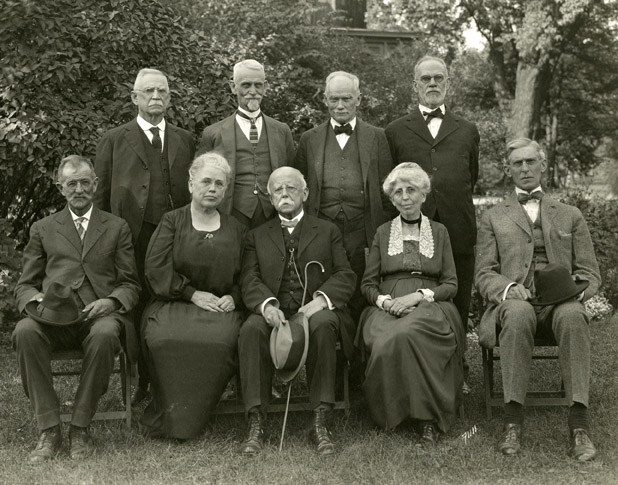
Alice Townshend-Wing (front row, second from left), and Hariett Townshend (front row, second from right), at a class reunion party in 1923

Alice Townshend-Wing (front row, second from left), and Harriet Townshend (front row, second from right), at a class reunion party in 1923

“Wedded Husband” married Chinese culture with English language at OSU

Hong Shen, 1919

Hong Shen, 1919

Nearly 100 years ago, a young man from China studying ceramic engineering at OSU wrote a play in English that was performed in University Hall. It was likely the first-ever English-language play written by a Chinese national to be performed in the U.S.

The young man’s name was Hong Shen, the play was called “The Wedded Husband” and it was performed in University Hall Chapel on April 11 and 12 in 1919 before a capacity audience of 1,300.


Shen was studying at OSU on a scholarship paid by the Chinese government. It was his first play written in English; previous works – “Fruit Vendor” and “Which Is It?” had been performed at his alma mater, Tsing Hua College in Beijing.


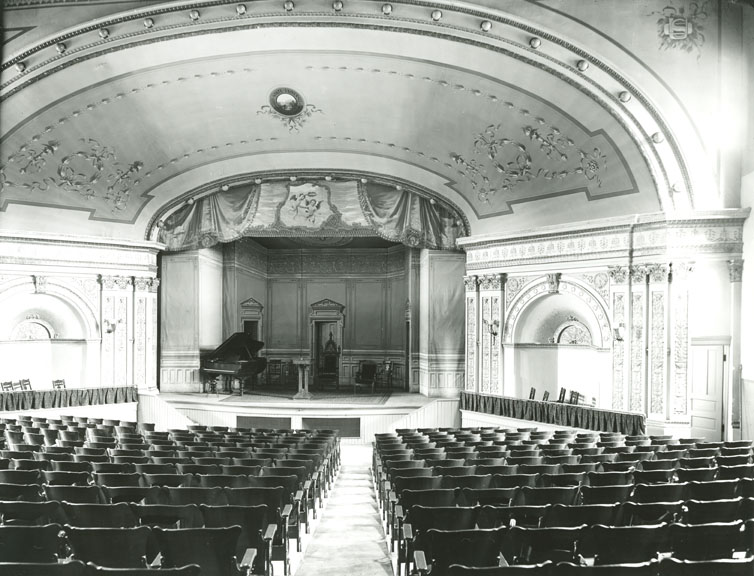
University Hall Chapel, c1900

University Hall Chapel, c1900

The play was co-sponsored by OSU’s Cosmopolitan Club and the Chinese Students’ Clubs of OSU and Oberlin College, and all of the men’s parts were performed by Chinese students who, like Shen, had been sent to the U.S. by the Chinese government under the provisions of the Boxer indemnity fund.


According to a Lantern article, Shen received a telegram from professors at Goucher College and the Columbia School of Fine Arts to reserve tickets for them. (They were going to be in Columbus for a meeting of the Methodist Centenary Movement.)


The play is about a young woman, Miss Wang, who is arranged to be married to a gentleman named Master Chen. She agrees to the marriage out of filial devotion to her father but during the ceremony, she falls ill. The doctor suspects she is a victim of the plague that is ravaging the city and orders her to be quarantined. Master Chen, however, defies the order to care for his wife. He ends up dying of the plague, while Miss Wang recovers. She is then arranged to be married to Master Yang, but when she hears of how Master Chen risked his life for her, she changes her mind and remains a loyal widow.


Last November, OSU’s Institute for Chinese Studies put on a revival of the play in the Roy Bowen Theatre, in the Drake Union. It was part of a series of events honoring Shen, who left OSU in 1919 to study dramatic arts at Harvard before returning to China where he eventually became an important figure in modern Chinese theater, film and drama. His daughter recently donated a collection of his works to the University.

Older posts Newer posts