From Woody's Couch

Our Playbook on OSU History

Category: Buildings (page 10 of 25)

Twelve Days: Bradley took art to the world as the ‘paint-brush ambassador’

Carolyn Bradley, 1940

Carolyn Bradley, 1940

OSU can boast of a number of well-known artists who either studied or taught at the University: George Bellows, James Hopkins, and Roy Lichtenstein, for example. One artist – Carolyn Bradley – drew acclaim not only for her art but for her many travels to bring her artistic passion to the world.

Carolyn Gertrude Bradley was born on September 22, 1898, in Richmond, Indiana. She received her first bachelor’s degree in 1920 from Earlham College in Richmond. She went on to earn another B.A. from John Herron Art School in Indianapolis, as well as degrees from Columbia University, the Traphagen School of Fashion in New York, and a master’s degree in fine arts from Escuela Universitaria de Bellas Artes in San Miguel Allende, Mexico.

1930_bradley_carolyn

Bradley with her artwork, no date

Bradley also was an avid traveler and fluent in Spanish, which earned her a place as an educational ambassador with the U.S. State Department from 1946-1951. Her first state-sponsored trip was as a visiting professor at the University of Chile, the second was a three-month tour of Guatemala, Honduras and Costa Rica. In 1950 she took a part-time teaching position at the Centre d’Art in Haiti, and in 1951 she was a visiting professor at the University of Costa Rica.

On all of these trips she taught and lectured almost every day, to audiences that ranged from university students to primary school children. Due to the economic situation in many places she taught, materials were scarce. Bradley was known to take students up into the hills to dig their own clay to use for paint pigment; she also brought many art supplies with her to donate to her students.

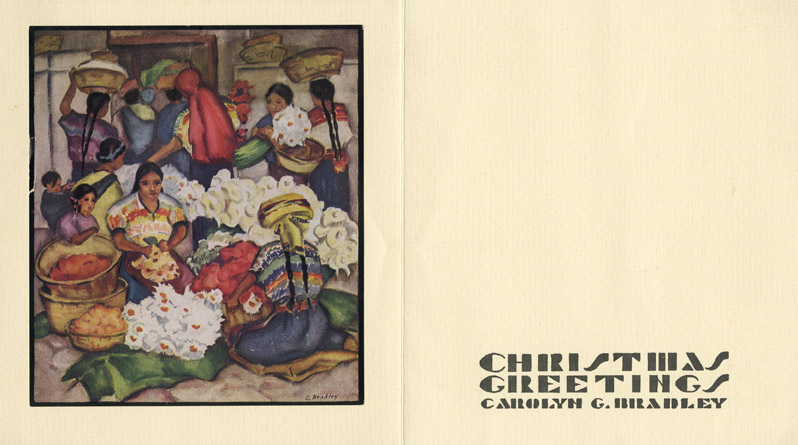
A Christmas card designed by Bradley, 1949

A Christmas card designed by Bradley, 1949

During these sojourns, she found time and plenty of inspiration to work on her art, and she returned with more than 60 of her own paintings, as well as the nickname “the paint-brush ambassador.”

A renowned water color artist in her own right, she studied with many well-known painters, including Henry B. Snell, George Pearce Ennis, James Hopkins, and Carlos Merida. She won 58 awards for her work and authored three books on costume design.

Bradley died on December 8, 1954, after a sudden illness. She was 56. Bradley Hall was dedicated in her honor on December 13, 1954.

In 1994, the OSU Archives received a small collection of handmade holiday greeting cards Bradley sent to friends and family, from 1940 to 1953.

– Filed by C.N.
1940
1940


Twelve Days: James’ 35-year quest led to OSU’s top-rated cancer hospital

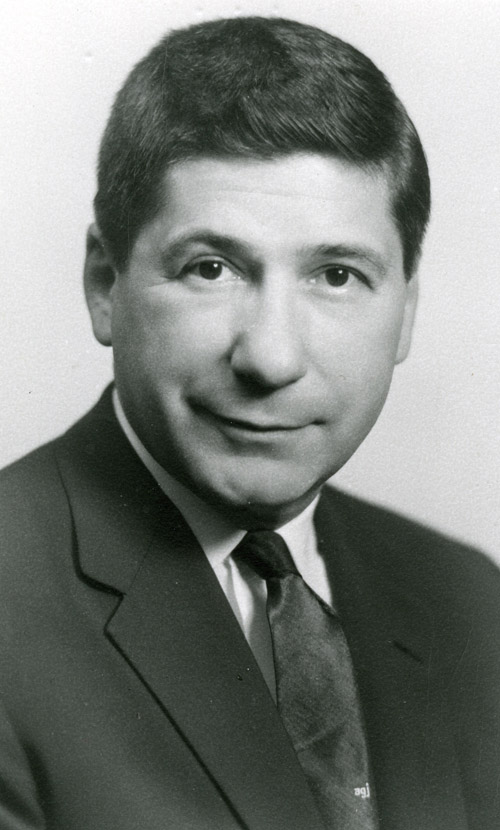
Arthur James, 1961

Arthur James, 1961

Dr. Arthur G. James believed all cancer would eventually be eradicated. That belief coupled with his dedication to the idea that cancer patients need separate, specialized care, led him to lobby, campaign, and fund-raise for 35 years to build a cancer hospital in Ohio.

The Arthur G. James Cancer Hospital and Research Institute opened at Ohio State on July 9, 1990. After a gift of $20 million from Richard J. Solove in 1999, the facility was renamed the Arthur G. James Cancer Hospital and Richard J. Solove Research Institute, but is commonly referred to as the James. The facility remains the only freestanding cancer hospital in Ohio to this day. 

James Cancer Hospital

James Cancer Hospital

James was born to Italian immigrant parents in the coal mining town of Rhodesdale, Ohio. The third of eight children, James worked to save enough money for college, graduated as co-valedictorian of his high school class and earned a scholarship to Ohio State.

Once at Ohio State, James continued to work part-time jobs to pay his room and board. He chose to study engineering, like his elder brother, but in his sophomore year decided he wanted to study medicine. He received his bachelor of arts degree in 1934 and his master’s degree in 1937. He met his wife, Milly, while in medical school and they were married in 1940.

Upon his graduation from Ohio State, he received a fellowship at Memorial Sloan-Kettering Hospital in New York, where he became interested in the field of surgical oncology. The outbreak of World War II disrupted these plans but eventually, he returned to complete his fellowship in New York.

Cancer Institute groundbreaking, 1984

Cancer Institute groundbreaking, 1984

He returned to his alma mater in 1948 as a member of the OSU faculty, a position he would hold for almost 40 years. In 1960 James began advocating for the establishment of a cancer hospital. At that time, the only hospitals dedicated to the study of cancer were in New York and Texas. Arthur James wanted to change that. It took him more than 30 years, but in the end, he convinced the community, the State and the University that a cancer hospital was needed.

In 1984, ground was broken on the hospital that now bears his name. It was completed in 1988, and, the James is now one of the premier cancer treatment hospitals in the nation.

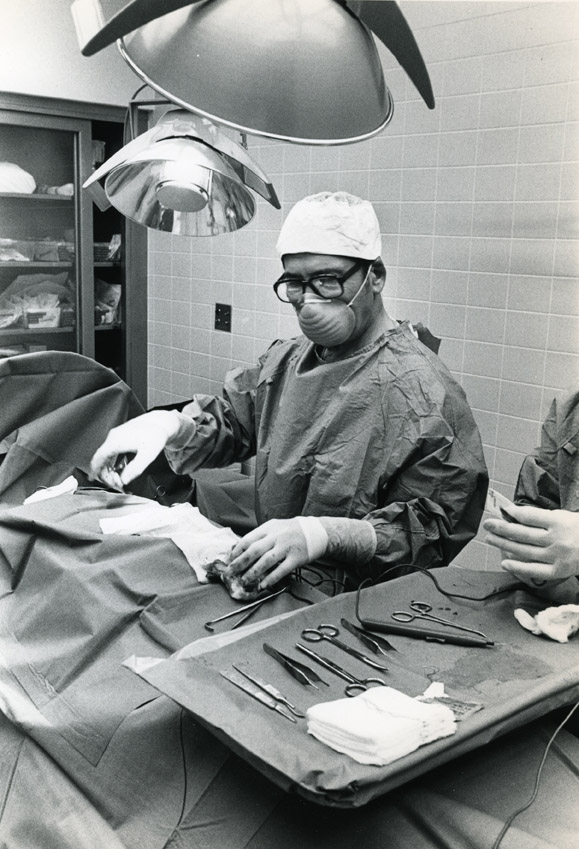
James performing surgery, 1979

James performing surgery, 1979

James was recognized for his work many times. He served as President of the American Cancer Society from 1972-73, and was awarded the organization’s Medal of Honor in 1990. He was also inducted into the Horatio Alger Association of Distinguished Americans, a non-profit service organization which recognized those people who have achieved great success despite humble or difficult circumstances. Despite the awards and the fanfare, James was always committed to the cause, and it was his passion to help people with cancer.

After a long battle with Parkinson’s disease, James died on October 22, 2001, at the age of 89 years. Dennis Smith, director of administration at The James at the time said of him, “Without Dr. James, this hospital simply would not exist. His memory and dedication will live on through this hospital and all we achieve.”

Twelve Days: Newton put School of Nursing on the map

Mildred Newton, 1960

Mildred Newton, 1960

Mildred Emily Newton was born on July 3, 1901 in Cedar Fall, Iowa. After receiving degrees in nursing and education from Northwestern, USC and Stanford, Mildred Newton came to Ohio State as director of the School of Nursing in 1951, a position she held until her retirement in 1968. She was credited for making the nursing program at Ohio State what it is today.

Under her supervision the program gained national accreditation, expanded its baccalaureate program and started a graduate program and a program in nursing research. Besides her academic achievements, Ms. Newton was in demand nationally as a volunteer. She worked closely with the Kellogg Foundation, the National League of Nursing as well as working for the U.S. Department of Defense.

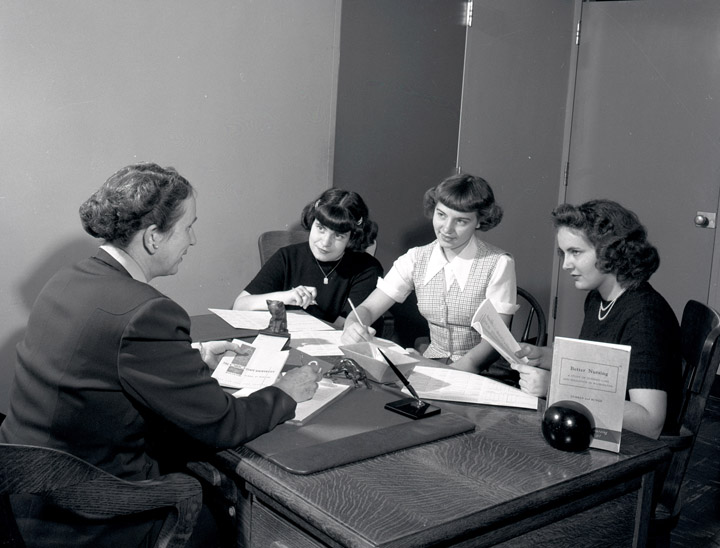
Newton meets with student nurses, 1951

Newton meets with student nurses, 1951

Throughout it all, she continued to teach. One of her passions was the history of the profession, particularly the life of Florence Nightingale, and she conveyed that to generations of students. She also was an avid collector of stamps related to medicine and nursing, and she donated her collection to the Health Center Library shortly before her death. She organized it into four volumes that depict the history of the Red Cross, the history of medicine and nursing, world attempts to eliminate diseases, and individuals’ contributions to health.

Newton Hall, 1983

Newton Hall, 1983

Recognition for her work came in the form of the National League of Nursing’s Adelaide Nutting Award in 1969 and one of Ohio State’s 1970 Centennial Achievement Awards. She was also given emeritus status upon her retirement in 1968.

Her personal legacy was that of a caring mentor who always had an open door and a sense of humor. She was also an advocate of patient rights. In a Nov. 11, 1958 article in The Lantern she identified the following as particularly critical to the nurse-patient relationship: “The patient’s welfare must always come first. Nothing a patient needs to have done is beneath the dignity of a doctor or nurse to perform.” She passed away on July 25, 1972. The School of Nursing’s building was renamed “Mildred E. Newton Hall” in her honor.

Older posts Newer posts