From Woody's Couch

Our Playbook on OSU History

Category: Dormitories (page 3 of 5)

This Week in OSU History: ‘Dynamo’ takes over presidency

James Canfield, 1897

It turns out E. Gordon Gee is not the University’s first president who could be mistaken for a human sparkplug. Back in 1895, OSU’s fourth president was elected – James Canfield – and he was considered quite the “human dynamo,” too.

Canfield was born in Delaware, Ohio, in 1847, but his family soon moved to New York City, where he grew up and attended school. He graduated from Williams College, and briefly practiced law in that “state up north” before taking a teaching position at the University of Kansas in 1877, which he held for 14 years. His teaching focus was English, History, Civics and Political Science, and he became a sought-after orator.

In 1891 Canfield accepted the Chancellorship at the University of Nebraska, and four years later – on April 11, 1895 – he was elected President of Ohio State. The Board of Trustees knew his reputation as a “human dynamo,” so it should have come as no surprise to them that Canfield immediately went to work once in office.

One of Canfield’s first acts as president was to establish a lab in 1895 near Lake Erie (the precursor to Stone Lab. Under his leadership, enrollment surpassed 1,000 (1897), and the Power Plant and Armory were built. The University also added Domestic Science, Commerce and Administration courses to the curriculum.

Canfield Hall, 1940s

Canfield was by all accounts a very “take charge” person. According to the University’s 75-year history, he once stopped to ask the janitors and scrub-women why they were not on their hands and knees, scrubbing the floor. So it is no wonder that his administration was also marked with conflict – particularly over Canfield’s attempt to form a partnership between OSU and a Columbus medical college. It turns out the University did end up partnering with the Starling Loving Hospital—shortly after Canfield left office. The move ultimately led to the formation of OSU’s Medical Center.

Canfield resigned his post in 1899 to become the Librarian at Columbia University. He died in 1909.

In 1940, Canfield Hall was named as a tribute to him and his daughter, the novelist Dorothy Canfield Fisher.


Filed by C.N.


A place of their own: Oxley Hall, the first women’s dorm

Oxley Hall, 1910

It may be hard to believe, but for many years in OSU’s early history, no female students lived on campus. Girls were expected to take rooms with local families or to live in boarding houses. Eventually, however, OSU women did get a dorm of their own: Oxley Hall.

The building was designed by a woman, who was an OSU alumna, to boot. Florence Kenyon Hayden was a former OSU student who had studied with then-University Architect Joseph Bradford. Her work was so good that Bradford suggested her to the Board of Trustees as the architect for the women’s dorm.

She got the job, although the trustees assigned her a male partner- Wilbur T. Mills – to complete the project. In a 1970 Columbus Dispatch interview, she said that she became fed up with Mills, locked him out of the office, and submitted her final plans for approval within the month. So apparently what we see today is Kenyon Hayden’s vision, although both she and Mills are listed as the official architectural team. After marrying a physician, she began designing medical facilities, for which she later gained some national attention.

Oxley Hall residents, 1931

Construction began on the building in 1907; it was built in the English Renaissance style with a Spanish tile roof, brick exterior and limestone trim. The cost of the original structure is listed as $66,490.85.

Residents moved into the building in September 1908 and took a vote on what to name their new home. The Board of Trustees accepted their recommendation, and on November 20, 1908, officially named the building for President William Oxley Thompson’s mother (her maiden name, which is where he got his middle name).

Some fun facts about living in Oxley Hall as a co-ed: A single room cost $1.75 per week in room and board; residing in a double room cost $1.50. The girls did have staff to cook and to clean the public areas of the house. There were mandatory quiet hours Monday-Thursday from

1950s

7:30 p.m. until 6:30 am. Girls could have callers on Sundays from noon-3 p.m., and from 5-10 p.m.; men were never allowed beyond the first-floor receiving rooms. Residents also had curfews, though those became less restrictive as the years progressed.

The building served as a dormitory until 1967, when it was decided that it was unsuitable as a residence hall and was leased to the University Research Foundation. The building was remodeled in 1989, and in 1991 the Department of International Affairs moved in, where it remains to this day.

Filed by C.N.

Twelve Days of Buckeyes: How OSU’s founding is reflected in its towers

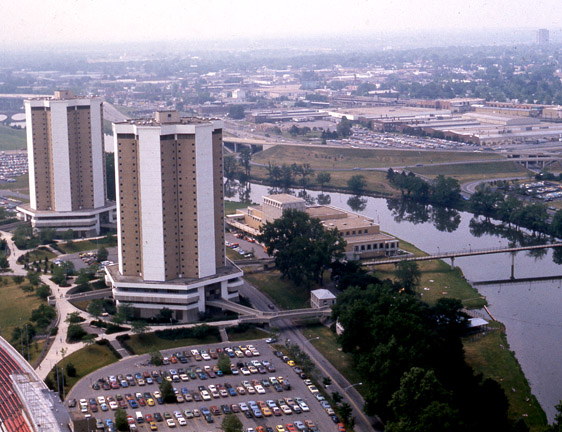
1977

Ever wondered why two of OSU’s tallest buildings have the names they do?

Let’s talk about Morrill Tower first: Congressman Justin Morrill of Vermont first proposed in 1859 for funded endowments for public colleges and universities through the sale of federal lands. These “land-grant” colleges would educate students in engineering and agriculture, while ensuring low tuition rates, because of the federal support.

Congress eventually passed the bill, after much debate, but it was vetoed by President James Buchanan. With the start of the Civil War, though, there was another opportunity for passage, since much of the opposition towards the bill was from the Southern Democrats, who by then had left Congress.

There was also a new President in office – this is where Lincoln Tower comes in – who supported the bill. President Abraham Lincoln signed the act into law on July 2, 1862. Eight years later, in 1870, the Ohio Agricultural and Mechanical College was founded as a land-grant institution.

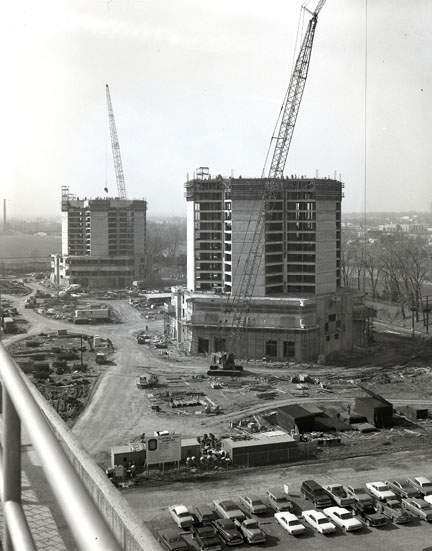
The Lincoln and Morrill Towers were named in 1965, as construction began, to honor the author and the signer of the Morrill Act, which allowed for the establishment of Ohio State.

(Most of this post comes from “The Ohio State University: An Illustrated History,” by retired University Archivist Raimund Goerler.)

Older posts Newer posts