From Woody's Couch

Our Playbook on OSU History

Category: Bleeds Scarlet and Gray series (page 2 of 3)

Bleeds Scarlet and Grey: Col. George L. Converse

Col. George L. Converse, n.d.

The Reserve Officers’ Training programs for the Army, Navy and Air Force are such fixtures at OSU that it would be difficult to imagine the campus without them. There was a time, however, when there was no such thing as the ROTC program. With the help of George Converse, and several other OSU leaders, the national ROTC program was created and the OSU program flourished.

Converse, who grew up on a farm near present-day Cleveland Avenue, enrolled as a freshman at OSU at age 17, in 1874. After his first quarter, however, he received an appointment to West Point, and eventually graduated in 1880. Two years later, he was a member of the 3rd U.S. Cavalry in Wyoming, when his company was sent to Arizona to combat the uprising by the Apaches, led by Geronimo. In one battle, Converse was shot in the eye and had to ride on horseback for 40 miles to receive medical treatment. The bullet was never extracted, and the rest of his life he wore a black eye patch. University lore said that he could see more with his single eye than most men could see with two.

Due to his injury, he retired from active duty in 1884 and returned to Columbus. He was later called back to serve in the Spanish American War, but returned again to Ohio State in 1900 to serve as the University’s first Commandant of Cadets in the Department of Military Science. He held that position, as well as a professorship and subsequently chairmanship, of that department for 18 years. During his tenure, enrollment grew from 400 to almost 3,000 students. Commandant Converse, whom students affectionately referred to as “Commy,” also gave regular Thursday morning talks to male freshmen. (On Wednesday mornings, the freshmen listened to President William Oxley Thompson.)

Converse Hall, 1949

With the outbreak of World War I, Converse returned to active-duty status, this time as examining officer for all Ohio officer training camps. During that period, as he continued his teaching duties at OSU, he also co-authored the Ohio Plan, along with Pres. Thompson, Gen. Edward Orton Jr. (professor of ceramic engineering) and OSU alumnus Ralph D. Mershon. That plan, which outlined university civilian training programs, became part of the 1916 National Defense Act, which established the ROTC as a national program.

In 1918, he left OSU when the military promoted him to district inspector, overseeing officer training camps in Ohio, Indiana, West Virginia and Kentucky. In 1920, he retired from the military—for good—and returned with his wife, Effie, to their house on Neil Avenue. (Effie had served as interim Dean of Women during the 1918-19 academic year.) He died on November 16, 1946.

Five years before he died, ground broke on the ROTC building, on February 17, 1941. In 1973, the Board of Trustees voted to re-name the building after Converse, who had served longer than any other Commandant at OSU.

Filed by C.N.
Bleeds Scarlet and Gray: James E. Boyd

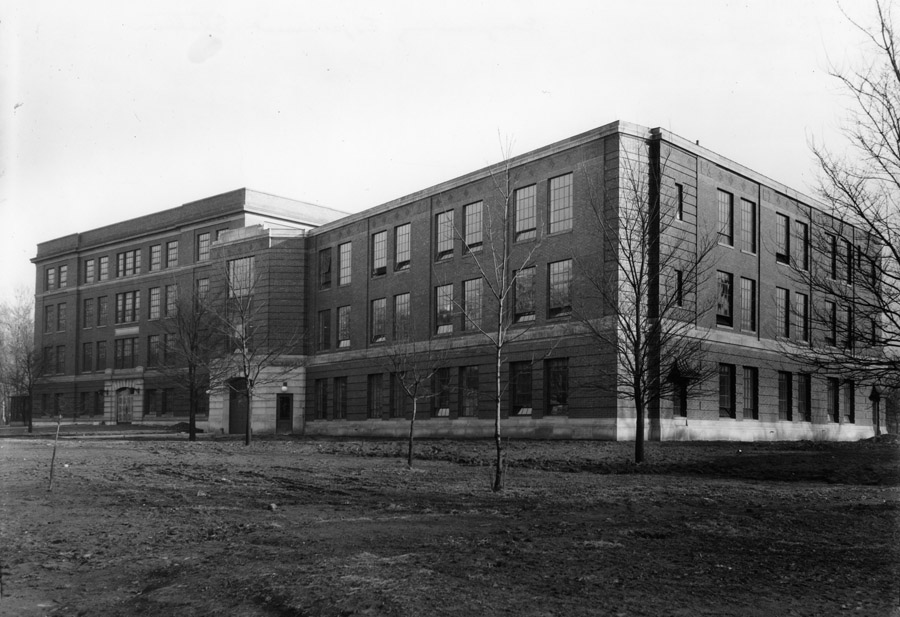
Boyd Lab (formerly known as the Highway Testing Laboratory), 1933

With progress comes change. As another Ohio State building falls to make room for a more modern version of itself, we wanted to remind everyone of the legacy behind Boyd Laboratory.

Completed in 1933, the building was the home to the Department of Engineering Mechanics. Its eponym was created in 1964 for the former chairman of the department, James Ellsworth Boyd.

James E. Boyd, n.d.

James “Jimmie” Boyd can be described as an Ohio State man. Boyd attended OSU from 1887-1891 earning his bachelor’s degree. Over the next forty-five years, except for a brief leave of absence in 1895-96 to study at Cornell for his Master’s degree, Boyd taught in various departments including Physics, Mathematics and Engineering Mechanics. His teaching style was described as strict but fair. Demanding students sit erect with both feet on the floor and that they knew their multiplication tables instead of depending on a slide rule were a few of more strict rules, but he was also known to change a grade if a student presented an interesting solution to a problem they misread.

Coming from a small farm in Muskingum County, Boyd stayed true to his small town roots. Even with his widely used textbooks, Strength of Materials and Mechanics, Boyd’s focus was on teaching. In 1938 Boyd received the Lamme medal, an award bestowed for outstanding engineering achievement. He then refused any honorary degrees from the university. Along with his work in the many scientific departments, Boyd was an alumni member of the Athletic Board, first secretary of the Entrance Board, and during World War I worked with the Bureau of Standards in Washington on airplane struts. While Boyd was widely known on campus for his distinctive goatee and powerful voice, his namesake is no longer a part of our landscape.

Bleeds Scarlet and Gray: Milton Caniff

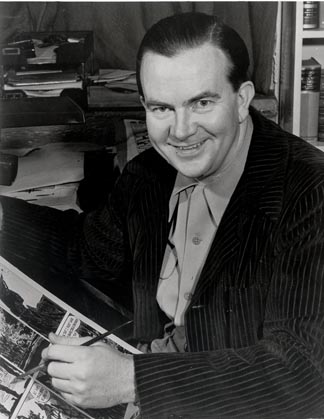
Milton Caniff, 1950

(Editor’s Note: This post is part of a series of profiles of life-long Buckeyes who have had a notable impact on the University. In other words, they bleed scarlet and gray.)

We’ve been talking lately about football season, and Homecoming, especially, which for alumni is always a great time to reconnect with other former students. One of OSU’s more famous alumni – and one of its most loyal – is Milton Caniff, sometimes known as the “Rembrandt of the comic strip.”

Caniff was born in 1907 in Hillsboro, Ohio, and he began drawing cartoons in grade school. One of his first professional jobs was at the Dayton Journal Herald. As an undergraduate at

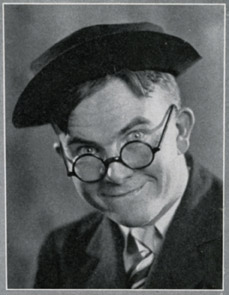
Caniff in the Scarlet Mask show "Beau Kay", 1927

Ohio State he served as art director of the Makio and the Sun Dial, also creating football program covers and working as a cartoonist for The Columbus Dispatch. These projects also helped to fund his education.  Caniff was also a member of Sigma Chi, president of Strollers, and vice president of Scarlet Mask, a male acting troupe at OSU. He graduated in 1930 with a bachelor’s degree in Journalism. He later wrote that, “In my five years [at OSU], I have run up a debt I will never liquidate. But I shall try, even though there can be no price tag on brain surgery from within.”

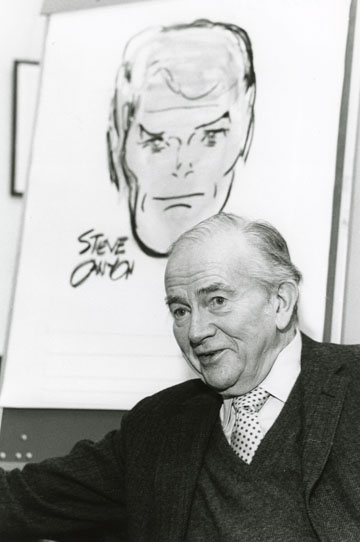
Caniff went on to become a world-renowned cartoonist. He is most famous for his two comic strips, “Terry and the Pirates,” and “Steve Canyon.” Caniff later said that he took inspiration for many of his “Terry” characters from real people he met at OSU, including his good friend Frank “Dude” Hennick (OSU class of 1925), who inspired the character of Capt. Dude Higgs. In 1947, Caniff launched “Steve Canyon,” a serial cartoon about an Air Force pilot for hire that was so popular, it spawned a short-lived television series in the late 1950s. Canyon wrote the strip for more than 40 years.

At the August 1974 Commencement, Caniff was awarded an honorary doctorate of Humane Letters and gave the Commencement address. Milton Caniff died on Easter Sunday in 1988 at the age of 81. He donated much of his work to the School of Journalism. His papers and artwork became one of the founding collections of the Billy Ireland Cartoon Library and Museum, named for Caniff’s good friend and fellow Columbus Dispatch cartoonist.

Filed by C.N.


Older posts Newer posts