From Woody's Couch

Our Playbook on OSU History

Category: Archival resources (page 8 of 14)

Famed OSU botanist left behind captivating photos and career

The Archives recently received a small donation of material that belonged to a former OSU professor who was regarded as “one of the greatest botanists of his day.”

John Henry Schaffner came to the University in 1897 as an assistant in Botany, and served as head of the Department of Botany from 1908 to 1918. Later in his career, he went on to make a radical discovery in in the field of Botany that brought admiration from scientists worldwide. But more about that in a bit.

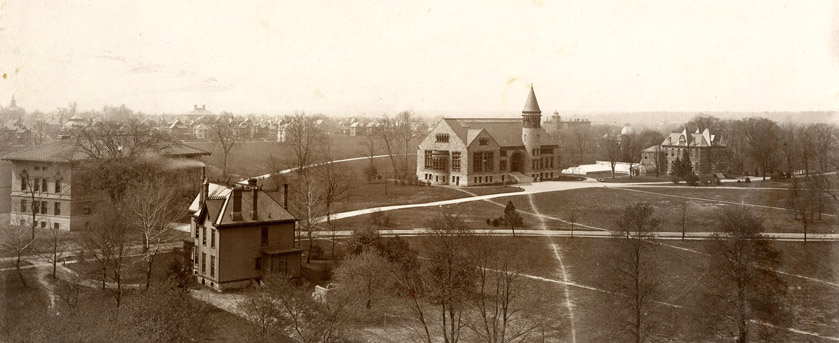
Early on in Schaffner’s tenure at OSU, he took the following photographs, which depict a very different view of campus.
Oval from Armory, 1899

This first photograph was taken from the top of the Armory in 1899. (The Armory was situated at the site where the Wexner Center sits today.) What we now think of the Oval did not quite exist yet, and as you can see, a house sat at the east end. In 1902, the house was moved to the north edge of today’s Mershon Auditorium and became the home to OSU athletics. It was aptly named the “Athletic House.”

To the left of the house is Biological Hall, which was built in 1898 for the departments of Anatomy and Physiology, and Botany and Zoology. The Biology Building was torn down in 1923 to make way for the current Hagerty Hall building.

To the right is Orton Hall, and the old Botanical Hall, which is where Schaffner spent much of his time in teaching and research.

1899_campus_view_from_southeast1

John H. Schaffner, 1900

John H. Schaffner, 1900

This panorama photo shows a view of campus from the southeast end, looking northwest. You can see the back side of Orton Hall towards the right, as well as McMillin Observatory, which was situated on the southwest side of Mirror Lake.  The observatory, which opened in 1896, was torn down in 1976.

But, what are even more interesting than Schaffner’s photographs, are his background and research interests. Schaffner was widely known among scientists for his botanical discoveries, and as a prolific writer of books and scientific papers. He was also renowned for his help in overthrowing the thought that the sex of plants was hereditary.

Yes, you heard right.

An Alumni Monthly article from October 1928 noted that Schaffner’s most important discovery is that the sex of the plant may be changed:

“Professor Schaffner found that by controlling the conditions in which a plant developed he could change the entire sex of the plant. The further development of this discovery will lead to many radical changes in the treatment of plant life.”

Schaffner read his paper describing this discovery in 1926 at a convention of botanists in Ithaca, New York, and it was widely acclaimed by scientists in many countries.

Schaffner died on January 27, 1939.

(Special thanks to Bob Cody, Schaffner’s grandson, who donated the campus photographs to the University Archives.)

Lantern celebrates 100 years of daily coverage

Lantern front page, 1881

Lantern front page, 1881

This week marks the 100th year that The Lantern, OSU’s award-winning student newspaper became a classroom laboratory for journalism students to learn how to report and write the news on a daily basis. Its origins, though, were much more literary.

In January 1881, Volume 1, No. 1 of The Lantern appeared. Its editors picked the name after “La Lanterne,” a popular French magazine published in Paris at the time, and it started as a monthly appearing during the academic year only. In the initial issue, the editors promised to “represent the interests of our institution and student life as we find them.” And that’s been the goal ever since.

When it started, the newspaper was more like a literary magazine, publishing essays, and other writings that were submitted to the staff. In 1884, the newspaper began to appear every two weeks, and it was published by the Alcyone, Horton and Browning Literary societies. Seven years later, in 1891, the publication became a weekly.

Lantern students, 1914

Lantern students, 1914

The next year, members of the literary societies managing The Lantern decided to breathe new life into the publication and changed the name to “Wahoo.” Alumni were not so keen about the change apparently and demanded the return of the old name. The then-“Wahoo” editors seemed perplexed in a Nov. 29, 1892 editorial: “Since so few of the alumni formerly subscribed for the paper, it was surprising to see the sudden interest manifested when the name was changed. So “The Lantern” returned to the masthead – just 20 issues after “Wahoo” had appeared.

In 1914, journalism students took over the newspaper and it became a daily. Over the years, it has covered all kinds of historic moments on campus, from presidential inaugurations to student riots to NCAA championships.

To mark its historic 100th anniversary, we decided to give snippets of what appeared on the front page of the inaugural daily Lantern:

Lantern front page: September 15, 1914

Lantern front page: September 15, 1914

A now-forgotten OSU tradition called Cane Rush – where the freshman class and sophomore class battle to get a cane over the other’s goal line (sort of a combination of football and rugby) – would be held on Ohio Field that week. Strict new rules were in place to prevent winning by “strategy;” apparently, the year before, the sophomore class won when “Karl McComb dressed as a janitor walked down the cinder track with the cane concealed and climbed the goal posts on the freshman end of the field before the freshman discovered him.”

The Women’s Council was trying something new by providing each female freshman a “Big Sister” from the junior and senior classes. Each of these advisors had been given a name of three freshmen expected to enter OSU and had arranged to meet them at the train depot and help them secure lodging and finalize their class schedules. They would also introduce them to upper-class members and other freshmen. “By means of this every freshman girl will get started in school with little or no trouble or worry to herself.”

And finally, the staff reported that the honor of being the first to subscribe to the Daily Lantern went to Lowry F. Sater, president of the Ohio State University Association. In a letter to the newspaper that enclosed a check for his year’s subscription, Lowry wrote: “May your stock of oil never run low. I hope the Lantern will outshine any other luminary of its kind.”

Interested in seeing past articles of The Lantern? Go to the Lantern Archives and browse to your heart’s content. You’ll learn a LOT about OSU history along the way.


Twelve Days: Bradley took art to the world as the ‘paint-brush ambassador’

Carolyn Bradley, 1940

Carolyn Bradley, 1940

OSU can boast of a number of well-known artists who either studied or taught at the University: George Bellows, James Hopkins, and Roy Lichtenstein, for example. One artist – Carolyn Bradley – drew acclaim not only for her art but for her many travels to bring her artistic passion to the world.

Carolyn Gertrude Bradley was born on September 22, 1898, in Richmond, Indiana. She received her first bachelor’s degree in 1920 from Earlham College in Richmond. She went on to earn another B.A. from John Herron Art School in Indianapolis, as well as degrees from Columbia University, the Traphagen School of Fashion in New York, and a master’s degree in fine arts from Escuela Universitaria de Bellas Artes in San Miguel Allende, Mexico.

1930_bradley_carolyn

Bradley with her artwork, no date

Bradley also was an avid traveler and fluent in Spanish, which earned her a place as an educational ambassador with the U.S. State Department from 1946-1951. Her first state-sponsored trip was as a visiting professor at the University of Chile, the second was a three-month tour of Guatemala, Honduras and Costa Rica. In 1950 she took a part-time teaching position at the Centre d’Art in Haiti, and in 1951 she was a visiting professor at the University of Costa Rica.

On all of these trips she taught and lectured almost every day, to audiences that ranged from university students to primary school children. Due to the economic situation in many places she taught, materials were scarce. Bradley was known to take students up into the hills to dig their own clay to use for paint pigment; she also brought many art supplies with her to donate to her students.

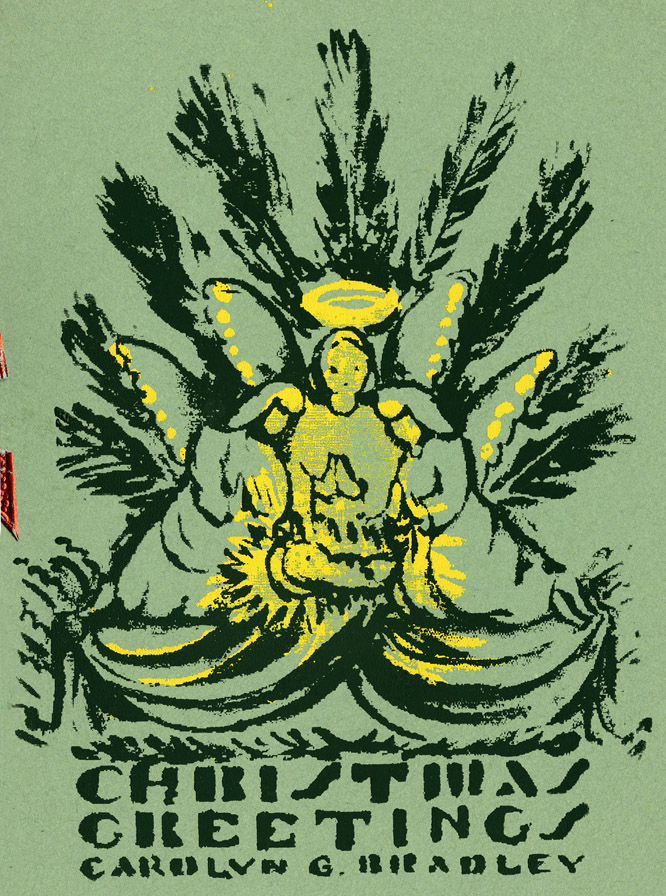
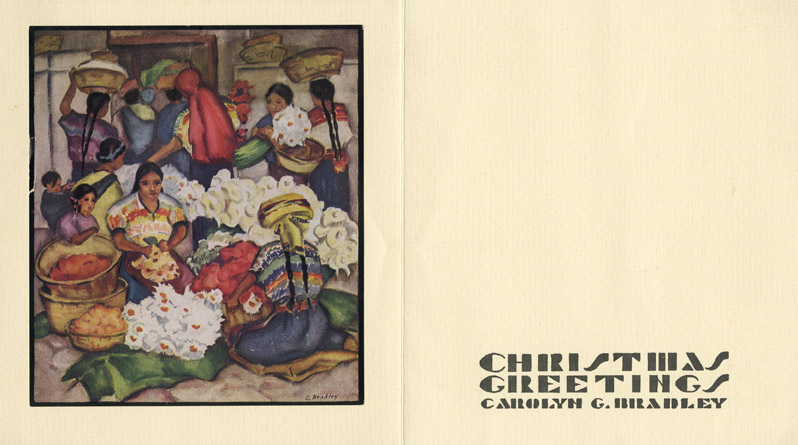
A Christmas card designed by Bradley, 1949

A Christmas card designed by Bradley, 1949

During these sojourns, she found time and plenty of inspiration to work on her art, and she returned with more than 60 of her own paintings, as well as the nickname “the paint-brush ambassador.”

A renowned water color artist in her own right, she studied with many well-known painters, including Henry B. Snell, George Pearce Ennis, James Hopkins, and Carlos Merida. She won 58 awards for her work and authored three books on costume design.

Bradley died on December 8, 1954, after a sudden illness. She was 56. Bradley Hall was dedicated in her honor on December 13, 1954.

In 1994, the OSU Archives received a small collection of handmade holiday greeting cards Bradley sent to friends and family, from 1940 to 1953.

– Filed by C.N.

1940

1940


Older posts Newer posts